

Before fabric weight, loop type, or spout design enters the conversation, an FIBC bag starts with a more basic decision: how the body itself is constructed. Circular, also called tubular bulk bag construction, U panel, and 4 panel are the three main approaches, and each one trades off cost, fill shape, and container efficiency differently. This guide compares FIBC Bag construction types side by side so buyers can narrow down the right starting point before moving into the finer details of specification.
Why Body Construction Is the First Decision in Specifying an FIBC Bag
Body construction determines how the bag fills, how efficiently it stacks and loads into a container, and how much fabric and labor go into producing it, which in turn drives unit cost. Getting this decision right before specifying fabric weight, loops, or spout details matters because construction type affects how those other elements perform together, not just the bag’s basic shape.
Circular (Tubular) Bulk Bag Construction
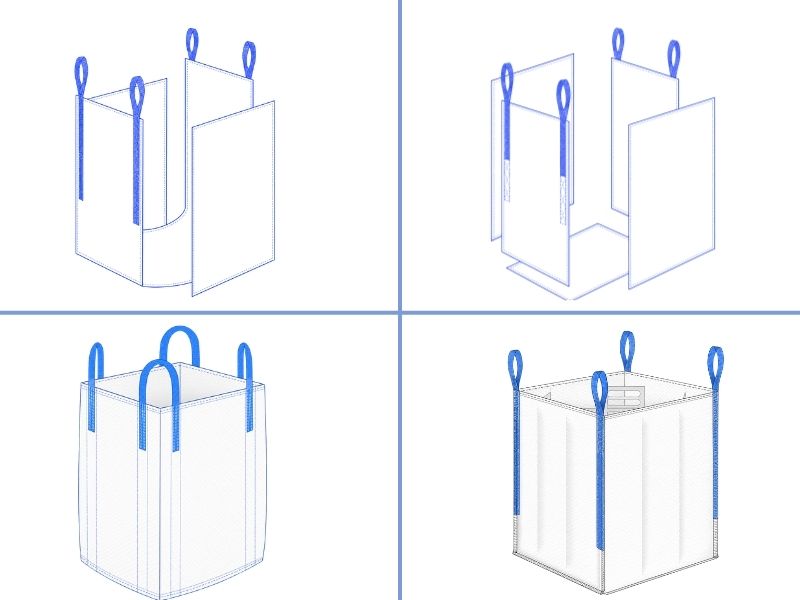
A circular or tubular bulk bag is woven as a seamless tube on a circular loom, with no vertical body seams at all. This is the most economical construction to produce, since there is no panel cutting or corner seam labor involved, but the filled bag tends to bulge outward in what is commonly called a barrel effect, reducing pallet and container space efficiency compared to panel constructions.
Read more: Circular FIBC Bags: What the Big Bag Specification Should Define
U Panel Construction
A U panel FIBC bag uses one continuous U-shaped fabric piece forming the base and two sides, with two additional flat panels stitched in to complete the body. This results in two vertical seams, fewer than a full 4 panel build but enough to hold a more square profile than a circular bag once filled. U panel construction sits as a middle option between circular and 4 panel in both cost and shape control.
Read more: U Panel Bulk Bags: How This Construction Shapes Bag Specs
4 Panel Construction
A 4 panel FIBC bag is built from four separate flat fabric panels sewn together at four vertical corner seams. This uses the most fabric and labor of the three constructions, but produces the most consistent square or rectangular fill shape, maximizing pallet and container space efficiency for buyers who prioritize that over unit cost.
Read more: 4 Panel FIBC Bags: How Construction Shapes the Bulk Bag Specs
Side-by-Side Comparison: Cost, Shape Stability, and Use Case
| Construction | Vertical Seams | Relative Cost | Best Fit |
| Circular (Tubular) | None | Lowest | Dense, heavy commodities where barrel shape has limited impact |
| U Panel | Two | Moderate | General industrial use needing better shape stability than circular |
| 4 Panel | Four | Highest | Maximum cube utilization and stacking predictability |
These are general positioning points rather than fixed rules, since actual seam strength and shape performance still depend on fabric weight, stitch type, and base construction within each category.
How Baffles Modify Any of the Three Constructions
Baffle panels, added at the corners of circular or U panel bags, restrict outward bulging during filling and push the bag toward a more cubic profile without the full fabric cost of a 4 panel build. This makes baffles a practical middle path for buyers who want some of the cube efficiency benefit of 4 panel construction while staying closer to circular or U panel cost.
Read more: What Is Baffle FIBC Bags?
Matching Construction Type to Your Product and Handling Method
- Circular construction suits dense, heavy products where fill weight itself keeps the bag reasonably stable, and where minimizing unit cost matters most.
- U panel construction suits general industrial products needing moderate shape stability without the cost of full panel construction.
- 4 panel construction suits buyers prioritizing container and warehouse space efficiency, particularly for lighter or bulkier products where cube utilization has a larger cost impact.
- Baffled circular or U panel bags suit buyers wanting improved shape control without committing to full 4 panel fabric and labor cost.
Questions to Ask Before Choosing a Construction Type
- How dense is the product, and will fill weight alone help the bag hold a stable shape during transport?
- How much does container and pallet space efficiency actually matter for this specific supply chain?
- What is the acceptable unit cost range, and how does that compare across the three construction types for this fill weight?
- Will the bags be stacked multiple layers high during storage or shipping?
- Is baffled construction a reasonable middle ground given the cost and shape priorities involved?
How Tam Tam Packaging Helps Buyers Choose the Right Construction
Tam Tam Packaging produces circular, U panel, and 4 panel bulk bags to a buyer-defined specification, and works through product density, handling method, and container loading priorities with buyers before recommending a construction type. Sample bags across construction types are available for buyers comparing options for a new product line before committing to a full production order.
Applications in Environmental and Waste Management
Environmental and waste handling operations use all three construction types depending on the material involved. Dense contaminated soil or sludge byproducts often move well in circular bags given their weight-driven stability, while lighter recyclable material bound for automated sorting facilities benefits from the more consistent shape of U panel or 4 panel construction to fit conveyor and stacking systems designed around predictable bag dimensions.
Frequently Asked Questions
What is the difference between a tubular bulk bag and a circular FIBC bag?
They describe the same construction: a bag body woven as a seamless tube on a circular loom, with tubular referring to the fabric and circular FIBC referring to the finished bag.
Which FIBC construction type is cheapest?
Circular or tubular construction is generally the lowest cost, since it requires no panel cutting or corner seam labor.
Which construction type stacks most efficiently?
4 panel construction generally provides the most consistent square shape and best container or pallet space efficiency.
Can baffles be added to any construction type?
Baffles are most commonly added to circular or U panel bags to improve fill shape without the full cost of 4 panel construction.
How do I decide which construction type is right for my product?
By weighing product density, required shape stability, container loading priorities, and acceptable unit cost together, rather than defaulting to one construction type across all products.
Conclusion
Circular, U panel, and 4 panel construction each solve the cost-versus-shape-control trade-off differently, and the right choice depends on product density, handling method, and how much container efficiency is actually worth for a given supply chain. Reviewing all three side by side, rather than defaulting to whichever construction a supplier happens to promote first, is what leads to a specification that actually fits the application.
Tam Tam Packaging Co. manufactures circular, U panel, and 4 panel FIBC bags, and can help match the right construction to your product and handling requirements. Contact our team to discuss the best option for your application.
Contact Us
Tam Tam Packaging Co.
Email: sales@tamtamjumbo.com
Website: https://tamtamjumbo.com/
Read more
FIBC Bags for Flour: Why Allergen Status Change the Specification
Flour shares the fine-particle and combustible dust characteristics of other food powders, but wheat’s status...
Aug
FIBC Bag for Starch Powder: Dustproof Bag Needs Antistatic
Starch powder occupies an unusual position in FIBC specification: it is a common food and...
Aug
FIBC Bags for Animal Feed: What Actually Makes a Clean Bulk Bag
FIBC bags for animal feed mean something more specific than a bag that looks unused....
Aug
FIBC Bag for PET Flakes: Why UV Resistance Matter More Than It
Recycled PET flakes share a base polymer with virgin resin pellets, but the two behave...
Aug
FIBC Bags for Plastic Resin: PP Fabric Packaging PP Pellets
There is a certain irony in shipping polypropylene resin pellets inside a bag woven from...
Aug
FIBC Bags for the Food Industry: Building a Food Grade Bag
Food manufacturers sourcing bulk ingredient packaging are working from a different starting point than a...
Aug