

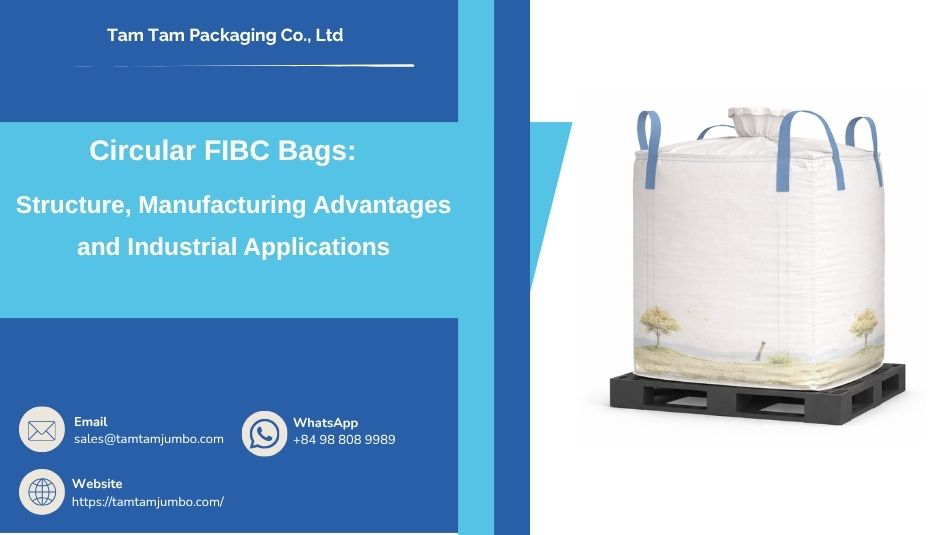
Circular FIBC bags remain the most widely produced bulk bag construction worldwide, largely because a seamless woven tube is faster and cheaper to manufacture than any panel-based design. That manufacturing simplicity is exactly why the jumbo bag specification matters more, not less, for this bag type: with no corner seams to add structure, every performance characteristic of the bag has to be built into the fabric, base, and top construction instead. This article covers how circular bags are made, where they perform well, where they fall short compared to panel constructions, and what a specification needs to define to get a circular bag that actually fits the application.
What Makes a Bag Circular in FIBC Manufacturing
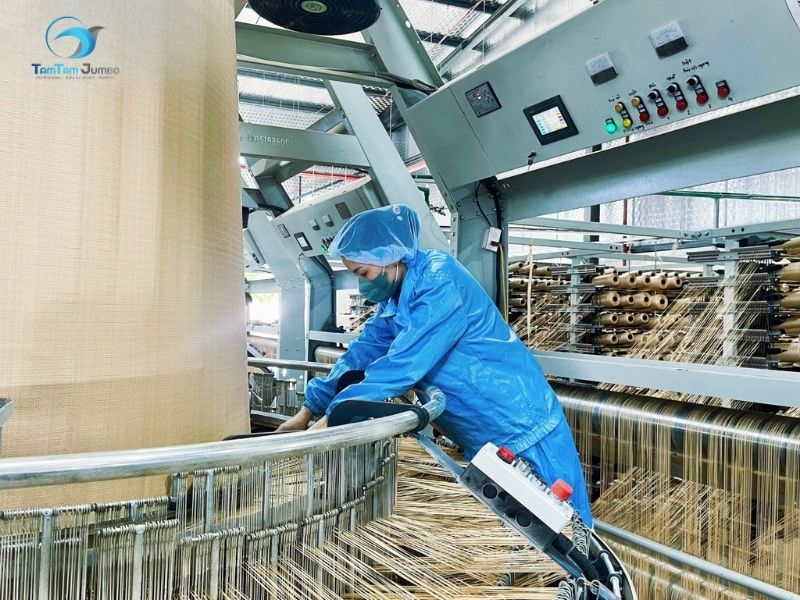
A circular FIBC bag is woven as a continuous tube on a circular loom, meaning the body fabric has no vertical seams at all. The base and top are added as separate fabric pieces stitched onto the tube, but the sides themselves come off the loom already formed. This is the defining difference from panel constructions, where the sides are cut as flat fabric pieces and joined with sewn seams.
Because the tube is produced in a continuous process, circular weaving is significantly faster and uses less labor per bag than cutting and stitching individual panels, which is the main reason circular construction remains the lowest-cost option in most FIBC product ranges.
How Circular Weaving Differs From Panel Construction
Seamless Body, Single Loom Process
With no vertical body seams, a circular bag has one less category of structural weak point compared to panel designs, where seam strength has to be engineered and tested separately from the fabric itself. This can be an advantage for certain applications, since seam failure is a common cause of FIBC bag rejection in quality inspections, and a circular bag simply has fewer seams that could fail.
Fill Shape and the Barrel Effect
The trade-off is shape. Once filled, a circular bag tends to bulge outward at the middle in what is commonly called a barrel effect, since the fabric has no corner creases to hold it square. This reduces how efficiently the bag uses pallet and container space compared to U panel or 4 panel construction, where sewn corners keep the filled bag closer to a rectangular block.
Read more: 4 Panel FIBC Bags: How Construction Shapes the Bulk Bag Specs
Why Circular Bags Remain the Most Common Choice
For a large share of bulk commodities, the space efficiency lost to the barrel effect matters less than the cost savings from simpler manufacturing. Products that are dense, granular, and shipped in high volume, such as sand, cement, and many mineral aggregates, are often better suited to circular bags because the fill weight itself keeps the bag reasonably stable during transport even without corner seams holding a square shape.
What a Jumbo Bag Specification Must Define for a Circular Bag
Because the fabric and base construction are doing all the structural work, the specification needs to be precise on the details that would otherwise be reinforced by seams in a panel design:
- Fabric weight and denier of the woven tube, since this is the primary factor determining tensile strength, with no seam reinforcement to compensate.
- Safe working load and safety factor, typically 5:1 or 6:1, depending on single-trip or multi-trip use.
- Base construction method, whether flat-sewn, cross-corner, or spouted, since the base is the highest-stress joint on a circular bag.
- Top construction, including whether it is a flat top, spouted top, or duffle top closure.
- Loop type, width, and anchoring method into the top seam.
- Liner type if moisture or contamination protection is required.
- UN rating and packing group, if the bag will carry dangerous goods, since circular UN rated constructions exist but require their own tested specification.
A specification that lists only overall dimensions and weight capacity without defining base and top construction leaves too much room for a factory to substitute a cheaper joint method that has not been engineered to the same load.
Base and Top Construction Options
The base is where a circular bag is most likely to fail under load, since it carries the full weight of the filled contents through a single seam rather than distributing it across multiple corners. A flat-sewn base is the simplest and least expensive option, while a cross-corner base distributes stitching across a wider area and generally performs better under repeated handling. Spouted bases add a discharge point but require additional stitching around the spout collar, which needs its own strength specification separate from the main base seam.
Where Circular Bags Fall Short
Beyond the barrel effect reducing space efficiency, circular bags are generally not the preferred choice when cargo needs a precise, stackable block shape for automated warehouse handling, when container loading efficiency is a priority over unit cost, or when the product is light enough that the bag does not naturally hold its shape from fill weight alone. In these situations, the fabric savings from circular construction are often outweighed by lost storage or shipping efficiency.
Read more: U Panel Bulk Bags: How This Construction Shapes the Bag Specs
Circular vs U Panel vs 4 Panel: Matching Construction to Cargo
Choosing between the three main constructions comes down to weighing unit cost against shape control. Circular bags offer the lowest cost and are well suited to dense, heavy commodities where the barrel effect has limited practical impact. U panel bags offer a moderate step up in shape stability for a moderate cost increase. 4 panel bags deliver the best cube utilization and stacking predictability at the highest fabric and labor cost. None of the three is universally correct; the right choice depends on cargo density, storage method, and how much container space efficiency is worth to the buyer.
How Tam Tam Packaging Manufactures Circular FIBC Bags to Specification
Tam Tam Packaging produces circular FIBC bags to a defined fabric weight, base construction, and loop configuration rather than a generic standard build, and documents each of these details on the specification sheet issued with the order. Base and top construction methods are confirmed with the buyer before production, since these are the areas most likely to affect performance once the bag is in regular use.
Specification Gaps That Cause Underperformance
- Defining only the overall bag capacity without specifying the base construction method.
- Assuming all circular bags use the same fabric weight regardless of cargo density.
- Leaving loop anchoring unspecified, which can result in loops that are not rated for the intended lifting equipment.
- Not confirming spout dimensions when a spouted base or top is required for filling or discharge equipment already in use.
- Overlooking the fact that a circular UN rated bag requires its own tested construction, separate from a standard circular specification.
Applications in Construction Materials
Circular FIBC bags are widely used for construction materials such as sand, cement, gravel, and mineral aggregates, where the product’s density keeps the bag reasonably stable despite the lack of corner seams, and where cost per bag matters at the volumes typical of construction supply chains. A well-specified cross-corner or spouted base is particularly important for these applications, since aggregate and cement bags are routinely handled with forklifts and cranes under repeated loading cycles at construction sites.
Frequently Asked Questions
What is a circular FIBC bag?
A bulk bag woven as a seamless tube on a circular loom, with no vertical body seams, compared to panel constructions that use sewn corner seams.
Why do circular bags bulge when filled?
Without corner seams to hold a square shape, the fabric expands outward under fill pressure, a behavior commonly called the barrel effect.
Are circular bags weaker than panel bags?
Not necessarily. With no body seams to fail, a well-specified circular bag can perform reliably, though the base and top construction need to be engineered carefully since they carry the full structural load.
What should a jumbo bag specification include for a circular bag?
Fabric weight, safe working load, safety factor, base and top construction method, loop configuration, liner requirements, and UN rating if applicable.
Are circular bags suitable for dangerous goods?
Yes, provided the specific circular construction has been tested and UN rated for the intended packing group and weight, separate from a standard non-rated circular specification.
Conclusion
Circular FIBC bags remain the most cost-effective bulk bag construction available, but that cost advantage only holds up if the jumbo bag specification defines fabric weight, base construction, and loop anchoring in enough detail to guarantee consistent performance. Buyers who specify these details up front get the benefit of lower unit cost without discovering base or seam weaknesses after the bags are already in use.
Tam Tam Packaging Co. manufactures circular FIBC bags to a buyer-defined specification, with documented fabric weight, base construction, and load rating for every order. Contact our team to confirm the right specification for your product.
Contact Us
Tam Tam Packaging Co.
Email: sales@tamtamjumbo.com
Website: https://tamtamjumbo.com/
Read more

FIBC Bags for Flour: Why Allergen Status Change the Specification
Flour shares the fine-particle and combustible dust characteristics of other food powders, but wheat’s status...
Aug
FIBC Bag for Starch Powder: Dustproof Bag Needs Antistatic
Starch powder occupies an unusual position in FIBC specification: it is a common food and...
Aug
FIBC Bags for Animal Feed: What Actually Makes a Clean Bulk Bag
FIBC bags for animal feed mean something more specific than a bag that looks unused....
Aug
FIBC Bag for PET Flakes: Why UV Resistance Matter More Than It
Recycled PET flakes share a base polymer with virgin resin pellets, but the two behave...
Aug
FIBC Bags for Plastic Resin: PP Fabric Packaging PP Pellets
There is a certain irony in shipping polypropylene resin pellets inside a bag woven from...
Aug
FIBC Bags for the Food Industry: Building a Food Grade Bag
Food manufacturers sourcing bulk ingredient packaging are working from a different starting point than a...
Aug