
Not every flexible intermediate bulk container is built to carry dangerous goods, and not every bag that claims to be compliant actually holds a valid approval behind it. A UN rated FIBC bag is a specific construction that has been tested against the UN Model Regulations and issued a UN certificate confirming the design meets the required performance criteria. This article walks through how that approval is earned, what the certificate should confirm, how to read the rating printed on the bag, and what buyers sourcing dangerous goods packaging should check before placing an order.
Why an FIBC Needs a UN Rating in the First Place
International transport regulations classify many industrial powders, granules, and chemical intermediates as dangerous goods based on flammability, reactivity, toxicity, or environmental hazard. When these substances move in bulk by road, sea, or a combination of both, the packaging itself becomes part of the safety system, not just a container. A UN rated FIBC bag is engineered and tested to contain the material through realistic handling stresses: lifting, stacking, dropping, and vibration during transit.
A bag without this rating may look identical to a certified one on the outside. The difference lies entirely in the fabric specification, stitching method, and the test data behind the design, none of which is visible without documentation.
The Approval Process Behind a UN Rated Bag
Getting a bag design rated is a structured process, not a self-declared claim by the manufacturer.
Who Issues the Approval
Approval comes from an accredited testing body or a national competent authority recognized under the UN Model Regulations. The manufacturer submits a specific bag construction for testing; once it passes, the authority issues an approval reference number tied to that exact design and manufacturer.
What Gets Tested
Testing follows the UN Manual of Tests and Criteria, Part III, Section 3, and covers the bag filled to its rated gross weight with the relevant safety factor applied. The sequence typically includes:
- A top lift test, suspending the filled bag by its loops to confirm the lifting system holds.
- A drop test, releasing the filled bag from a set height onto a rigid surface.
- A stacking test, applying a sustained compressive load to simulate bags stored beneath others.
- A tear propagation test, confirming that a small cut does not spread under load.
Only after passing this sequence can the manufacturer legally print the UN mark on bags of that construction.
Read more: UN Certified Bulk Bags: What the Jumbo Bag Certificate Actually Covers
What the UN Certificate Actually Verifies
The UN certificate is the paper trail behind the printed mark. A certificate worth relying on will state the fabric weight and construction tested, the coating and liner specification if applicable, the maximum gross weight, the packing group approved, the testing laboratory, and the approval reference number. Without these details, a certificate cannot be matched against the actual bags being shipped, and it offers little protection if a customs authority or carrier asks for verification.
Buyers should also check the date of issue. Some approvals are tied to a specific production period, and a manufacturer that has changed fabric supplier or stitching method since the original test may no longer be producing bags that match the certificate on file.
Decoding the Rating Printed on the Bag
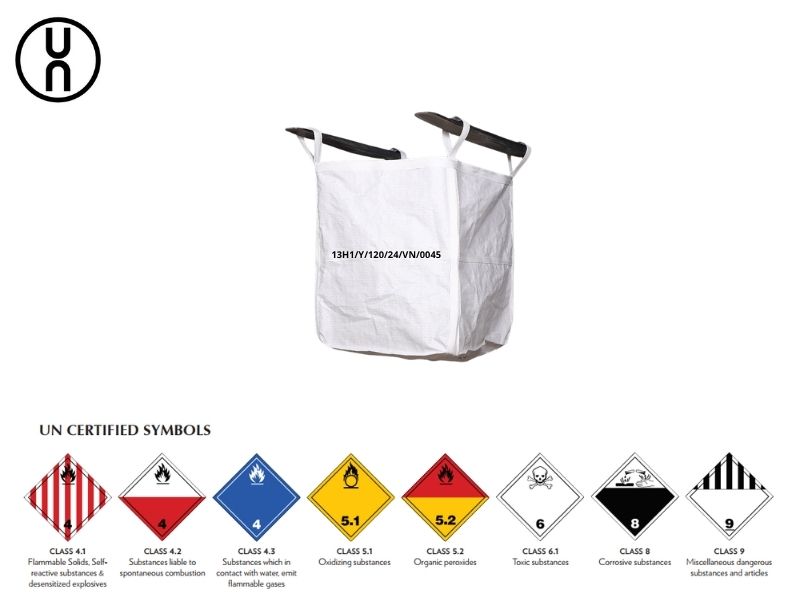
A UN rated FIBC bags carries a code such as UN 13H1/Y/120/24/VN/0045. The first block identifies the container type and construction; the letter identifies the packing group the bag is approved for; the number that follows is the maximum gross weight in kilograms; the following two digits are the year of manufacture; then the country of origin and an approval reference number issued by the certifying authority. This marking must be permanent and legible on the bag body itself, not printed on a separate tag that can be swapped between different bag designs.
Matching a UN Rated Bag to Your Dangerous Goods Classification
Before ordering, the shipper needs to confirm the UN number and packing group of the substance being transported, since this determines which rated bag construction is legally permitted. A bag rated for Packing Group II can also carry Packing Group III material, but the reverse is not allowed. Buyers occasionally assume a UN rated bag is universally compliant regardless of cargo, which is not correct. The rating is specific to the packing group tested, and using a bag outside that scope voids the compliance the rating was meant to provide.
Fabric and Liner Choices Within a UN Rated Construction
Within the UN rated category, construction options range from uncoated woven fabric through to coated fabric with an integrated liner. The right choice depends on whether the material is moisture sensitive, whether fine particles need to be contained beyond what the woven fabric alone can hold, and whether the cargo could react with ambient humidity during a long sea voyage. A liner is often the deciding factor for chemical powders that must stay dry from origin to destination, while dry, coarse granules may only need an uncoated or lightly coated construction.
How Tam Tam Packaging Supports UN Rated Bag Orders
Tam Tam Packaging manufactures UN rated FIBC bags in Vietnam to the exact weight, packing group, and construction a shipment requires. Each rated design carries its own approval reference, and production batches are checked against the tested specification for fabric weight, seam strength, and liner integrity before dispatch. Buyers receive the UN certificate together with the underlying test report and batch traceability records, so the documentation can be matched directly against the bags loaded into the container.
Read more: FIBC Bags Safety Factor
Verifying a Supplier’s UN Certificate Before You Order
A short verification routine avoids costly delays later:
- Confirm the approval reference number on the certificate matches the code printed on a sample bag.
- Ask for the underlying test report, not only the one-page certificate summary.
- Check that the packing group on the certificate covers the classification of your cargo.
- Request batch traceability data for the specific production run supplying your order.
- Confirm whether the destination country requires any additional dangerous goods packaging approval beyond the UN Model Regulations.
Mining Industry Applications
UN rated FIBC bags are widely used in mining and mineral processing, where reagents, flotation chemicals, and certain concentrates fall under dangerous goods classification due to reactivity or toxicity. Cyanide-based reagents, acid salts, and some processing chemicals are commonly packed in coated or lined UN rated constructions to prevent moisture ingress during storage at remote mine sites and to withstand the repeated handling involved in long-haul transport to processing facilities.
Mining operators typically favor a consistent bag specification across recurring orders, since re-qualifying packaging for every shipment adds delay to supply chains that are already sensitive to site access and weather conditions. A manufacturer able to hold a stable, documented specification across repeat production runs reduces that friction.
Frequently Asked Questions
What does UN rated mean for an FIBC bag?
It means the specific bag construction has been tested against the UN Model Regulations and approved to transport dangerous goods within a defined packing group and maximum weight.
Is a UN certificate required for every FIBC shipment?
Only when the cargo is classified as dangerous goods under the applicable transport regulations. Standard, non-hazardous bulk materials do not require a UN rated bag.
Can a UN rated bag be used for a different packing group than the one tested?
Only if the tested packing group covers it. A bag rated for Group II also covers Group III, but a bag rated only for Group III cannot be used for Group II cargo.
How can a buyer confirm a UN certificate is genuine?
By matching the approval reference number on the certificate against the code printed on the bag, and requesting the underlying test report from the manufacturer.
Does the UN rating expire?
The rating remains valid for the tested construction, but any change in fabric, coating, liner, or stitching requires retesting before the new production can carry the same mark.
Final Thoughts
A UN rated FIBC bag is only as reliable as the certificate and test data behind it. Buyers who verify the approval reference, request the full test report, and confirm the packing group matches their cargo avoid the compliance gaps that surface during customs inspection or carrier acceptance. Working with a manufacturer that maintains consistent documentation across production runs makes that verification straightforward rather than a recurring administrative task.
Tam Tam Packaging Co. manufactures UN rated FIBC bags with full certificate and test report documentation for each approved construction. Contact our team to confirm the correct rating and specification for your dangerous goods cargo.
Contact Us
Tam Tam Packaging Co.
Email: sales@tamtamjumbo.com
Website: https://tamtamjumbo.com/
Read more

FIBC Bags for Flour: Why Allergen Status Change the Specification
Flour shares the fine-particle and combustible dust characteristics of other food powders, but wheat’s status...
Aug
FIBC Bag for Starch Powder: Dustproof Bag Needs Antistatic
Starch powder occupies an unusual position in FIBC specification: it is a common food and...
Aug
FIBC Bags for Animal Feed: What Actually Makes a Clean Bulk Bag
FIBC bags for animal feed mean something more specific than a bag that looks unused....
Aug
FIBC Bag for PET Flakes: Why UV Resistance Matter More Than It
Recycled PET flakes share a base polymer with virgin resin pellets, but the two behave...
Aug
FIBC Bags for Plastic Resin: PP Fabric Packaging PP Pellets
There is a certain irony in shipping polypropylene resin pellets inside a bag woven from...
Aug
FIBC Bags for the Food Industry: Building a Food Grade Bag
Food manufacturers sourcing bulk ingredient packaging are working from a different starting point than a...
Aug