
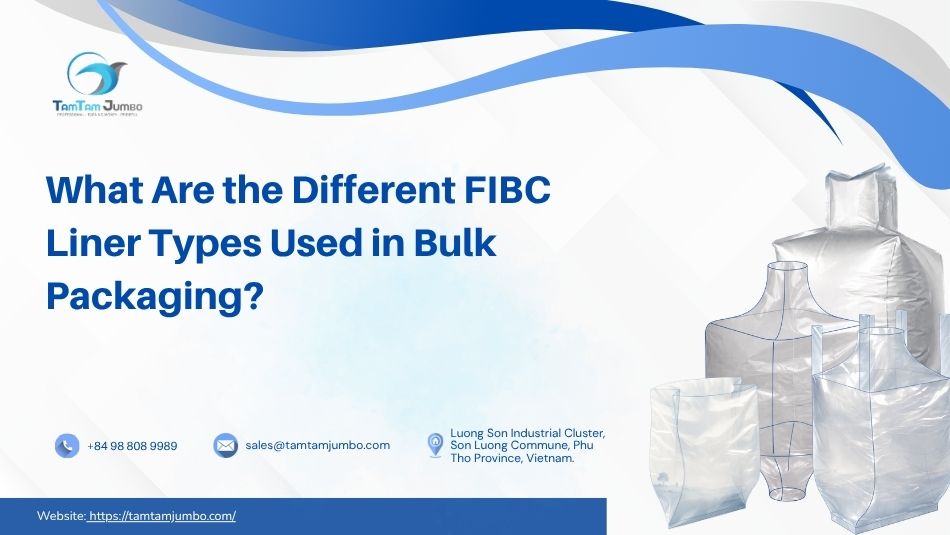
FIBC liners play a critical role in protecting bulk materials during storage and transportation. While the outer FIBC bag provides structural strength, the inner liner adds an additional barrier against moisture, contamination, oxygen exposure, dust leakage, and electrostatic hazards.
For industries handling fine powders, food ingredients, chemicals, pharmaceuticals, or moisture-sensitive materials, selecting the correct liner is often as important as selecting the bulk bag itself.
This article explains the most common FIBC liner types, how they are manufactured, where they are used, and what international buyers should evaluate before sourcing lined FIBC bags from a manufacturer.
Understanding the Role of FIBC Liners
An FIBC liner is a flexible inner bag inserted into a woven polypropylene bulk bag. Most liners are manufactured from polyethylene films such as LDPE, LLDPE, or HDPE. Depending on the application, liners may also include barrier layers, conductive properties, or customized shapes.
The primary purpose of FIBC liners is to improve product protection and packaging performance.
Common functions include:
- Preventing moisture ingress
- Reducing product contamination
- Minimizing dust leakage
- Improving discharge efficiency
- Protecting oxygen-sensitive materials
- Supporting food-grade compliance
- Reducing static electricity risks
- Improving shelf life for sensitive products
In export logistics, liners also help reduce cargo claims caused by humidity, condensation, and contamination during long transit periods.
Read more: What Is FIBC Liner
Main Categories of FIBC Liner Types
FIBC liner types can generally be divided into two groups:
- Classification by liner shape and construction
- Classification by liner material or function
Both factors are important because the liner design affects operational efficiency, while the liner material determines barrier performance and product compatibility.
FIBC Liner Types by Construction
Lay-Flat Liners
Lay-flat liners are the simplest and most economical liner type. These liners are essentially tubular polyethylene films inserted loosely into the FIBC bag.
Characteristics:
- Flat tubular construction
- Open-top or sealed-bottom options
- Cost-effective solution
- Suitable for standard industrial materials
Applications:
- Minerals
- Construction powders
- Plastic resins
- General industrial products
Advantages:
- Lower production cost
- Fast manufacturing
- Suitable for high-volume packaging
Limitations:
- Excess folds inside the bag
- Reduced discharge efficiency
- Potential product retention in corners
Lay-flat liners are commonly selected when the primary requirement is basic moisture protection rather than optimized product flow.
Form-Fit Liners
Form-fit liners are designed to match the internal shape of the FIBC bag, including the filling and discharge spouts.
Characteristics:
- Custom-shaped construction
- Reduced wrinkles and folds
- Improved bag stability
- Better discharge performance
Applications:
- Food ingredients
- Fine powders
- Pharmaceutical raw materials
- Hygroscopic chemicals
Advantages:
- Cleaner discharge
- Reduced product residue
- Better filling efficiency
- Improved pallet stability
From a manufacturing perspective, form-fit liners require more precise dimensional control during production. However, they significantly improve operational efficiency for automated filling lines.
Many industrial buyers prefer form-fit liners because they reduce product waste during discharge and improve container utilization during export shipping.
Gusseted Liners
Gusseted liners include folded side panels that expand to match square or rectangular FIBC shapes.
Characteristics:
- Side gussets for shape retention
- Better internal volume utilization
- Improved stacking performance
Applications:
- Agricultural products
- Chemicals
- Powders requiring stable palletization
Advantages:
- Better cubic efficiency
- Improved container loading
- More stable bag geometry
These liners are often selected for export programs where maximizing container space is important.
Tubular Liners
Tubular liners are pre-manufactured cylindrical liners commonly inserted during FIBC production.
Characteristics:
- Continuous tubular film
- Economical structure
- Simple installation
Applications:
- Standard industrial powders
- Fertilizers
- Granular products
Tubular liners are widely used because of their manufacturing simplicity and consistent dimensions.
Baffle Liners
Baffle liners contain internal panels that help the bulk bag maintain a square shape after filling.
Characteristics:
- Internal baffle construction
- Enhanced shape retention
- Improved stacking performance
Applications:
- High-density warehouse storage
- Export container optimization
- Food-grade powder handling
Advantages:
- Improved container efficiency
- Reduced bag bulging
- Better warehouse stacking
For logistics-intensive industries, baffle liners can significantly improve transport efficiency by allowing more stable pallet stacking.
FIBC Liner Types by Material and Function
Standard PE Liners
Polyethylene liners are the most common liner type in the FIBC industry. They are typically manufactured using LDPE or LLDPE films.
Characteristics:
- Flexible structure
- Moisture resistance
- Economical cost
Applications:
- Cement
- Sand
- Agricultural products
- Industrial powders
Standard PE liners are suitable for products that require basic contamination and moisture protection.
Food-Grade Liners
Food-grade liners are produced using virgin resin in controlled manufacturing environments.
Applications:
- Sugar
- Flour
- Starch
- Dairy powders
- Rice ingredients
Important considerations:
- FDA or EU compliance
- Cleanroom production
- Migration testing
- Traceability documentation
For international food exporters, food-grade certification is often mandatory rather than optional.
Conductive and Anti-Static Liners
Static electricity can become a serious hazard during the filling and discharge of fine powders. Conductive liners are designed to reduce electrostatic risks.
Common liner classifications include:
| Liner Type | Function | Typical Use |
| L1 | Conductive liner | Type C FIBC |
| L2 | Static dissipative liner | Type C or Type D FIBC |
| L3 | Standard insulating liner | Non-hazardous products |
Applications:
- Chemicals
- Flammable powders
- Pigments
- Explosive dust environments
Proper grounding procedures remain essential when using conductive liner systems.
Barrier Liners
Barrier liners are designed for products sensitive to oxygen, moisture, UV light, or odors.
Materials may include:
- EVOH films
- Aluminum foil laminates
- Multi-layer coextruded films
Applications:
- Pharmaceuticals
- Specialty chemicals
- Nutraceuticals
- Food additives
Advantages:
- Extended shelf life
- Improved moisture resistance
- Oxygen barrier protection
Barrier liners are commonly used for international shipping routes with long transit durations or humid climates.
Aluminum Foil Liners
Aluminum foil liners provide the highest level of barrier protection available in FIBC liner systems.
Applications:
- Sensitive pharmaceutical powders
- Aroma-sensitive products
- Oxidation-sensitive chemicals
Advantages:
- Near-complete oxygen barrier
- UV protection
- Strong moisture resistance
These liners are significantly more expensive than standard PE liners but are necessary for highly sensitive products.
Comparison of Common FIBC Liner Types
| Liner Type | Main Benefit | Typical Industry | Relative Cost |
| Lay-flat liner | Economical protection | Construction | Low |
| Form-fit liner | Better discharge efficiency | Food & chemicals | Medium |
| Gusseted liner | Better cubic efficiency | Agriculture | Medium |
| Baffle liner | Improved stacking stability | Export logistics | Medium-High |
| Conductive liner | Static protection | Chemicals | High |
| Barrier liner | Oxygen/moisture barrier | Pharma & food | High |
| Aluminum liner | Maximum protection | Specialty materials | Highest |
Buyer Considerations Before Ordering FIBC Liners
Product Characteristics
The physical behavior of the material determines liner selection.
Important factors include:
- Particle size
- Moisture sensitivity
- Flowability
- Static generation
- Oxygen sensitivity
- Abrasiveness
Filling and Discharge Systems
The liner design must match the customer’s operational equipment.
Considerations include:
- Filling spout size
- Discharge spout configuration
- Automatic filling systems
- Vacuum filling requirements
Poor compatibility between liner design and filling equipment often causes operational inefficiencies.
Export Environment
Long-distance export shipments introduce additional risks:
- Container condensation
- Temperature variation
- Humidity exposure
- Long storage periods
For sea freight shipments, barrier liners are often recommended for moisture-sensitive materials.
Regulatory Compliance
International buyers should verify:
- FDA compliance
- EU food-contact regulations
- UN hazardous goods standards
- ISO manufacturing systems
- Cleanroom production capabilities
At Tam Tam Packaging Co., Ltd, liner specifications are developed based on the product characteristics, export conditions, and handling systems required by each customer.
Manufacturing Considerations for High-Quality FIBC Liners
Consistent liner quality depends heavily on manufacturing control.
Important production factors include:
- Virgin resin quality
- Film extrusion stability
- Thickness consistency
- Heat-sealing precision
- Static control testing
- Cleanroom conditions for food-grade liners
In industrial packaging, liner failures typically occur because of poor sealing quality, inconsistent film thickness, or incorrect liner selection rather than the outer FIBC bag itself.
Experienced manufacturers usually conduct:
- Leak testing
- Thickness testing
- Tensile testing
- Static decay testing
- Food-contact compliance verification
FAQ
What is the purpose of an FIBC liner?
An FIBC liner provides additional protection inside a bulk bag by preventing moisture, contamination, dust leakage, and oxygen exposure.
Which FIBC liner is best for food products?
Food-grade PE liners manufactured from virgin resin in controlled environments are commonly used for food ingredients and agricultural products.
What is the difference between a lay-flat liner and a form-fit liner?
Lay-flat liners are loose tubular liners, while form-fit liners are customized to match the exact shape of the bulk bag for better filling and discharge performance.
Are conductive liners necessary for chemical powders?
Conductive or anti-static liners are required when handling flammable powders or products that generate static electricity during filling or discharge.
Can FIBC liners improve export shipping performance?
Yes. Proper liners help protect products from moisture, contamination, and condensation during long international shipments.
Conclusion
Selecting the correct FIBC liner type directly affects product protection, operational efficiency, and export reliability.
Different liner designs serve different purposes:
- Lay-flat liners provide economical protection
- Form-fit liners improve filling and discharge
- Barrier liners protect sensitive materials
- Conductive liners reduce electrostatic hazards
- Food-grade liners support regulatory compliance
For industrial buyers, liner selection should be based on product behavior, transport conditions, handling systems, and regulatory requirements rather than price alone.
An experienced FIBC manufacturer can help optimize liner design for both product safety and logistics efficiency.
Contact Us
Tam Tam Packaging Co., Ltd
Email: sales@tamtamjumbo.com
Website: tamtamjumbo.com
Read more
FIBC Bags for Flour: Why Allergen Status Change the Specification
Flour shares the fine-particle and combustible dust characteristics of other food powders, but wheat’s status...
Aug
FIBC Bag for Starch Powder: Dustproof Bag Needs Antistatic
Starch powder occupies an unusual position in FIBC specification: it is a common food and...
Aug
FIBC Bags for Animal Feed: What Actually Makes a Clean Bulk Bag
FIBC bags for animal feed mean something more specific than a bag that looks unused....
Aug
FIBC Bag for PET Flakes: Why UV Resistance Matter More Than It
Recycled PET flakes share a base polymer with virgin resin pellets, but the two behave...
Aug
FIBC Bags for Plastic Resin: PP Fabric Packaging PP Pellets
There is a certain irony in shipping polypropylene resin pellets inside a bag woven from...
Aug
FIBC Bags for the Food Industry: Building a Food Grade Bag
Food manufacturers sourcing bulk ingredient packaging are working from a different starting point than a...
Aug