
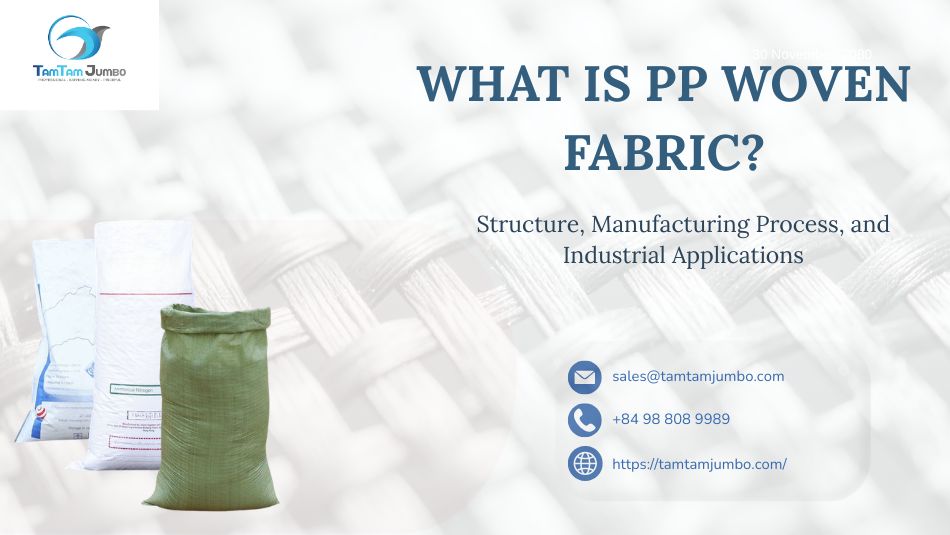
PP woven fabric is one of the most widely used industrial packaging materials in global supply chains. It is commonly used in FIBC jumbo bags, woven sacks, agricultural packaging, construction materials, and logistics applications due to its high strength-to-weight ratio, durability, and cost efficiency.
For international buyers sourcing packaging products, understanding what PP woven fabric is goes beyond knowing the material itself. Fabric quality directly affects bag performance, load capacity, printing quality, UV resistance, and export reliability.
This article explains the structure, manufacturing process, specifications, and applications of PP woven fabric from a manufacturer’s perspective. It also covers practical considerations buyers should evaluate before purchasing woven polypropylene packaging products.
What Is PP Woven Fabric?
PP woven fabric refers to a textile material made from woven polypropylene tapes or threads. “PP” stands for polypropylene, a thermoplastic polymer widely used in industrial packaging because of its strength, chemical resistance, and lightweight properties.
The fabric is produced by weaving flat polypropylene tapes in two directions:
- Warp direction (lengthwise)
- Weft direction (crosswise)
This weaving structure creates a strong and flexible fabric suitable for packaging heavy or bulk materials.
Simple Definition
PP woven fabric is a woven plastic fabric made from polypropylene tapes, commonly used to manufacture woven bags, FIBC jumbo bags, tarpaulins, and industrial packaging products.
How PP Woven Fabric Is Manufactured
Understanding the manufacturing process helps buyers evaluate fabric quality more accurately. Small differences during production can significantly affect tensile strength, weight consistency, and bag performance.
Step 1: Polypropylene Resin Extrusion
At Tam Tam Packaging Co., Ltd, resin selection is carefully controlled because resin quality directly impacts:
- Fabric strength
- UV stability
- Flexibility
- Durability during transportation
Step 2: Tape Stretching
The PP film is slit into narrow tapes and stretched under controlled temperature conditions.
This stretching process aligns the molecular structure of polypropylene, increasing tensile strength.
Improper stretching often causes:
- Weak fabric
- Uneven tape thickness
- Reduced safe working load capacity
Step 3: Circular Weaving
The stretched tapes are woven on circular looms to create tubular woven fabric.
Fabric specifications are determined during this stage, including:
- Fabric density
- Weave pattern
- Fabric width
- Strength performance
Step 4: Lamination or Coating (Optional)
Some PP woven fabrics receive lamination or coating to improve:
- Moisture resistance
- Printing surface quality
- Dust protection
- Barrier performance
Laminated PP woven fabric is commonly used for:
- Food products
- Fertilizer packaging
- Cement bags
- Chemical packaging
Step 5: Cutting and Conversion
The finished fabric is converted into:
- PP woven bags
- BOPP laminated bags
- FIBC jumbo bags
- Bale wraps
- Industrial covers
Main Properties of PP Woven Fabric
PP woven fabric is widely used because it combines strength, flexibility, and lightweight characteristics.
High Tensile Strength
The woven structure distributes load efficiently, allowing the material to carry heavy products without tearing easily.
This is especially important for:
- Bulk agricultural products
- Chemicals
- Minerals
- Construction materials
Lightweight Material
Compared to paper or cotton alternatives, PP woven fabric offers excellent load performance with lower packaging weight.
This helps reduce:
- Freight costs
- Handling costs
- Storage weight
Moisture Resistance
Polypropylene naturally resists moisture absorption.
When combined with PE coating or lamination, the fabric can provide enhanced protection against humidity and contamination.
Chemical Resistance
PP woven fabric performs well when exposed to:
- Fertilizers
- Chemicals
- Industrial powders
- Agricultural materials
Reusability and Recyclability
Many industrial users choose woven polypropylene packaging because it can often be reused multiple times and recycled, depending on local waste management systems.
Read more: Eco Friendly Packaging Solutions
Common Types of PP Woven Fabric
Different applications require different fabric constructions.
Uncoated PP Woven Fabric
This fabric has no additional lamination layer.
Characteristics:
- Breathable
- Lightweight
- Economical
- Suitable for products requiring ventilation
Typical applications:
- Agricultural packaging
- Grain bags
- Produce sacks
Coated PP Woven Fabric
Also called laminated woven fabric.
Characteristics:
- Moisture barrier
- Better printability
- Improved dust resistance
Typical applications:
- Fertilizer bags
- Cement bags
- Chemical packaging
BOPP Laminated Woven Fabric
This type combines woven PP fabric with BOPP film for high-quality printing and improved appearance.
Characteristics:
- Premium graphics
- High-resolution printing
- Better shelf presentation
Typical applications:
- Retail rice packaging
- Animal feed bags
- Consumer packaging
Read more: BOPP Laminated Bags Advantages
UV Stabilized PP Woven Fabric
UV additives are incorporated into the fabric for outdoor storage applications.
Used for:
- Agriculture
- Construction
- Outdoor industrial storage
PP Woven Fabric vs Non-Woven Fabric
Many buyers confuse woven polypropylene fabric with non-woven fabric. However, their structures and applications are completely different.
| Feature | PP Woven Fabric | Non-Woven Fabric |
| Structure | Woven tapes | Bonded fibers |
| Strength | High tensile strength | Lower load capacity |
| Reusability | High | Moderate |
| Typical Use | Industrial packaging | Hygiene products |
| Heavy Load Handling | Excellent | Limited |
| Moisture Resistance | Good | Moderate |
For industrial bulk packaging, woven PP fabric remains the preferred solution because of its structural strength and durability.
Industrial Applications of PP Woven Fabric
FIBC Jumbo Bags
One of the largest applications of PP woven fabric is Flexible Intermediate Bulk Containers (FIBC).
The fabric is engineered to handle:
- 500 kg to 2000 kg loads
- Bulk powders
- Granules
- Agricultural commodities
Agricultural Packaging
PP woven fabric is widely used for:
- Rice bags
- Flour bags
- Sugar packaging
- Seed bags
- Animal feed sacks
Breathability and strength are important advantages in agricultural storage and transportation.
Construction Industry
Construction applications include:
- Cement bags
- Sand bags
- Debris collection
- Geotextile products
High tear resistance is essential in these environments.
Chemical Industry
Chemical manufacturers use woven polypropylene packaging because of its:
- Chemical resistance
- High load stability
- Moisture protection capability
Logistics and Export Packaging
Exporters prefer PP woven packaging because it:
- Maximizes container loading efficiency
- Reduces packaging weight
- Performs well during long-distance transportation
Read more: PP Woven Bags Vs FIBC Bags
Key Specifications Buyers Should Evaluate
When sourcing PP woven fabric, buyers should review more than just price.
Fabric GSM
GSM (grams per square meter) determines fabric weight and strength.
Higher GSM generally provides:
- Better strength
- Improved puncture resistance
- Higher durability
However, excessive GSM can increase packaging costs unnecessarily.
Denier
Denier measures tape thickness.
Higher denier usually means:
- Stronger tapes
- Higher tensile performance
- Better durability
Fabric Density
Density refers to the number of tapes per inch.
Incorrect density may cause:
- Fabric distortion
- Lower strength
- Poor printing surface
UV Protection
For outdoor storage or long export transit times, UV stabilization becomes critical.
UV degradation can weaken woven fabric significantly if protection is insufficient.
Lamination Quality
Poor lamination may result in:
- Delamination
- Cracking
- Print defects
- Moisture leakage
Manufacturing Insights Buyers Often Overlook
From a factory perspective, several hidden factors affect final bag performance.
Resin Quality Matters More Than Many Buyers Expect
Low-grade recycled resin can reduce:
- Fabric consistency
- Tensile strength
- UV performance
- Long-term durability
At Tam Tam Packaging Co., Ltd, resin control is considered a critical part of quality management, especially for export-grade packaging.
Weaving Consistency Affects Bag Safety
Uneven weaving tension may not be visually obvious, but it can create weak points during lifting or transportation.
Consistent loom calibration is essential for industrial packaging reliability.
Printing Quality Depends on Fabric Surface Stability
High-quality printing requires:
- Stable lamination
- Smooth surface treatment
- Controlled fabric tension
This is particularly important for branded retail packaging.
How Buyers Choose the Right PP Woven Fabric
The correct fabric specification depends on:
- Product weight
- Filling method
- Storage conditions
- Transportation requirements
- Regulatory standards
Buyers Should Consider:
- Is moisture protection required?
- Is high-quality printing needed?
- What is the target loading weight?
- Is UV stabilization necessary?
A suitable fabric structure improves:
- Packaging performance
- Supply chain efficiency
- Product protection
- Cost optimization
FAQ
What is PP woven fabric made of?
PP woven fabric is made from polypropylene resin that is extruded into tapes and woven into a durable textile structure.
Is PP woven fabric waterproof?
Standard woven fabric is moisture-resistant but not fully waterproof. Laminated or coated PP woven fabric provides better moisture protection.
What industries use PP woven fabric?
Industries include agriculture, chemicals, construction, food packaging, logistics, mining, and industrial bulk packaging.
What is the difference between laminated and unlaminated woven fabric?
Laminated fabric includes an additional coating layer for moisture protection and better printing quality, while unlaminated fabric is breathable and more economical.
Can PP woven fabric be recycled?
Yes. Polypropylene woven fabric can often be recycled, depending on local recycling infrastructure and contamination conditions.
Conclusion
PP woven fabric remains one of the most efficient materials for industrial packaging because it combines strength, lightweight performance, flexibility, and cost efficiency.
For buyers sourcing woven bags or FIBC products internationally, fabric quality directly affects packaging reliability, transportation safety, and long-term supply consistency. Understanding the technical structure behind woven polypropylene fabric helps buyers make better sourcing decisions and avoid quality risks.
At Tam Tam Packaging Co., Ltd, woven fabric production is managed with strict control over resin quality, weaving consistency, lamination performance, and export packaging standards to support industrial applications worldwide.
Contact Us
Tam Tam Packaging Co., Ltd
Email: sales@tamtamjumbo.com
Website: tamtamjumbo.com
Read more
FIBC Bags for Flour: Why Allergen Status Change the Specification
Flour shares the fine-particle and combustible dust characteristics of other food powders, but wheat’s status...
Aug
FIBC Bag for Starch Powder: Dustproof Bag Needs Antistatic
Starch powder occupies an unusual position in FIBC specification: it is a common food and...
Aug
FIBC Bags for Animal Feed: What Actually Makes a Clean Bulk Bag
FIBC bags for animal feed mean something more specific than a bag that looks unused....
Aug
FIBC Bag for PET Flakes: Why UV Resistance Matter More Than It
Recycled PET flakes share a base polymer with virgin resin pellets, but the two behave...
Aug
FIBC Bags for Plastic Resin: PP Fabric Packaging PP Pellets
There is a certain irony in shipping polypropylene resin pellets inside a bag woven from...
Aug
FIBC Bags for the Food Industry: Building a Food Grade Bag
Food manufacturers sourcing bulk ingredient packaging are working from a different starting point than a...
Aug