

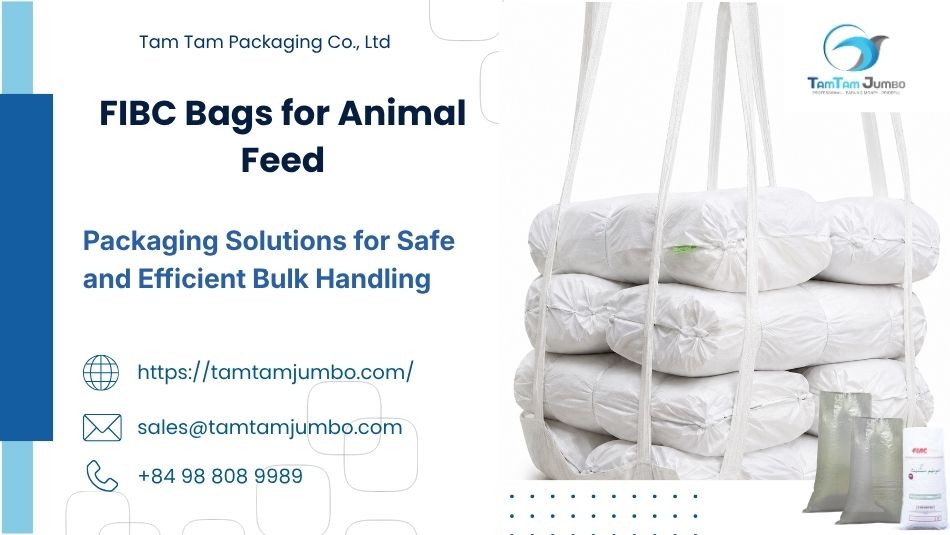
FIBC bags for animal feed mean something more specific than a bag that looks unused. Feed manufacturing carries its own contamination risks, medicated feed carryover, cross-species ingredient restrictions, and mold growth from moisture exposure that go beyond the general hygiene concerns covered by standard food grade certification. This guide covers what genuinely matters when sourcing FIBC bags for animal feed, building on top of, not replacing, general agricultural packaging considerations.
How Animal Feed FIBC Needs Differ From Human Food Ingredient Packaging
Animal feed sits under its own regulatory framework in most markets, separate from human food safety standards, with specific concerns around medicated feed additives, ingredient carryover between species-restricted formulations, and mycotoxin risk from moisture exposure during storage. These are addressed in more depth here than in general agricultural or food industry packaging guidance, since feed manufacturing carries risks that don’t have a direct equivalent in human food ingredient handling.
Read more: FIBC Bags for Agriculture: Match Specification to Product Category
Preventing Cross-Contamination Between Feed Batches
Feed manufacturers producing multiple formulations need to prevent ingredient carryover between batches, particularly for restricted ingredients that cannot cross into certain species’ feed due to regulatory or safety concerns. A bag used for one formulation and reused for another without proper verification can introduce exactly this kind of cross-contamination, making batch-level bag tracking and single-trip use a common practice for higher-risk formulations.
Medicated Feed Carryover: Why Some Bags Cannot Be Reused
Feed containing medicated additives presents a specific carryover risk, since residue from a medicated batch can transfer to a subsequent non-medicated batch through a reused bag, potentially exposing animals to unintended drug residue. Regulatory frameworks in many markets require documented cleanout procedures for equipment handling medicated feed, and the same logic extends to bulk bags, where single-trip use or verified cleaning protocols become a practical necessity rather than an optional precaution.
Moisture Protection and Mold and Mycotoxin Prevention
Feed ingredients exposed to moisture during storage risk mold growth, and certain molds produce mycotoxins that are harmful to livestock even at relatively low concentrations. This makes moisture protection a food safety issue for feed in a more direct way than it is for many other bulk commodities, since the consequence isn’t just spoiled product but a genuine animal health risk if contaminated feed reaches livestock.
Read more: Moisture Proof FIBC Bags: What Triple Proofed Actually Combines
Pest and Rodent Resistance for Farm Storage
Feed stored at farm level is a natural target for rodents and pests, and while fabric weight and weave density are not a substitute for proper site pest management, more tightly woven fabric provides at least some additional resistance compared to loosely woven or damaged bags. Buyers storing feed for extended periods at farm sites should treat this as a secondary consideration alongside broader on-site pest control practices.
What Makes a Bag Genuinely Clean for Multi-Trip Feed Use
A genuinely clean bulk bag for multi-trip feed use means the bag has either never contacted a different, potentially incompatible formulation, or has gone through a documented and verified cleaning process between uses. Visual inspection alone cannot confirm the absence of medicated feed residue or cross-species restricted ingredients, which is why feed manufacturers handling higher-risk formulations often default to single-trip bags for these specific products rather than relying on cleaning verification.
Traceability and Labeling for Feed Recalls
Batch and lot traceability on the bag label becomes particularly important in feed manufacturing, since a contamination issue discovered after distribution needs to be traced back to the specific bags and batches involved for an effective recall. This makes accurate batch labeling as much a feed safety requirement as a general quality practice.
Read more: FIBC Label Requirements: Reading 5:1 vs 6:1 Safety Factor Markings Correctly
Building a Complete Animal Feed FIBC Specification
Bringing these considerations together, a complete animal feed specification typically addresses single-trip versus verified-clean multi-trip use based on formulation risk, moisture protection to prevent mold and mycotoxin development, batch traceability labeling, and food or feed grade hygiene certification appropriate to the destination market’s regulations.
Common Animal Feed FIBC Specification Combinations
| Feed Product | Typical Specification Combination |
| Standard non-medicated feed | Feed grade hygiene standards, moisture proof construction, standard capacity, verified multi-trip use acceptable |
| Medicated feed additive formulations | Single-trip use only, batch traceability labeling, moisture protection |
| Species-restricted ingredient feed | Single-trip use, documented batch tracking, moisture protection |
| Farm-stored bulk feed | Tighter weave fabric, moisture proof liner, UV stabilization for outdoor storage |
How Tam Tam Packaging Specifies Bags for Animal Feed
Tam Tam Packaging works with feed manufacturers to determine single-trip versus multi-trip suitability based on formulation risk, applying moisture protection and batch traceability labeling as standard practice for feed applications. Specification sheets document hygiene certification, moisture protection method, and labeling detail individually for each order.
Common Mistakes When Sourcing Animal Feed FIBC Bags
- Reusing bags across medicated and non-medicated feed batches without a documented cleaning verification process.
- Assuming visual cleanliness confirms the absence of residue from a previous formulation.
- Overlooking moisture protection despite its direct connection to mold and mycotoxin risk in feed.
- Not maintaining batch traceability on bag labels, complicating recall response if a contamination issue arises.
- Treating animal feed packaging as identical to general agricultural grain packaging without addressing feed-specific carryover risks.
Applications Across the Animal Feed Industry
Animal feed FIBC applications span commercial feed mills, farm-level bulk storage, and specialty medicated feed manufacturing, each carrying different contamination risk profiles that should shape single-trip versus multi-trip decisions. Feed manufacturers producing multiple formulation types benefit from assessing carryover risk formulation by formulation rather than applying one bag reuse policy across their entire product range.
Frequently Asked Questions
What makes a bulk bag genuinely clean for animal feed reuse?
Either the bag has never contacted a different, potentially incompatible formulation, or it has gone through a documented and verified cleaning process, since visual inspection alone cannot confirm the absence of residue.
Why can’t medicated feed bags always be reused?
Residue from a medicated batch can carry over into a subsequent non-medicated batch through a reused bag, risking unintended drug exposure to animals that shouldn’t receive it.
Why does moisture protection matter more for feed than some other products?
Moisture exposure can lead to mold growth and mycotoxin development, which presents a direct animal health risk rather than just product spoilage.
Do animal feed bags need the same food grade certification as human food?
Animal feed typically falls under its own regulatory framework, though many buyers still require food or feed grade hygiene standards depending on destination market regulations and their own supply chain requirements.
Why does batch traceability matter for feed bags specifically?
If a contamination issue is discovered after distribution, batch traceability allows an effective recall by identifying exactly which bags and feed batches are affected.
Conclusion
FIBC bags for animal feed mean more than the absence of visible residue. Carryover risk from medicated or restricted formulations, moisture-driven mold and mycotoxin risk, and batch traceability all need to be addressed deliberately, with single-trip use as the practical default for higher-risk formulations rather than relying on cleaning verification alone.
Tam Tam Packaging Co. builds FIBC specifications for animal feed addressing carryover risk, moisture protection, and batch traceability together. Contact our team to work through the right specification for your feed formulation.
Contact Us
Tam Tam Packaging Co.
Email: sales@tamtamjumbo.com
Website: https://tamtamjumbo.com/
Read more
FIBC Bags for Pharmaceutical Powders: What Sets a Pharma Bag
Pharmaceutical powder handling sits at the far end of the specification spectrum from general industrial...
Sep
FIBC Bags for Hazardous Material: How to Classify Bags Required
A UN certificate confirms a bag’s packing group and maximum weight, but it doesn’t tell...
Sep
FIBC Bags for Recycling Industry: Bulk Bag Across Material Stream
Recycling operations move an unusually wide range of material through FIBC packaging, plastic flakes, metal...
Sep
FIBC Bags for Construction: A Complete Guide Across Materials
Walk onto almost any construction site or materials yard and the bulk bags you see...
Aug
FIBC Bags for Flour: Why Allergen Status Change the Specification
Flour shares the fine-particle and combustible dust characteristics of other food powders, but wheat’s status...
Aug
FIBC Bag for Starch Powder: Dustproof Bag Needs Antistatic
Starch powder occupies an unusual position in FIBC specification: it is a common food and...
Aug