
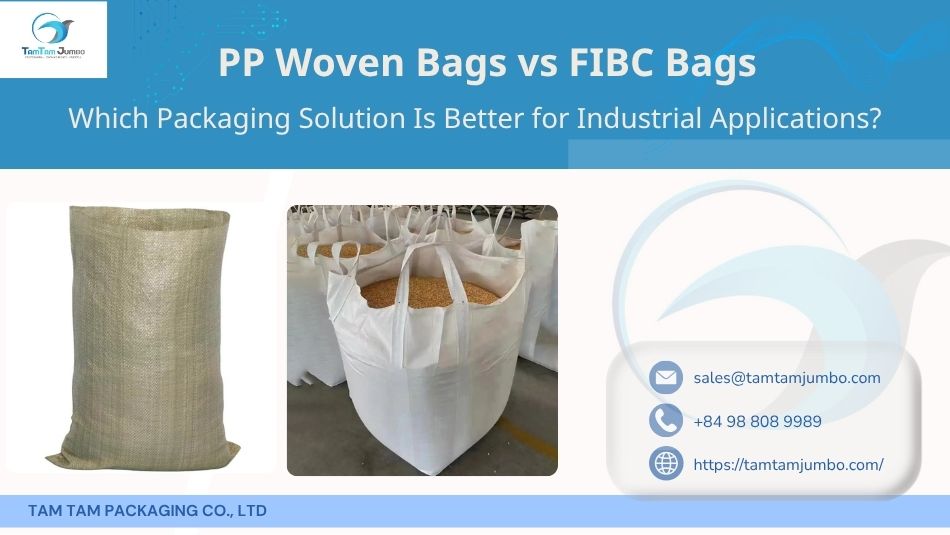
Industrial packaging buyers often compare PP woven bags vs FIBC bags when evaluating bulk material handling solutions.
Both packaging types are manufactured using woven polypropylene fabric, but they serve very different operational purposes. The correct choice depends on:
- Product weight
- Filling system
- Transportation method
- Storage requirements
- Labor efficiency
- Export logistics
For some applications, standard PP woven bags remain the most economical option. In other industries, FIBC bags significantly improve handling efficiency and reduce logistics costs.
At Tam Tam Packaging Co., packaging selection is typically based on the customer’s full operational process rather than simply comparing bag prices. A lower-cost bag may increase labor costs, loading time, or transportation inefficiency if the packaging system is not optimized correctly.
This article explains the technical and operational differences between PP woven bags and FIBC bags from an industrial manufacturing perspective.
What Are PP Woven Bags?
PP woven bags are smaller industrial packaging bags manufactured from woven polypropylene tapes.
They are commonly used for products packed in:
- 5 kg
- 10 kg
- 25 kg
- 50 kg
Typical Applications
- Rice
- Flour
- Sugar
- Animal feed
- Fertilizer
- Cement
- Chemicals
These bags are usually handled manually or by palletized transportation systems.
What Are FIBC Bags?
FIBC bags, also called jumbo bags or bulk bags, are large flexible containers designed for bulk material handling.
FIBC stands for Flexible Intermediate Bulk Container.
Typical FIBC capacities include:
- 500 kg
- 1000 kg
- 1500 kg
- 2000 kg
FIBC bags are designed for:
- Forklift handling
- Crane lifting
- Bulk filling systems
- Industrial storage and export logistics
PP Woven Bags vs FIBC Bags: Core Difference
Simple Explanation
PP woven bags are designed for small-volume packaging, while FIBC bags are engineered for bulk industrial material handling.
The biggest difference is handling efficiency and load capacity.
PP woven bags focus on:
- Small-unit packaging
- Manual handling
- Retail and medium-scale distribution
FIBC bags focus on:
- Bulk transportation
- Industrial efficiency
- Reduced labor handling
- Logistics optimization
Comparison Table: PP Woven Bags vs FIBC Bags
| Feature | PP Woven Bags | FIBC Bags |
| Capacity | 5–50 kg | 500–2000 kg |
| Handling Method | Manual or palletized | Forklift or crane |
| Filling System | Semi-automatic/manual | Bulk filling systems |
| Transportation Efficiency | Moderate | High |
| Labor Requirement | Higher | Lower |
| Storage Efficiency | Moderate | High |
| Cost per Bag | Lower | Higher |
| Cost per Ton Packed | Higher | Lower |
| Export Efficiency | Moderate | Excellent |
| Common Industries | Food, agriculture | Chemicals, minerals, bulk materials |
Material Structure Differences
PP Woven Bags Structure
PP woven bags typically use:
- Lightweight woven fabric
- Simple stitching
- Optional lamination
The structure is optimized for:
- Small-unit handling
- Lower packaging weight
- Cost efficiency
FIBC Bags Structure
FIBC bags use:
- Heavy-duty woven fabric
- Reinforced lifting loops
- Safety-tested construction
- Structural sewing reinforcement
Additional components may include:
- Liners
- Baffles
- Dust-proof closures
- Conductive systems
- UV stabilization
The engineering complexity is significantly higher compared to standard PP woven bags.
Handling Efficiency Comparison
PP Woven Bags
PP woven bags often require:
- Manual lifting
- Pallet stacking
- Labor-intensive loading
For example:
- 20 tons of material packed in 25 kg bags requires approximately 800 bags.
This increases:
- Filling time
- Labor cost
- Warehouse handling
FIBC Bags
FIBC bags dramatically reduce handling complexity.
The same 20 tons may require only:
- 20 jumbo bags at 1000 kg each
Benefits include:
- Faster loading
- Reduced labor
- Improved warehouse efficiency
- Faster container stuffing
For industrial bulk logistics, FIBC bags often reduce total operational cost despite higher unit bag prices.
Transportation and Container Optimization
PP Woven Bags
Smaller woven bags are suitable when:
- Retail distribution is required
- End users need smaller package sizes
- Products are sold through distribution networks
However, container loading efficiency may be lower due to:
- Pallet usage
- Labor stacking limitations
FIBC Bags
FIBC bags improve:
- Container utilization
- Loading speed
- Bulk transportation efficiency
Baffle FIBC bags further improve:
- Shape stability
- Container space optimization
- Stacking performance
This is especially important in export markets where freight cost plays a major role.
Cost Comparison: Bag Cost vs Operational Cost
One common mistake among buyers is evaluating only the bag price.
PP Woven Bags
Advantages:
- Lower unit price
- Lower initial packaging cost
Hidden operational costs:
- Higher labor requirement
- Slower loading
- Increased pallet usage
- More warehouse handling
FIBC Bags
Advantages:
- Lower handling cost
- Faster filling
- Improved logistics efficiency
- Reduced manpower
A higher upfront bag price may be offset by:
- Labor savings
- Faster shipment preparation
- Reduced transportation complexity
Industrial buyers often evaluate total packaging system cost rather than bag cost alone.
Industry Applications
When PP Woven Bags Are Preferred
PP woven bags are commonly used when:
- Products are sold in small quantities
- Retail distribution is needed
- Manual handling is acceptable
Typical Industries
- Rice packaging
- Flour packaging
- Animal feed
- Consumer agricultural products
When FIBC Bags Are Preferred
FIBC bags are commonly selected for:
- Bulk industrial transportation
- Export logistics
- Automated filling systems
- Heavy material handling
Typical Industries
- Chemicals
- Mining
- Construction
- Petrochemicals
- Plastic resin
- Industrial minerals
Storage and Warehouse Performance
PP Woven Bags
Smaller bags:
- Require pallets
- Need more storage handling
- Increase warehouse movement
Large inventories may create operational inefficiency.
FIBC Bags
FIBC bags improve:
- Bulk storage management
- Warehouse organization
- Forklift efficiency
Stackable FIBC designs further optimize storage density.
Safety and Handling Differences
PP Woven Bags
Manual handling increases:
- Labor fatigue
- Injury risk
- Repetitive movement exposure
FIBC Bags
FIBC bags reduce manual handling but require:
- Proper lifting equipment
- Trained operators
- Safe lifting procedures
Improper lifting methods can create:
- Loop stress
- Bag instability
- Handling accidents
Sustainability Considerations
Both PP woven bags and FIBC bags are made from polypropylene and may support recycling depending on:
- Material purity
- Coating structure
- Contamination level
However, FIBC bags may reduce overall packaging consumption because:
- One jumbo bag replaces many smaller bags
- Pallet usage can be reduced
- Packaging waste volume decreases
Multi-trip FIBC bags can further improve packaging sustainability in closed-loop systems.
Manufacturing Experience
At Tam Tam Packaging Co., both PP woven bags and FIBC bags are produced from woven polypropylene fabric, but the manufacturing complexity differs significantly.
FIBC bags require stricter control over:
- Fabric tensile strength
- Webbing quality
- Sewing reinforcement
- Safety testing
- Load performance
PP woven bags focus more on:
- Consistent fabric weaving
- Accurate dimensions
- Printing quality
- Production efficiency
Two suppliers may offer visually similar bags while delivering very different performance levels during transportation and storage.
How Buyers Should Choose Between PP Woven Bags and FIBC Bags
Choose PP Woven Bags If:
- Products are sold in small units
- Manual handling is required
- Retail packaging is necessary
- The budget focuses on low unit packaging cost
Choose FIBC Bags If:
- Bulk handling efficiency matters
- Export logistics is important
- Labor reduction is needed
- Industrial-scale transportation is required
Quick Summary
PP woven bags are:
- Smaller packaging bags
- Suitable for 5–50 kg products
- Common in the agriculture and food industries
FIBC bags are:
- Bulk industrial containers
- Suitable for 500–2000 kg loads
- Designed for forklift and crane handling
PP woven bags offer:
- Lower unit cost
- Retail flexibility
FIBC bags offer:
- Better logistics efficiency
- Reduced labor handling
- Improved bulk transportation
The correct packaging solution depends on the customer’s operational and logistics requirements.
FAQ
Are FIBC bags made from PP woven fabric?
Yes. FIBC bags are manufactured using heavy-duty woven polypropylene fabric with reinforced structural components.
Which is cheaper: PP woven bags or FIBC bags?
PP woven bags are cheaper per unit, but FIBC bags may reduce total operational cost in bulk handling applications.
Can FIBC bags replace PP woven bags?
In bulk industrial logistics, yes. However, retail and small-unit distribution still commonly require PP woven bags.
What industries commonly use FIBC bags?
Chemical, mining, construction, agriculture, resin, and industrial manufacturing industries widely use FIBC bags.
Which packaging solution is better for export?
For bulk transportation, FIBC bags usually provide better export efficiency due to improved container utilization and reduced labor handling.
Conclusion
The comparison between PP woven bags vs FIBC bags is not simply about packaging size. It is about operational efficiency, handling systems, transportation strategy, and total logistics cost.
PP woven bags remain highly effective for:
- Small-unit distribution
- Retail packaging
- Manual handling operations
FIBC bags provide significant advantages for:
- Bulk transportation
- Industrial material handling
- Export logistics
- Labor optimization
For international B2B buyers, the most effective packaging solution is the one that aligns with the full supply chain operation rather than focusing only on the initial bag price.
Contact Us
Tam Tam Packaging Co.
Email: sales@tamtamjumbo.com
Website: https://tamtamjumbo.com/
Read more
FIBC Bags for Flour: Why Allergen Status Change the Specification
Flour shares the fine-particle and combustible dust characteristics of other food powders, but wheat’s status...
Aug
FIBC Bag for Starch Powder: Dustproof Bag Needs Antistatic
Starch powder occupies an unusual position in FIBC specification: it is a common food and...
Aug
FIBC Bags for Animal Feed: What Actually Makes a Clean Bulk Bag
FIBC bags for animal feed mean something more specific than a bag that looks unused....
Aug
FIBC Bag for PET Flakes: Why UV Resistance Matter More Than It
Recycled PET flakes share a base polymer with virgin resin pellets, but the two behave...
Aug
FIBC Bags for Plastic Resin: PP Fabric Packaging PP Pellets
There is a certain irony in shipping polypropylene resin pellets inside a bag woven from...
Aug
FIBC Bags for the Food Industry: Building a Food Grade Bag
Food manufacturers sourcing bulk ingredient packaging are working from a different starting point than a...
Aug