

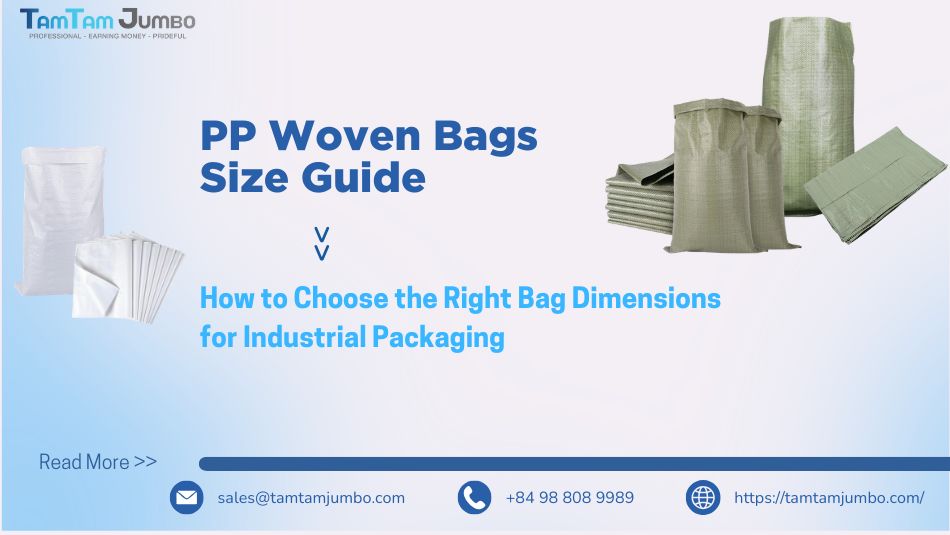
Selecting the correct bag size is one of the most important decisions in industrial packaging. A mismatch between product density, filling volume, and bag dimensions can lead to inefficient palletization, transportation issues, product leakage, or higher packaging costs.
This PP woven bags size guide explains how bag dimensions are determined, how different industries use different sizes, and what international buyers should consider before placing bulk orders.
At Tam Tam Packaging Co., we manufacture PP woven bags for agricultural, food, chemical, construction, and industrial applications. Through export experience across Europe, Canada, and Asia, we have found that many buyers focus only on bag weight capacity while overlooking critical dimensional specifications that directly affect logistics efficiency and packaging performance.
This guide provides practical technical insights for importers, wholesalers, and manufacturers sourcing PP woven packaging.
What Are PP Woven Bags?
PP woven bags are industrial packaging bags manufactured from woven polypropylene fabric. Polypropylene tapes are extruded, woven into fabric, laminated or coated if required, and converted into bags for bulk packaging.
These bags are widely used because they are:
- Lightweight
- Strong and tear-resistant
- Cost-efficient
- Moisture-resistant
- Suitable for high-volume packaging operations
PP woven bags are commonly used for:
- Rice
- Sugar
- Flour
- Animal feed
- Fertilizer
- Chemicals
- Cement
- Seeds
- Resin pellets
- Minerals
The size of the bag directly affects filling efficiency, stackability, transportation costs, and product protection.
Read more: What Is PP Woven Bags
Why PP Woven Bags Size Matters
Many buyers assume bag size is determined only by weight capacity, such as 25kg or 50kg. In reality, the correct size depends on multiple technical factors.
Product Density
Two products with the same weight may require completely different bag dimensions.
For example:
| Product | Weight | Typical Bag Size |
| Rice | 50kg | Smaller volume |
| Plastic Resin | 25kg | Medium volume |
| Animal Feed | 25kg | Larger volume |
| Sawdust | 20kg | Much larger volume |
Low-density materials require larger bags even when the weight is lower.
Filling Equipment Compatibility
Automatic filling systems require specific bag dimensions to match filling spouts, conveyors, and sewing lines.
Incorrect bag width or height may reduce filling speed or create sealing problems.
Transportation Efficiency
Bag size affects:
- Pallet loading quantity
- Container loading efficiency
- Warehouse stacking stability
- Shipping cost per ton
Well-optimized bag dimensions can significantly improve logistics efficiency.
Standard PP Woven Bag Sizes
Although custom production is common, several standard sizes are widely used internationally.
Common Small PP Woven Bag Sizes
| Capacity | Typical Size |
| 5kg | 30 x 50 cm |
| 10kg | 35 x 60 cm |
| 20kg | 45 x 75 cm |
| 25kg | 50 x 80 cm |
These sizes are commonly used for:
- Food products
- Rice
- Flour
- Seeds
- Pet food
Common Medium and Large Sizes
| Capacity | Typical Size |
| 40kg | 55 x 95 cm |
| 50kg | 60 x 100 cm |
| 75kg | 70 x 120 cm |
These bags are commonly used for:
- Fertilizer
- Chemicals
- Industrial minerals
- Resin pellets
- Construction materials
Actual dimensions may vary depending on product density and customer filling systems.
Understanding PP Woven Bag Dimensions
PP woven bag sizes are generally measured by:
- Width
- Length
- Gusset size (if applicable)
Width
Bag width determines filling volume and pallet footprint.
Typical widths range from:
- 30 cm to 80 cm
Length
Length affects total capacity and stacking height.
Typical lengths range from:
- 50 cm to 120 cm
Gusset
Gusseted bags include side folds that increase volume and improve pallet stacking.
Common gusset sizes:
- 5 cm
- 7 cm
- 10 cm
Gusseted PP woven bags are commonly preferred for automated packaging lines.
PP Woven Bag Size by Industry
Different industries require different bag structures and dimensions.
Rice Packaging Bag Sizes
Rice packaging is one of the largest applications for PP woven bags.
Typical sizes include:
| Capacity | Typical Size |
| 5kg rice bag | 30 x 50 cm |
| 10kg rice bag | 35 x 60 cm |
| 25kg rice bag | 50 x 80 cm |
| 50kg rice bag | 60 x 100 cm |
Rice exporters often prefer:
- Laminated bags
- BOPP laminated bags
- Moisture barrier coating
- Anti-slip surface treatment
Read more: PP Woven Bags for Rice Packaging
Fertilizer Bag Sizes
Fertilizer requires a stronger fabric and high seam strength.
Common sizes:
| Capacity | Typical Size |
| 25kg | 50 x 80 cm |
| 50kg | 60 x 100 cm |
For fertilizer packaging, buyers typically specify:
- UV stabilization
- PE liner
- Laminated coating
- High GSM woven fabric
Animal Feed Bag Sizes
Animal feed products often have lower bulk density, requiring larger dimensions.
Typical sizes:
| Capacity | Typical Size |
| 20kg | 45 x 75 cm |
| 25kg | 50 x 85 cm |
| 40kg | 60 x 105 cm |
Feed bags frequently include:
- Ventilation
- BOPP printing
- Easy-open systems
- Block bottom design
Chemical Packaging Bag Sizes
Chemical packaging requires attention to:
- Product reactivity
- Moisture sensitivity
- Powder leakage
- Safety standards
Typical sizes range from:
- 25kg to 50kg
Chemical bags often use:
- Inner PE liner
- Heat sealing
- Anti-static treatment
- Laminated woven fabric
Laminated vs Non-Laminated Bag Sizes
Lamination may slightly affect final bag dimensions because of additional coating layers.
Laminated PP Woven Bags
Advantages:
- Better moisture resistance
- Improved print quality
- Reduced powder leakage
- Better appearance
Applications:
- Rice
- Flour
- Sugar
- Fertilizer
- Chemicals
Non-Laminated PP Woven Bags
Advantages:
- Lower cost
- Better air permeability
- Faster production
Applications:
- Agricultural products
- Sand
- Feed
- Minerals
How to Choose the Correct PP Woven Bags Size
Buyers should evaluate several technical factors before finalizing bag dimensions.
Step 1: Determine Product Density
Bulk density directly affects bag volume.
A dense product like sugar requires smaller dimensions than lightweight feed products.
Step 2: Confirm Filling Weight
Common filling weights include:
- 5kg
- 10kg
- 20kg
- 25kg
- 40kg
- 50kg
Export markets may have different standard preferences.
Step 3: Evaluate Filling System
Semi-automatic and fully automatic filling systems require different tolerances.
Important considerations:
- Bag mouth width
- Bag stiffness
- Opening consistency
- Sewing compatibility
Step 4: Consider Transportation Requirements
Efficient pallet loading is critical for export shipments.
A properly sized bag can improve:
- Container utilization
- Warehouse stacking
- Transport stability
At Tam Tam Packaging Co., our technical team often recommends slight dimension adjustments to improve pallet efficiency without increasing material consumption.
Common Mistakes Buyers Make
Selecting Size Based Only on Weight
Two 25kg products may require different bag sizes because of bulk density differences.
Ignoring Pallet Dimensions
Incorrect bag dimensions can reduce container loading efficiency.
Choosing Thin Fabric for Heavy Products
Bag dimensions and fabric strength must work together.
Large bags with insufficient GSM may fail during handling.
Overlooking Filling Machine Compatibility
Bag dimensions should match the customer’s filling equipment specifications.
Custom PP Woven Bag Sizes
Many industrial buyers require customized dimensions.
Common customization options include:
- Custom width and height
- Gusseted design
- Valve bags
- Block bottom bags
- BOPP laminated bags
- PE liner integration
- UV resistance
- Vent holes
- Custom printing
At Tam Tam Packaging Co., we manufacture customized PP woven bags based on product characteristics, filling systems, export requirements, and logistics optimization.
Manufacturing Considerations for Accurate Bag Sizes
Consistent bag dimensions require strict production control.
Key manufacturing factors include:
Fabric Tension Control
Improper weaving tension may cause inconsistent bag widths.
Cutting Accuracy
Automated cutting systems improve dimensional consistency.
Lamination Stability
Uneven lamination may affect bag flexibility and final dimensions.
Sewing Precision
Incorrect stitching can alter usable bag dimensions and reduce seam strength.
For export customers, dimensional consistency is especially important for automatic filling lines.
FAQ
What is the standard size of a 50kg PP woven bag?
The most common size for a 50kg PP woven bag is approximately 60 x 100 cm, although dimensions vary depending on product density and bag design.
How do I calculate PP woven bags size?
Bag size depends on:
- Product bulk density
- Filling weight
- Desired filling volume
- Packaging method
Manufacturers typically calculate dimensions based on volume requirements and handling conditions.
Are laminated PP woven bags larger than non-laminated bags?
Not necessarily. Lamination mainly affects moisture resistance and print quality rather than basic size. However, laminated fabric may slightly alter bag stiffness and flexibility.
Which PP woven bag size is best for rice packaging?
Common rice bag sizes include:
- 5kg: 30 x 50 cm
- 10kg: 35 x 60 cm
- 25kg: 50 x 80 cm
- 50kg: 60 x 100 cm
Can PP woven bags be customized?
Yes. Most industrial buyers order customized dimensions based on product characteristics, filling systems, and export logistics requirements.
Conclusion
Choosing the correct PP woven bag size is not simply about weight capacity. Proper sizing affects filling efficiency, transportation cost, product protection, pallet stability, and operational performance.
Industrial buyers should evaluate:
- Product density
- Filling equipment
- Transportation requirements
- Storage conditions
- Fabric strength
- Lamination requirements
Working directly with an experienced manufacturer allows buyers to optimize bag dimensions for both packaging performance and logistics efficiency.
Tam Tam Packaging Co. manufactures customized PP woven bags for international B2B customers across food, agriculture, chemical, and industrial sectors. Our production team supports customers with technical recommendations based on real manufacturing and export experience.
Contact Us
Tam Tam Packaging Co.
Email: sales@tamtamjumbo.com
Website: https://tamtamjumbo.com/
Read more
FIBC Bags for Flour: Why Allergen Status Change the Specification
Flour shares the fine-particle and combustible dust characteristics of other food powders, but wheat’s status...
Aug
FIBC Bag for Starch Powder: Dustproof Bag Needs Antistatic
Starch powder occupies an unusual position in FIBC specification: it is a common food and...
Aug
FIBC Bags for Animal Feed: What Actually Makes a Clean Bulk Bag
FIBC bags for animal feed mean something more specific than a bag that looks unused....
Aug
FIBC Bag for PET Flakes: Why UV Resistance Matter More Than It
Recycled PET flakes share a base polymer with virgin resin pellets, but the two behave...
Aug
FIBC Bags for Plastic Resin: PP Fabric Packaging PP Pellets
There is a certain irony in shipping polypropylene resin pellets inside a bag woven from...
Aug
FIBC Bags for the Food Industry: Building a Food Grade Bag
Food manufacturers sourcing bulk ingredient packaging are working from a different starting point than a...
Aug