

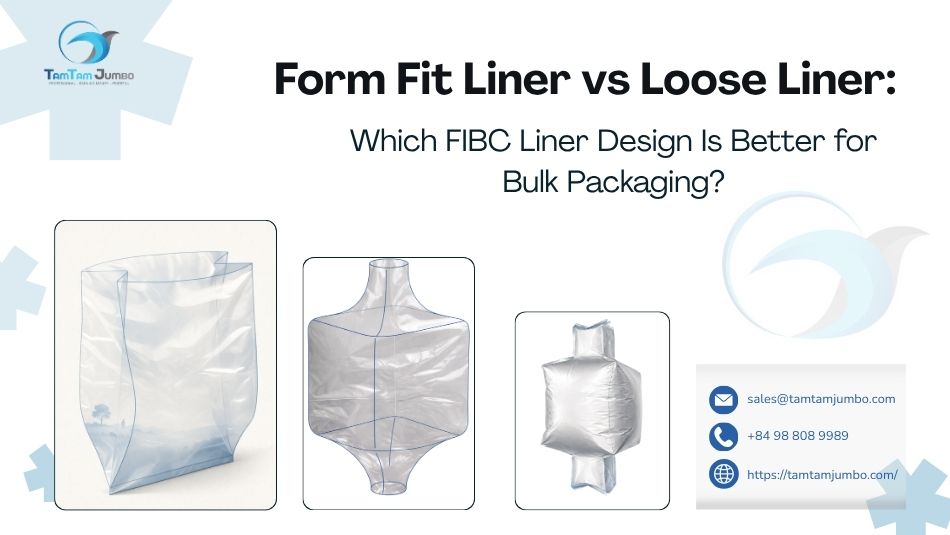
Selecting the correct liner design is one of the most important decisions when sourcing FIBC bags for powder, chemical, food, mineral, or moisture-sensitive products. While the outer bulk bag provides structural strength, the liner plays a critical role in contamination control, moisture protection, discharge efficiency, and overall packaging stability.
Among the most commonly used liner configurations, buyers often compare form fit liner vs loose liner solutions. Both designs are widely used in the FIBC industry, but they perform differently depending on the filling system, product flow characteristics, export conditions, and operational requirements.
This article explains the technical differences between form fit liners and loose liners, including manufacturing structure, performance advantages, limitations, applications, and buyer considerations. The goal is to help importers, distributors, and industrial users select the most suitable liner solution for their packaging operations.
Understanding FIBC Liners
An FIBC liner is an internal polyethylene or barrier film inserted into a bulk bag to protect the packaged material from moisture, contamination, oxygen exposure, or product leakage.
Liners are commonly used for:
- Food ingredients
- Fine powders
- Chemical products
- Pharmaceutical materials
- Hygroscopic products
- Ultra-fine minerals
- Agricultural materials
The liner can either remain loosely inserted inside the bag or be manufactured to match the exact shape of the FIBC body.
This is where the comparison between form fit liner vs loose liner becomes important.
Read more: What is FIBC Liner
What Is a Loose Liner?
A loose liner is a standard tubular or flat polyethylene liner inserted freely inside the FIBC bag without being shaped to the bag dimensions.
The liner is typically attached at the filling spout or fixed lightly at several points.
Key Characteristics of Loose Liners
- Flexible and simple structure
- Lower manufacturing cost
- Easy to produce in large volumes
- Suitable for standard applications
- Available in LDPE, HDPE, EVOH, aluminum barrier, or conductive films
Loose liners are commonly used in standard industrial packaging where exact liner conformity is not critical.
Common Loose Liner Types
Lay Flat Liners
Produced from flat film rolls and inserted manually into the FIBC.
Tubular Liners
Manufactured as continuous tubes without side sealing.
Gusseted Liners
Include side gussets to improve space utilization inside square bags.
What Is a Form Fit Liner?
A form fit liner is engineered to match the exact dimensions and geometry of the FIBC bag. The liner expands together with the bag during filling, minimizing wrinkles, folds, and dead spaces.
Unlike loose liners, form fit liners are shaped specifically for the bag design.
Key Characteristics of Form Fit Liners
- Precisely matched to bag dimensions
- Reduced air pockets and folds
- Better product discharge performance
- Improved pallet stability
- Higher filling efficiency
- Better appearance after filling
Form fit liners are widely used in food-grade, pharmaceutical, and high-value chemical applications.
Form Fit Liner vs Loose Liner: Technical Comparison
| Feature | Form Fit Liner | Loose Liner |
| Shape conformity | Precisely matches bag shape | Freely inserted |
| Filling efficiency | High | Moderate |
| Product discharge | Better flow performance | May create folds |
| Bag appearance | Stable and uniform | Less structured |
| Cost | Higher | Lower |
| Production complexity | More complex | Simpler |
| Dust control | Better | Standard |
| Moisture protection | Excellent | Good |
| Suitable for fine powders | Highly suitable | Acceptable |
| Installation | More controlled | Easier |
Read more: What Are the Difference FIBC Liner Types Used in Bulk Packaging
Why Form Fit Liners Perform Better for Fine Powders
One major advantage in the form fit liner vs loose liner comparison is powder flow behavior.
Fine powders often create operational challenges such as:
- Product retention
- Dust leakage
- Bridging during discharge
- Uneven filling
- Air entrapment
Because form fit liners closely follow the bag geometry, they reduce excess film folds where powders can accumulate.
This creates:
- Cleaner discharge
- Lower product loss
- Better emptying efficiency
- Improved warehouse handling
For industries handling titanium dioxide, carbon black, starch, resin powder, pigments, or specialty chemicals, form fit liners are often preferred.
Advantages of Loose Liners
Despite the technical advantages of form fit liners, loose liners remain widely used across the global FIBC industry.
Lower Packaging Cost
Loose liners are more economical to manufacture due to simpler film conversion and reduced production complexity.
For large-volume commodity products, cost efficiency is often the deciding factor.
Faster Production Lead Time
Standard loose liners can be manufactured quickly in large quantities.
This is important for buyers requiring:
- Urgent export shipments
- Seasonal agricultural packaging
- High-volume industrial supply
Flexibility Across Different Bag Sizes
Loose liners can often fit multiple FIBC dimensions, reducing inventory complexity.
This is useful for distributors and wholesalers managing mixed packaging sizes.
Advantages of Form Fit Liners
Improved Filling Stability
During filling, the liner expands evenly with the bag structure. This reduces deformation and improves stackability.
Better Pallet Performance
A properly fitted liner helps maintain a square bag shape, improving:
- Container loading efficiency
- Warehouse stacking
- Transport stability
Reduced Product Residue
Form fit liners minimize film folds where material can become trapped.
This is especially important for expensive or sensitive products.
Enhanced Hygiene Standards
Food-grade applications often require cleaner discharge and reduced contamination risks.
Form fit liners are widely used for:
- Sugar
- Flour
- Milk powder
- Food additives
- Starch
- Seeds
Manufacturing Considerations for FIBC Liners
At Tam Tam Packaging Co., Ltd, liner selection is usually determined during the early bag engineering stage rather than after bag production.
Several technical factors influence the final liner design:
Product Characteristics
The physical behavior of the product is critical.
Factors include:
- Bulk density
- Moisture sensitivity
- Powder fineness
- Flowability
- Electrostatic properties
Filling Equipment
Different filling systems require different liner constructions.
For example:
- Automatic filling lines often favor form fit liners
- Manual filling systems may use loose liners
Discharge Requirements
Some industries prioritize complete product evacuation to minimize waste.
In these cases, form fit liners generally perform better.
Export Environment
Ocean freight conditions can expose products to:
- Humidity
- Temperature variation
- Condensation
Barrier liners or laminated liners may be integrated into either loose or form fit designs.
Applications by Industry
Food Industry
Preferred liner: Form fit liner
Reasons:
- Better hygiene
- Reduced contamination
- Cleaner discharge
- Improved shape retention
Chemical Industry
Preferred liner: Depends on product
Fine powders usually favor form fit liners, while granular chemicals may use loose liners.
Agriculture
Preferred liner: Loose liner
Agricultural commodities often prioritize packaging cost efficiency.
Pharmaceutical Industry
Preferred liner: Form fit liner
Precise liner performance helps maintain contamination control.
Mineral and Construction Materials
Preferred liner: Loose liner
Most coarse materials do not require advanced liner conformity.
Common Buyer Mistakes When Selecting FIBC Liners
Focusing Only on Price
Lower-cost liners may increase operational losses if discharge efficiency is poor.
Ignoring Product Flow Behavior
Some powders behave differently during transport and discharge than during laboratory testing.
Using Standard Liners for Fine Powders
Loose liners may create retention zones in ultra-fine powder applications.
Overlooking Filling Line Compatibility
The liner design must match the filling and discharge systems.
How to Choose Between Form Fit Liner vs Loose Liner
Choose Form Fit Liners If:
- You handle fine powders
- Product cleanliness is critical
- You require better discharge performance
- You need better pallet stability
- Product value is high
Choose Loose Liners If:
- Cost efficiency is the priority
- You package granular products
- Your operation uses manual filling
- Standard moisture protection is sufficient
- You require faster production lead times
FAQ
What is the main difference between form fit liner vs loose liner?
A form fit liner is manufactured to match the exact shape of the FIBC bag, while a loose liner is freely inserted without precise shaping.
Are form fit liners more expensive?
Yes. Form fit liners typically cost more due to additional film conversion and shaping processes.
Which liner type is better for fine powders?
Form fit liners are generally better for fine powders because they reduce wrinkles and improve discharge efficiency.
Can loose liners provide moisture protection?
Yes. Loose liners can still provide strong moisture resistance depending on the liner material and thickness.
Are form fit liners required for food-grade FIBCs?
Not always, but many food-grade applications prefer form fit liners for improved hygiene and cleaner discharge performance.
Conclusion
The decision between form fit liner vs loose liner depends on far more than packaging cost alone. Product characteristics, discharge efficiency, hygiene requirements, filling systems, and export conditions all influence liner performance.
Loose liners remain a practical and economical solution for many industrial applications, especially for granular or lower-value products. Form fit liners, however, offer measurable advantages in powder handling, pallet stability, cleanliness, and operational efficiency.
For industrial buyers sourcing FIBC packaging internationally, evaluating the liner structure during the packaging design stage can reduce product loss, improve filling performance, and enhance supply chain reliability.
Tam Tam Packaging Co., Ltd manufactures customized FIBC bags and liner solutions for food, chemical, agricultural, and industrial applications. Our production team works closely with buyers to develop liner configurations based on product behavior, filling systems, and export requirements.
For technical consultation, custom specifications, or export packaging support, contact our team directly.
Contact Us
Tam Tam Packaging Co., Ltd
Email: sales@tamtamjumbo.com
Website: tamtamjumbo.com
Read more
FIBC Bags for Flour: Why Allergen Status Change the Specification
Flour shares the fine-particle and combustible dust characteristics of other food powders, but wheat’s status...
Aug
FIBC Bag for Starch Powder: Dustproof Bag Needs Antistatic
Starch powder occupies an unusual position in FIBC specification: it is a common food and...
Aug
FIBC Bags for Animal Feed: What Actually Makes a Clean Bulk Bag
FIBC bags for animal feed mean something more specific than a bag that looks unused....
Aug
FIBC Bag for PET Flakes: Why UV Resistance Matter More Than It
Recycled PET flakes share a base polymer with virgin resin pellets, but the two behave...
Aug
FIBC Bags for Plastic Resin: PP Fabric Packaging PP Pellets
There is a certain irony in shipping polypropylene resin pellets inside a bag woven from...
Aug

FIBC Bags for the Food Industry: Building a Food Grade Bag
Food manufacturers sourcing bulk ingredient packaging are working from a different starting point than a...
Aug