

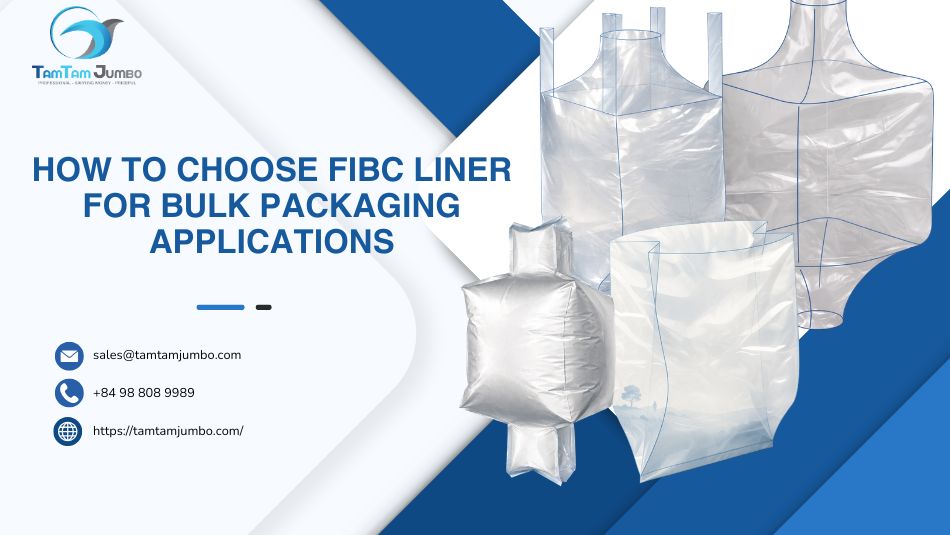
Selecting the correct liner for a bulk bag directly affects product protection, filling efficiency, discharge performance, and shipment reliability. An unsuitable liner can lead to moisture contamination, leakage, static issues, product waste, or handling difficulties during transport and storage.
This article explains how to choose FIBC liner solutions based on material characteristics, industry requirements, filling methods, and export conditions. It also compares common liner types, outlines technical considerations, and highlights practical recommendations from bulk packaging manufacturing experience.
At Tam Tam Packaging Co., Ltd, FIBC liners are developed alongside the bulk bag structure to ensure compatibility between the liner and the outer bag. This integrated manufacturing approach helps improve filling stability, transportation safety, and product protection for industrial bulk packaging applications.
Understanding the Role of an FIBC Liner
An FIBC liner is an inner plastic layer installed inside a FIBC bag to provide additional protection against moisture, contamination, oxygen, vapor transmission, and product leakage.
Linings are commonly used for:
- Fine powders
- Hygroscopic materials
- Food ingredients
- Chemical products
- Pharmaceutical materials
- High-purity industrial products
The liner acts as a barrier between the packaged material and the woven polypropylene outer bag.
Why Many Bulk Products Require a Liner
Standard woven polypropylene fabric contains micro gaps between tapes. While suitable for many dry bulk products, certain materials require a higher protection level.
A liner helps to:
- Prevent moisture ingress
- Reduce product leakage
- Protect against external contamination
- Improve oxygen barrier performance
- Maintain product purity
- Improve discharge efficiency
- Reduce material residue inside the bag
Industries such as food processing, chemicals, agriculture, and minerals often specify liner requirements in procurement documents and packaging standards.
Main Factors to Consider When Choosing an FIBC Liner
Product Characteristics
The first step in how to choose FIBC liner solutions is understanding the material being packed.
Particle Size
Fine powders require better sealing performance than granular products.
Examples:
- Titanium dioxide
- Carbon black
- Cement additives
- Fine chemicals
- Flour and starch powders
Very fine products may require:
- Form-fit liners
- High-seal liners
- Anti-sifting construction
Moisture Sensitivity
Moisture-sensitive materials require liners with strong vapor barrier performance.
Examples:
- Fertilizers
- Food powders
- Resins
- Pharmaceutical ingredients
- Specialty chemicals
For export shipments through humid environments or long ocean transit routes, barrier liners become especially important.
Flow Characteristics
Some products discharge easily, while others bridge or cling to surfaces.
Poor-flowing products may benefit from:
- Smooth-wall liners
- Form-fit liners
- Conductive liners
- Anti-static liners
Filling and Discharge Method
The filling system affects liner design selection.
Manual Filling
Manual operations generally allow greater liner flexibility and simpler insertion methods.
Automated Filling Systems
Automated production lines require:
- Stable liner positioning
- Consistent dimensions
- Controlled spout alignment
- Better dimensional accuracy
Form-fit liners are commonly preferred for automated filling systems.
Discharge Equipment
Discharge design must match:
- Hopper systems
- Valve systems
- Gravity discharge systems
- Pneumatic conveying systems
Incorrect liner configuration can cause:
- Material bridging
- Uneven discharge
- Product retention
- Worker handling difficulties
Common FIBC Liner Types
Loose Liners
Loose liners are inserted independently inside the bulk bag without being attached to the outer body.
Characteristics
- Lower production cost
- Flexible installation
- Suitable for standard products
- Easy replacement
Applications
- Agricultural products
- Standard powders
- Non-sensitive materials
Limitations
Loose liners may shift during filling or transportation, especially in high-speed filling operations.
Form-Fit Liners
Form-fit liners are shaped to match the internal dimensions of the FIBC bag.
Characteristics
- Better shape stability
- Improved discharge efficiency
- Reduced air pockets
- Better pallet stability
Applications
- Food ingredients
- Fine chemicals
- Pharmaceutical materials
- Export packaging
Manufacturing Considerations
Form-fit liners require tighter dimensional control during production. The liner and outer bag must be designed together for proper compatibility.
Baffle Liners
Baffle liners are used in conjunction with baffle bulk bags to maintain a square shape and improve container utilization.
Advantages
- Better stacking stability
- Improved warehouse efficiency
- Higher container loading efficiency
Common Industries
- Petrochemical products
- Food powders
- Plastic resins
Aluminum Foil Liners
Aluminum liners provide enhanced barrier performance for moisture-sensitive or oxygen-sensitive materials.
Typical Structure
These liners often use a multilayer construction combining:
- Aluminum foil
- PE film
- Barrier layers
Applications
- Specialty chemicals
- High-value powders
- Pharmaceutical ingredients
- Sensitive food products
Key Benefit
Excellent protection against:
- Oxygen
- UV exposure
- Moisture vapor
Read more: What Are the Difference FIBC Liner Types Used in Bulk Packaging
Comparing Form-Fit Liners and Loose Liners
| Feature | Form-Fit Liner | Loose Liner |
| Shape Stability | High | Moderate |
| Filling Efficiency | Excellent | Standard |
| Cost | Higher | Lower |
| Product Protection | Better | Moderate |
| Discharge Performance | Better | Standard |
| Automated Filling Compatibility | Excellent | Limited |
| Installation Complexity | Higher | Simpler |
| Container Stability | Better | Standard |
Material Options for FIBC Liners
Polyethylene (PE) Liners
PE liners are the most common option for bulk bag applications.
Advantages
- Good moisture resistance
- Cost-effective
- Flexible
- Widely available
Typical Applications
- Food ingredients
- Fertilizers
- Minerals
- Industrial powders
EVOH Barrier Liners
EVOH liners provide improved oxygen barrier properties.
Suitable For
- Sensitive food products
- Specialty chemicals
- Oxidation-sensitive materials
Anti-Static Liners
Some materials generate an electrostatic charge during filling or discharge.
Anti-static liners help reduce electrostatic risks in hazardous environments.
Common Industries
- Chemicals
- Solvent powders
- Explosive dust environments
Industry-Specific Recommendations
Food Industry
Food-grade liners should provide:
- FDA or food-contact compliance
- Hygienic production conditions
- Moisture protection
- Contamination prevention
Recommended options:
- Form-fit PE liners
- Aluminum barrier liners for sensitive products
Chemical Industry
Chemical applications often require:
- Chemical resistance
- Static control
- Moisture protection
Recommended options:
- Anti-static liners
- Multilayer barrier liners
Agricultural Products
Agricultural bulk materials typically focus on:
- Cost efficiency
- Moisture protection
- Shipment durability
Recommended options:
- Standard PE liners
- Loose liners for commodity products
Technical Questions Buyers Should Ask Before Ordering
When evaluating suppliers, buyers should confirm:
- What liner material is used?
- Is the liner food-grade certified?
- What liner thickness is recommended?
- Is the liner loose or form-fit?
- Is the liner attached to the outer bag?
- What moisture barrier properties are available?
- Can the liner support automated filling systems?
- Is anti-static protection required?
- Are export packaging conditions considered?
These details affect both packaging performance and total logistics cost.
Manufacturing Considerations for Export Markets
From a manufacturing perspective, liner quality depends heavily on process consistency.
Important production factors include:
- Film extrusion quality
- Thickness consistency
- Seal integrity
- Dimensional accuracy
- Cleanroom standards for food applications
- Static control during manufacturing
At Tam Tam Packaging Co., Ltd, liner compatibility is evaluated alongside bulk bag construction to improve filling performance and shipment stability. Coordinating liner design with lifting loops, filling spouts, discharge systems, and bag dimensions helps reduce operational issues during industrial use.
Common Mistakes When Selecting FIBC Liners
Selecting Based Only on Price
Low-cost liners may create larger downstream losses due to:
- Product contamination
- Leakage
- Shipment rejection
- Filling inefficiency
Ignoring Filling Conditions
A liner suitable for manual filling may not perform properly on automated systems.
Using Incorrect Barrier Properties
Moisture-sensitive materials require proper barrier evaluation based on shipping conditions and storage duration.
Poor Dimensional Matching
Improper liner sizing can cause:
- Wrinkling
- Collapse during filling
- Uneven discharge
- Reduced bag stability
FAQ
What is the difference between a liner and a coated FIBC fabric?
Coated woven fabric adds a thin PP coating to the outer bag fabric, while a liner is a separate internal layer providing stronger moisture and contamination protection.
Which liner is best for food-grade bulk bags?
Form-fit PE liners are commonly used for food products because they improve hygiene, discharge efficiency, and moisture protection.
Are aluminum liners necessary for all sensitive products?
Not always. Aluminum liners are typically used for products requiring high oxygen and moisture barrier performance.
Can FIBC liners be customized?
Yes. Liners can be customized by:
- Thickness
- Shape
- Material structure
- Spout design
- Barrier properties
- Attachment method
How do I know if I need an anti-static liner?
Anti-static liners are recommended when handling powders or chemicals that generate static electricity in potentially hazardous environments.
Conclusion
Understanding how to choose FIBC liner solutions requires evaluating the product itself, transportation conditions, filling systems, discharge requirements, and industry regulations. The correct liner improves product protection, operational efficiency, and shipment reliability throughout the supply chain.
Bulk packaging performance depends not only on the outer FIBC structure but also on how well the liner integrates with the overall bag design. Factors such as liner shape, material composition, sealing performance, and dimensional compatibility all contribute to packaging stability during export handling and industrial use.
Tam Tam Packaging Co., Ltd manufactures FIBC bags and liner-integrated bulk packaging solutions for industrial applications requiring moisture protection, contamination control, and export-grade durability.
Contact Us
Tam Tam Packaging Co., Ltd
Email: sales@tamtamjumbo.com
Website: tamtamjumbo.com
Read more
FIBC Bags for Flour: Why Allergen Status Change the Specification
Flour shares the fine-particle and combustible dust characteristics of other food powders, but wheat’s status...
Aug
FIBC Bag for Starch Powder: Dustproof Bag Needs Antistatic
Starch powder occupies an unusual position in FIBC specification: it is a common food and...
Aug
FIBC Bags for Animal Feed: What Actually Makes a Clean Bulk Bag
FIBC bags for animal feed mean something more specific than a bag that looks unused....
Aug
FIBC Bag for PET Flakes: Why UV Resistance Matter More Than It
Recycled PET flakes share a base polymer with virgin resin pellets, but the two behave...
Aug
FIBC Bags for Plastic Resin: PP Fabric Packaging PP Pellets
There is a certain irony in shipping polypropylene resin pellets inside a bag woven from...
Aug
FIBC Bags for the Food Industry: Building a Food Grade Bag
Food manufacturers sourcing bulk ingredient packaging are working from a different starting point than a...
Aug