

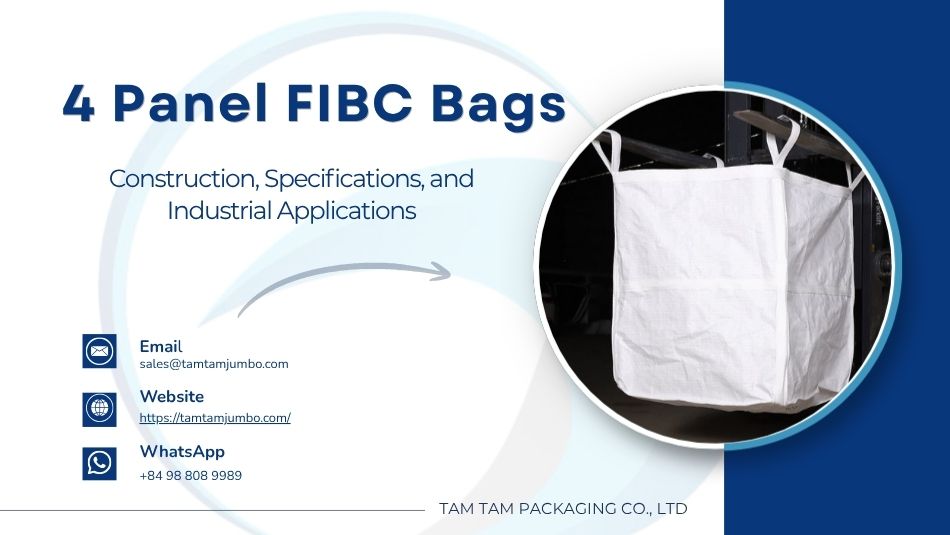
The way an FIBC bag is cut and sewn has a direct effect on how it fills, stacks, and holds its shape under load. 4 panel FIBC bags are built from four separate fabric panels stitched at the corners rather than from a single circular tube, and that construction choice shows up in almost every line of the bulk bag specification, from fabric usage to load distribution. This article explains what a 4 panel construction actually involves, how it compares to circular and U-panel designs, and which specification details buyers should confirm before committing to this bag type.
What a 4 Panel Construction Actually Means
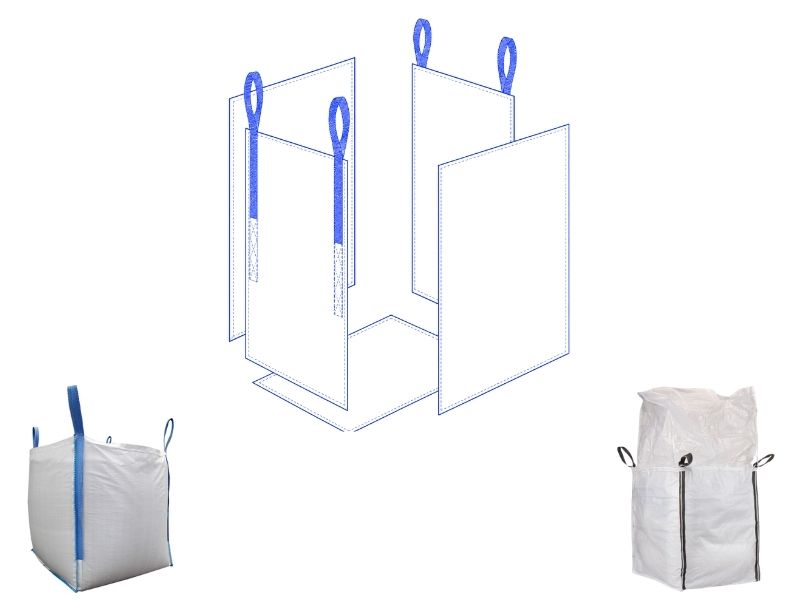
A 4 panel FIBC bags is assembled from four rectangular fabric pieces, one for each side, sewn together along four vertical corner seams. This is different from a circular woven bag, which is extruded as a continuous tube on a circular loom with no vertical body seams, and from a U-panel bag, which uses a single U-shaped piece for the base and two sides plus two separate side panels. The 4 panel method uses flat, individually cut fabric pieces, giving the manufacturer more control over panel dimensions and corner reinforcement, but it also introduces four seams that must be sewn to the correct strength.
Because each panel is cut to a set width and height, a 4 panel bag holds a more consistent square or rectangular shape once filled, compared to the rounder profile typical of circular woven construction.
How 4 Panel Bags Compare to Circular Woven Bags
Fabric Usage and Seam Placement
Circular FIBC bags use less fabric per unit and require fewer seams, since the body is a single tube. 4 panel bags use more fabric relative to volume because of the flat-cut layout, and the four corner seams need to be engineered to the bag’s rated safe working load. This generally makes 4 panel construction somewhat more material and labor intensive, which is reflected in unit cost.
Shape Stability When Filled
The corner seams in a 4 panel bag act as structural creases that hold the bag close to a cube shape when filled, which improves stacking efficiency on pallets and inside containers. Circular bags tend to bulge outward at the middle when filled, which can leave more unused space during container loading. For buyers optimizing container utilization, this difference in fill geometry is often the deciding factor over price alone.
Reading a Bulk Bag Specification Sheet
A bulk bag specification sheet should describe the finished bag precisely enough that two different factories could reproduce it identically. For a 4 panel bag, the specification needs to go beyond overall dimensions and include panel-level detail, since the construction method affects strength and fit in ways a generic size listing does not capture.
Key Specification Fields Buyers Should Confirm
- Safe working load (SWL) and the safety factor applied, typically 5:1 or 6:1 depending on end use.
- Fabric weight and denier for the body panels, base, and top.
- Filled dimensions, including width, length, and height, which for a 4 panel bag correspond directly to panel cut size.
- Loop type, loop width, and loop loading angle, since 4 panel bags commonly use cross-corner or four-loop configurations tied into the panel seams.
- Liner type, if the cargo requires moisture or contamination barrier protection.
- Filling spout and discharge spout specifications, including diameter and closure method.
- UN rating, if the bag will carry dangerous goods, since this adds specific fabric and seam requirements on top of the standard construction.
A specification missing any of these fields leaves room for a factory to substitute materials or dimensions that technically match the description but not the buyer’s actual requirement.
Load Distribution and Stacking Behavior in 4 Panel Bags
Because load is carried through four distinct corner seams rather than distributed around a continuous circular wall, the seam strength specification matters more in a 4 panel design than in circular construction. A well-specified 4 panel bag distributes filled weight evenly across all four panels and the base, keeping the bag square during transport and reducing the risk of leaning or toppling during multi-layer stacking. Buyers moving product by sea freight, where bags are commonly double or triple stacked inside a container, tend to favor this stability over the material savings of a circular design.
When to Choose 4 Panel Over Circular or U-Panel Construction
4 panel construction tends to make sense when container space efficiency matters more than unit cost, when the product benefits from a consistent block shape for warehouse stacking, or when the cargo is dense enough that seam strength under sustained compressive load is a priority. Circular bags remain a practical choice for lighter, less dense materials where cost efficiency outweighs the benefits of a squared profile. U-panel construction sits between the two, offering some of the shape control of 4 panel bags with fewer seams to engineer.
How Tam Tam Packaging Builds 4 Panel Bags to Spec
Tam Tam Packaging produces 4 panel FIBC bags to a buyer-defined specification rather than a fixed catalog size, cutting panels to the exact dimensions needed for the target fill volume and reinforcing corner seams to match the rated safe working load. Every specification sheet issued for a 4 panel order includes panel dimensions, fabric weight, loop configuration, and base construction, so the buyer can verify the finished bags against the agreed specification before shipment rather than after the goods have already been packed and moved.
Read more: How to Lift FIBC Bags Safely
Common Specification Mistakes That Cause Fit or Performance Issues
- Specifying overall bag dimensions without confirming individual panel cut sizes, which can result in an unexpected filled shape.
- Underestimating the fabric weight needed for the four corner seams relative to a circular design at the same safe working load.
- Choosing a loop configuration that does not match the lifting equipment used at the filling or discharge site.
- Omitting liner requirements from the initial specification requires a mid-production change that delays the order.
- Assuming a 4 panel bag from one factory will match the stacking behavior of a 4 panel bag from another without confirming seam strength and fabric specification.
Applications Industry in Agriculture
4 panel FIBC bags are common in agricultural bulk handling, where grains, seeds, fertilizers, and animal feed benefit from the squared, stable profile these bags hold once filled. The consistent block shape makes warehouse stacking and forklift handling more predictable at grain storage and processing facilities, and the stronger corner seams support the repeated loading and unloading cycles typical of seasonal harvest operations. Fertilizer producers in particular often specify 4 panel construction combined with a liner to protect hygroscopic products from moisture during storage between harvest seasons.
Frequently Asked Questions
What makes a 4 panel FIBC bag different from a standard bulk bag?
It is built from four separate fabric panels sewn at the corners rather than a single circular tube, which gives the bag a more consistent square shape once filled.
Are 4 panel bags stronger than circular woven bags?
Strength depends on the specification rather than the construction type alone, but the corner seams in a well-specified 4 panel bag distribute load in a way that supports stable multi-layer stacking.
Do 4 panel bags cost more than circular bags?
Generally yes, due to higher fabric usage and additional seam labor, though the improved container fill efficiency can offset part of that cost on large orders.
What details should be included in a bulk bag specification for a 4 panel bag?
Panel dimensions, fabric weight, loop configuration, base construction, safe working load, safety factor, liner requirements, and spout details.
Can 4 panel bags be UN rated for dangerous goods?
Yes, provided the specific 4 panel construction has been tested and approved under the UN Model Regulations for the intended packing group and weight.
Conclusion
4 panel FIBC bags offer a more predictable fill shape and stacking behavior than circular construction, but that benefit only holds if the bulk bag specification accounts for panel dimensions, seam strength, and loop configuration in detail. Buyers who confirm these fields before ordering avoid the fit and stability issues that surface only after the bags are in use.
Tam Tam Packaging Co. manufactures 4 panel FIBC bags to a buyer-defined specification, with full documentation on panel dimensions, fabric weight, and load rating for every order. Contact our team to confirm the right specification for your product.
Contact Us
Tam Tam Packaging Co.
Email: sales@tamtamjumbo.com
Website: https://tamtamjumbo.com/
Read more

FIBC Bags for Flour: Why Allergen Status Change the Specification
Flour shares the fine-particle and combustible dust characteristics of other food powders, but wheat’s status...
Aug
FIBC Bag for Starch Powder: Dustproof Bag Needs Antistatic
Starch powder occupies an unusual position in FIBC specification: it is a common food and...
Aug
FIBC Bags for Animal Feed: What Actually Makes a Clean Bulk Bag
FIBC bags for animal feed mean something more specific than a bag that looks unused....
Aug
FIBC Bag for PET Flakes: Why UV Resistance Matter More Than It
Recycled PET flakes share a base polymer with virgin resin pellets, but the two behave...
Aug
FIBC Bags for Plastic Resin: PP Fabric Packaging PP Pellets
There is a certain irony in shipping polypropylene resin pellets inside a bag woven from...
Aug
FIBC Bags for the Food Industry: Building a Food Grade Bag
Food manufacturers sourcing bulk ingredient packaging are working from a different starting point than a...
Aug