

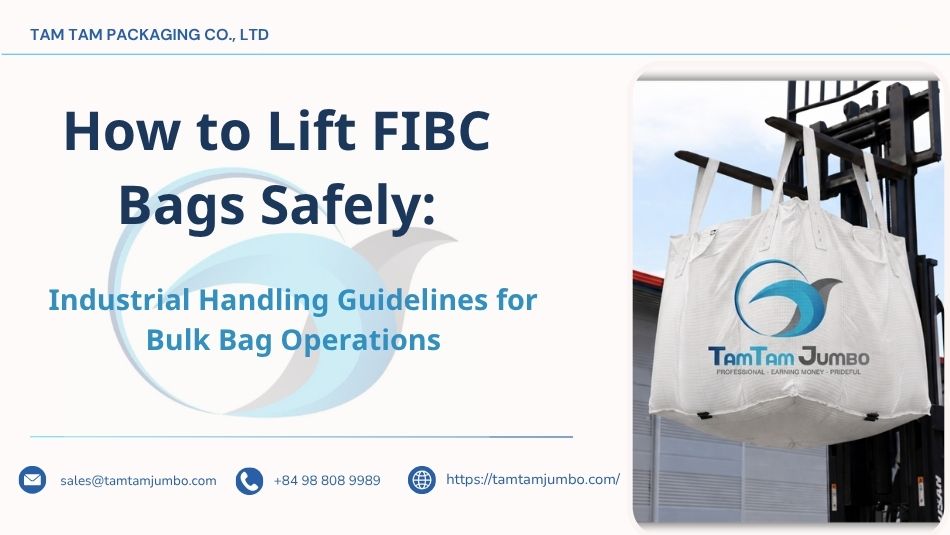
FIBC bags are designed to transport large volumes of bulk materials efficiently, but safe handling remains one of the most critical aspects of bulk packaging operations.
A fully loaded FIBC bag can weigh between 500 kg and 2000 kg or more. Improper lifting methods can lead to:
- Product loss
- Equipment damage
- Workplace injuries
- Bag failure
- Operational downtime
Many industrial accidents involving bulk bags are not caused by the bag itself, but by incorrect lifting procedures and unsuitable handling equipment.
At Tam Tam Packaging Co., lifting safety is one of the most important technical discussions during FIBC development for export customers. The lifting method must always match:
- Bag construction
- Loop configuration
- Handling equipment
- Product weight
- Operational environment
This guide explains how to lift FIBC bags safely, including best practices, common mistakes, equipment recommendations, and practical considerations from a manufacturing perspective.
What Does Safe FIBC Lifting Mean?
Safe FIBC lifting refers to the proper handling of bulk bags using approved lifting methods, equipment, and operational procedures that prevent:
- Structural overload
- Loop damage
- Bag instability
- Workplace accidents
Simple Definition
Safe FIBC lifting means handling bulk bags according to their designed lifting configuration, Safe Working Load (SWL), and manufacturer instructions.
Safe lifting is not only about the bag itself. It also depends on:
- Forklift condition
- Operator training
- Hook design
- Loop positioning
- Load stability
Understanding FIBC Safe Working Load (SWL)
Before lifting any FIBC bag, operators must verify the Safe Working Load.
SWL indicates the maximum weight the bag is designed to carry safely.
Common SWL ratings include:
- 500 kg
- 1000 kg
- 1250 kg
- 1500 kg
- 2000 kg
Most industrial FIBC bags are manufactured with:
- 5:1 safety factor for single-trip use
- 6:1 safety factor for multi-trip use
Important Manufacturing Insight
The safety factor does not mean operators should overload the bag.
Overloading increases:
- Seam stress
- Loop fatigue
- Risk of sudden failure
Inspect the FIBC Before Lifting
One of the most overlooked safety procedures is pre-use inspection.
Before lifting:
- Check lifting loops for damage
- Inspect seams and stitching
- Look for cuts or abrasions
- Verify bag labels and SWL
- Confirm discharge spouts are closed properly
Damaged bags should never be lifted.
Safe Lifting Methods for FIBC Bags
Lifting with Forklifts
Forklifts are the most common equipment used for handling FIBC bags.
Correct Forklift Practices
Use Proper Forklift Capacity
The forklift must be rated to support:
- Bag weight
- Dynamic movement
- Handling height
An undersized forklift creates serious operational risks.
Keep Forklift Tines Smooth and Rounded
Sharp edges can cut lifting loops during movement.
Forklift tines should:
- Have rounded edges
- Be free from protrusions
- Use protective sleeves if necessary
Several industry guidelines recommend rounded edges with at least a 5 mm radius.
Space Forklift Tines Correctly
Incorrect tine spacing can:
- Twist lifting loops
- Create uneven load distribution
- Damage the bag structure
The tines should match the lifting loop width and remain evenly positioned.
Lift Smoothly
FIBC bags should be raised and lowered gradually.
Avoid:
- Sudden jerking
- Rapid acceleration
- Abrupt stopping
Jerking movements create excessive stress on loops and seams.
Lifting with Cranes or Hoists
Crane lifting is common in:
- Construction sites
- Mining operations
- Port facilities
- Industrial manufacturing
Best Practices for Crane Handling
Use Rounded Hooks
Hooks should:
- Be smooth
- Have protective surfaces
- Include safety latches when possible
Sharp hooks can damage lifting loops.
Keep Loops Vertical
Twisted or angled loops create uneven stress distribution.
All lifting loops should:
- Remain vertical
- Stay untwisted
- Be equally tense
Use All Lift Loops
Never lift an FIBC using fewer loops than designed.
For example:
- 4-loop bags must use all 4 loops
- Single-point lifting should only be used for bags specifically designed for it
Common Mistakes When Lifting FIBC Bags
Lifting with One Loop
This is one of the most dangerous handling errors.
Unless the bag is specifically engineered for single-point lifting:
- Never gather all loops onto one hook
- Never lift using only one loop
This creates extreme stress concentration.
Dragging the Bag
FIBC bags should never be dragged across the floor.
Dragging can:
- Damage fabric
- Weaken seams
- Cause loop abrasion
Lifting Damaged Bags
Even small cuts or stitching damage can reduce load capacity significantly.
A damaged bag should be removed from operation immediately.
Standing Under Suspended Bags
Personnel should never stand beneath a suspended FIBC bag.
This is one of the most important industrial safety rules.
How Loop Design Affects Lifting Safety
Different loop designs require different handling methods.
Read more: FIBC Lifting Loop Types Bags
| Loop Type | Recommended Equipment | Safety Consideration |
| Cross Corner Loops | Forklift | Ensure correct tine spacing |
| Side Seam Loops | Forklift / Crane | Maintain vertical lifting |
| Tunnel Lift | Forklift | Verify tunnel dimensions |
| Single Loop | Hook Systems | Use only the approved lifting method |
| Sling Bags | Crane / Forklift | Check sling alignment |
Incorrect handling for a specific loop type can damage the bag structure.
Load Stability During Lifting
Proper load stability is critical for safe transport.
Avoid Off-Center Loading
Uneven filling can cause:
- Bag tilting
- Swinging during lifting
- Structural imbalance
Manufacturers should design filling systems that distribute material evenly.
Maintain Proper Height-to-Width Ratio
Overfilled bags become unstable.
Industry handling guidelines recommend maintaining stable bag geometry during lifting and storage.
Environmental Considerations
Environmental conditions also affect lifting safety.
UV Exposure
Long-term sunlight exposure weakens polypropylene fabric.
Outdoor storage without UV protection may reduce lifting performance over time.
Moisture and Contamination
Water exposure can:
- Affect product quality
- Increase bag weight
- Damage to liners and stitching
Proper storage is essential before lifting operations.
Manufacturing Experience: Why Bag Quality Matters
At Tam Tam Packaging Co., safe lifting performance depends heavily on manufacturing quality.
Critical production factors include:
- Webbing tensile strength
- Stitching accuracy
- Loop reinforcement
- Fabric consistency
- Load testing procedures
Low-cost bags may appear visually similar but can perform very differently under lifting stress.
For export-oriented operations, lifting safety should never be treated as a secondary specification.
Best Practices Checklist for Safe FIBC Lifting
Before lifting any FIBC bag:
- Verify SWL and safety factor
- Inspect loops and seams
- Use compatible lifting equipment
- Keep loops vertical and untwisted
- Use all designated lifting points
- Lift gradually without jerking
- Keep personnel away from suspended loads
- Avoid dragging bags
- Confirm forklift and crane capacity
- Follow the manufacturer handling instructions
Quick Summary
Safe lifting of FIBC bags requires:
- Correct lifting equipment
- Proper loop handling
- Stable load distribution
- Compliance with SWL limits
- Routine bag inspection
The most common lifting risks include:
- Overloading
- Twisted loops
- Sharp forklift edges
- Uneven lifting
- Improper hook use
Safe handling improves:
- Workplace safety
- Bag lifespan
- Operational efficiency
- Product protection
FAQ
How should FIBC bags be lifted safely?
FIBC bags should be lifted using all designated lifting loops with approved forklifts, cranes, or hoists while keeping loops vertical and untwisted.
Can FIBC bags be lifted with one loop?
Only if the bag is specifically designed for single-point lifting. Standard 4-loop bags should use all loops.
Why should forklift tines have rounded edges?
Sharp edges can cut or damage lifting loops during handling.
Is it safe to stand under a suspended FIBC bag?
No. Personnel should never stand beneath suspended bulk bags.
What is the most common cause of FIBC lifting accidents?
Improper lifting methods, overloaded bags, damaged loops, and unsuitable handling equipment are among the most common causes.
Conclusion
Understanding how to lift FIBC bags safely is essential for industrial bulk handling operations.
Safe lifting depends on more than bag strength alone. It requires:
- Proper equipment
- Correct lifting techniques
- Suitable loop configurations
- Operational discipline
- High manufacturing quality
Well-designed FIBC bags combined with proper handling procedures help reduce operational risk while improving logistics efficiency and workplace safety.
Contact Us
Tam Tam Packaging Co.
Email: sales@tamtamjumbo.com
Website: https://tamtamjumbo.com/
Read more

FIBC Bags for Flour: Why Allergen Status Change the Specification
Flour shares the fine-particle and combustible dust characteristics of other food powders, but wheat’s status...
Aug
FIBC Bag for Starch Powder: Dustproof Bag Needs Antistatic
Starch powder occupies an unusual position in FIBC specification: it is a common food and...
Aug

FIBC Bags for Animal Feed: What Actually Makes a Clean Bulk Bag
FIBC bags for animal feed mean something more specific than a bag that looks unused....
Aug

FIBC Bag for PET Flakes: Why UV Resistance Matter More Than It
Recycled PET flakes share a base polymer with virgin resin pellets, but the two behave...
Aug

FIBC Bags for Plastic Resin: PP Fabric Packaging PP Pellets
There is a certain irony in shipping polypropylene resin pellets inside a bag woven from...
Aug
FIBC Bags for the Food Industry: Building a Food Grade Bag
Food manufacturers sourcing bulk ingredient packaging are working from a different starting point than a...
Aug