

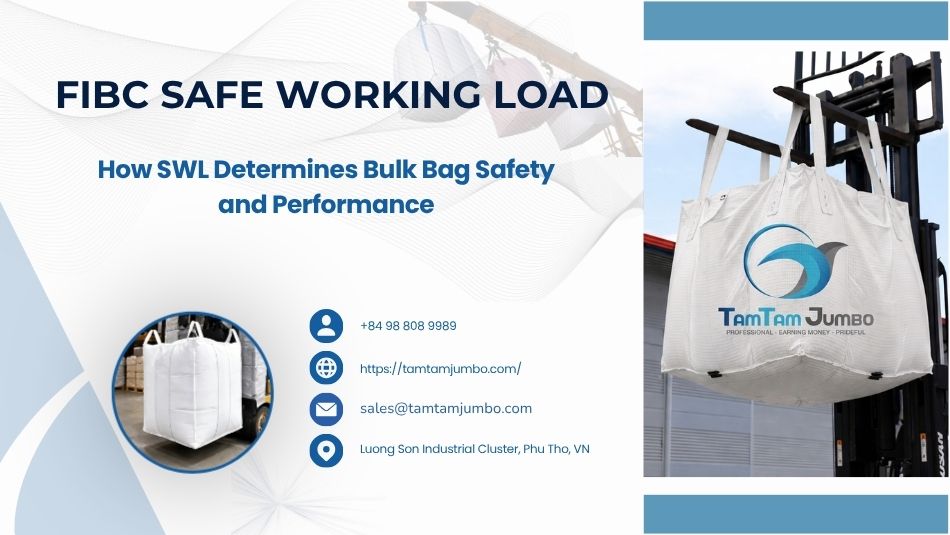
A big bag advertised as a 1000kg bag is not tested to break at 1000kg, and it should never be loaded anywhere near its actual failure point during normal use. Safe working load is the maximum fill weight a bag is rated to carry under normal operating conditions, calculated with a safety margin built in specifically so the bag never operates near its true breaking strength. This guide explains what that rating means, how it is calculated and tested, and what buyers should check before treating a bag’s advertised capacity as a straightforward number.
What Safe Working Load Means for FIBC Bags
FIBC safe working load, commonly abbreviated SWL, is the maximum weight a bag is certified to carry repeatedly under normal filling, lifting, transport, and stacking conditions. It is not the weight at which the bag fails. SWL is deliberately set well below a bag’s actual breaking strength, using a safety factor that accounts for handling variability, wear over the bag’s service life, and dynamic forces during lifting that exceed the static weight of the contents.
Why a 1000kg Bag Isn’t Rated to Carry Exactly 1000kg
When a supplier describes a big bag as a 1000kg bag, they are describing its safe working load, the intended fill weight for normal use, not the point at which the bag would actually fail. The bag’s real breaking strength is engineered to be several times higher than this figure, specifically so that normal handling stresses, which can momentarily exceed the static fill weight during lifting or transport, stay well within the bag’s actual capacity.
The Safety Factor: 5:1 and 6:1 Explained
The safety factor is the ratio between a bag’s tested breaking strength and its rated safe working load. A 5:1 safety factor means the bag is engineered to withstand roughly five times its rated SWL before failure, while a 6:1 factor provides a larger margin still.
Single-Trip (5:1) Bags
A 5:1 safety factor is the standard requirement for single-trip bags, meaning the bag is intended to be filled, transported, and discharged once before disposal or recycling. This is the most common safety factor for standard industrial and commodity bulk bags.
Multi-Trip (6:1) Bags
Bags intended for repeated use over multiple fill and discharge cycles are generally required to meet a 6:1 safety factor, providing additional margin to account for cumulative wear across the bag’s extended service life. Buyers planning to reuse bags should confirm the safety factor matches multi-trip requirements rather than assuming a standard single-trip bag is adequate for repeated use.
Read more: FIBC Bag GSM Guide: How Fabric Weight Determines Strength
How FIBC Safe Working Load Is Tested
SWL testing follows a defined sequence, typically referencing ISO 21898, including a top lift test where the bag is filled to its rated capacity and suspended by its loops, a drop test simulating impact during handling, and a cyclic top lift test for multi-trip bags to simulate repeated use. Testing confirms the complete bag construction, fabric, seams, and loops together, rather than any single component in isolation, meets the required safety factor at the stated fill weight.
Read more: Bulk Bag Stitching Types: How Sewing Machine Choice Affects Seam
What Affects a Bag’s Actual SWL Rating
Fabric GSM and Weave
Fabric weight and weave density contribute directly to tensile strength, but as covered in detail elsewhere, GSM alone does not determine SWL without also accounting for weave quality and tape yarn strength.
Seam and Stitch Type
Seams are typically the first failure point under load, so stitch type, thread specification, and seam construction at the base and body panels all directly affect the tested SWL a bag can achieve, independent of fabric strength alone.
Loop Configuration
Loop type and anchoring method determine how load transfers from the lifting point through the bag body, and a loop configuration mismatched to the bag’s fill weight can become the limiting factor in SWL even when fabric and seams are rated higher.
Read more: Cross Corner FIBC Bags: Comparing and Choosing Loop Types Fits
Reading an SWL Rating on a Specification Sheet or Bag Label
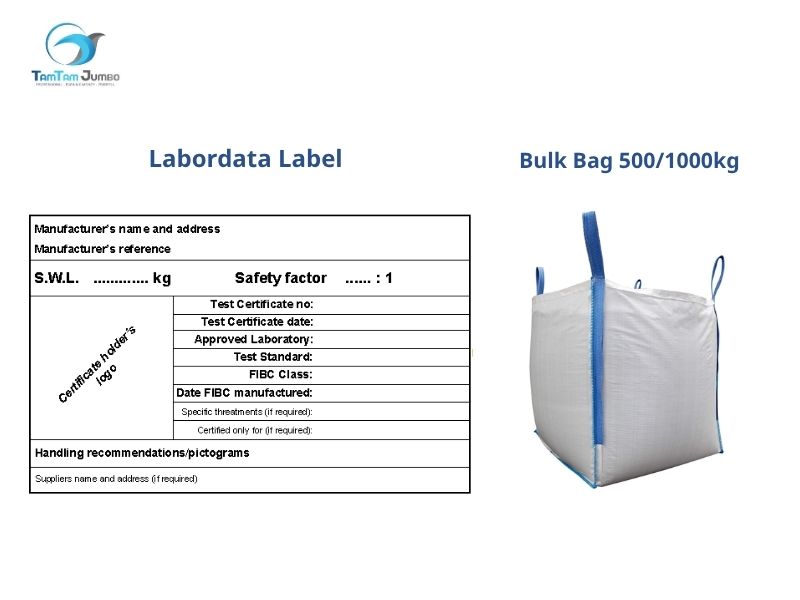
A properly documented SWL rating should appear on both the bag’s printed label and its specification sheet, stated alongside the safety factor used, whether 5:1 or 6:1, and ideally referencing the test standard applied. A specification listing only a fill weight capacity without a stated safety factor or test reference leaves the buyer unable to confirm how that number was actually derived.
Common SWL Mistakes Buyers Make
- Assuming a bag’s advertised capacity, such as a 1000kg bag, is a rounded marketing figure rather than a specific tested rating with its own safety factor.
- Using a single-trip 5:1 bag for repeated multi-trip use without confirming it meets the higher 6:1 requirement.
- Overloading bags beyond their rated SWL during peak operations, assuming the safety factor provides room for regular overloading rather than occasional handling variability.
- Not checking whether a stated SWL accounts for dynamic lifting forces or only static fill weight.
- Accepting a capacity figure without requesting the underlying test data and safety factor used to establish it.
How Tam Tam Packaging Tests and Rates Bags for SWL
Tam Tam Packaging tests complete bag constructions, fabric, seams, and loops together, against the target fill weight and required safety factor before assigning an SWL rating, whether for a standard single-trip big bag 1000kg specification or a multi-trip design requiring 6:1 testing. Test documentation is provided alongside the specification sheet for each order, so buyers can verify how the rated SWL was established rather than relying on a stated capacity alone.
Applications in Agriculture
The standard FIBC bag 1000kg rating is one of the most common specifications in agricultural bulk handling, used across grain, fertilizer, and animal feed supply chains where a metric ton per bag aligns conveniently with common truck and container loading calculations. Buyers in this sector should still confirm the specific safety factor and test basis behind a 1000kg rating, since not all suppliers apply the same rigor in testing and documentation despite advertising the same nominal capacity.
Frequently Asked Questions
What does SWL mean for an FIBC bag?
FIBC safe working load is the maximum weight a bag is certified to carry repeatedly under normal conditions, set well below the bag’s actual breaking strength using a safety factor.
Does a big bag 1000kg rating mean the bag breaks at 1000kg?
No. The 1000kg figure is the safe working load, and the bag’s actual tested breaking strength is engineered to be several times higher, typically five or six times the SWL depending on the safety factor applied.
What is the difference between a 5:1 and 6:1 safety factor?
A 5:1 factor is standard for single-trip bags, while a 6:1 factor is generally required for multi-trip bags to account for cumulative wear across repeated use cycles.
How is SWL tested?
Through a defined test sequence, typically referencing ISO 21898, including top lift testing at rated capacity, drop testing, and cyclic testing for multi-trip bags.
Can a bag be safely loaded above its rated SWL occasionally?
No. The safety factor is meant to account for handling variability and wear, not to provide routine headroom for exceeding the rated capacity, and doing so increases the risk of seam or fabric failure.
Conclusion
A FIBC bag 1000kg rating, or any stated SWL figure, represents a tested safe operating limit built on a specific safety factor, not the bag’s actual breaking point and not a number to be routinely exceeded. Buyers who confirm the safety factor, test basis, and whether a bag is rated for single or multi-trip use get a far more accurate picture of a bag’s real capability than the advertised capacity alone provides.
Tam Tam Packaging Co. tests complete bag constructions against your target fill weight and required safety factor, with documentation provided for every order. Contact our team to confirm the right SWL specification for your application.
Contact Us
Tam Tam Packaging Co.
Email: sales@tamtamjumbo.com
Website: https://tamtamjumbo.com/
Read more
FIBC Bags for Flour: Why Allergen Status Change the Specification
Flour shares the fine-particle and combustible dust characteristics of other food powders, but wheat’s status...
Aug
FIBC Bag for Starch Powder: Dustproof Bag Needs Antistatic
Starch powder occupies an unusual position in FIBC specification: it is a common food and...
Aug
FIBC Bags for Animal Feed: What Actually Makes a Clean Bulk Bag
FIBC bags for animal feed mean something more specific than a bag that looks unused....
Aug
FIBC Bag for PET Flakes: Why UV Resistance Matter More Than It
Recycled PET flakes share a base polymer with virgin resin pellets, but the two behave...
Aug
FIBC Bags for Plastic Resin: PP Fabric Packaging PP Pellets
There is a certain irony in shipping polypropylene resin pellets inside a bag woven from...
Aug
FIBC Bags for the Food Industry: Building a Food Grade Bag
Food manufacturers sourcing bulk ingredient packaging are working from a different starting point than a...
Aug