

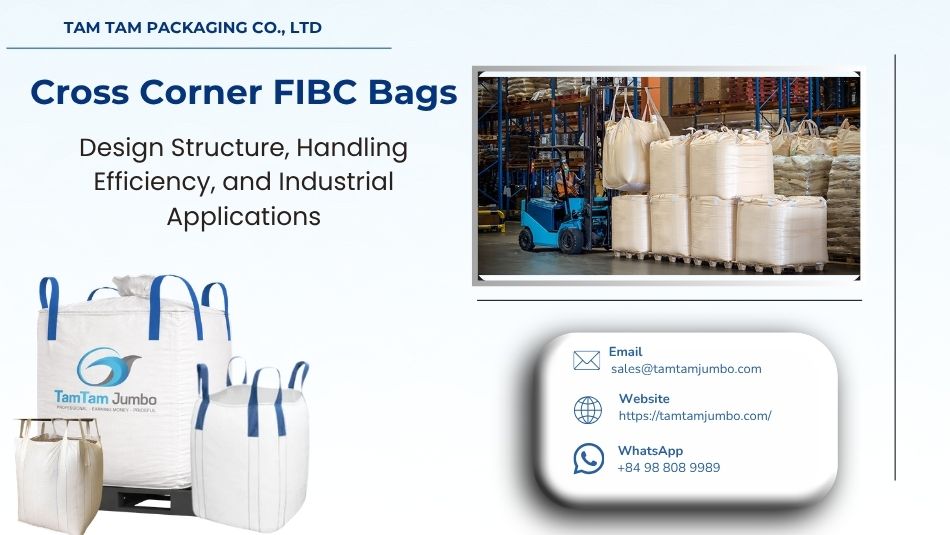
The loops on an FIBC bag do more than provide a handle for a forklift. They define how the load path travels through the bag body during lifting, and the wrong loop configuration can put stress on seams that were never engineered to carry it. Cross corner FIBC bags use one specific approach to this problem, anchoring the lifting straps diagonally across the bag rather than at each individual corner. This article explains how cross corner loops are built, how they compare to the other types of loop used in FIBC manufacturing, and which loop specification details buyers should confirm before ordering.
What Cross Corner Refers to in FIBC Loop Design
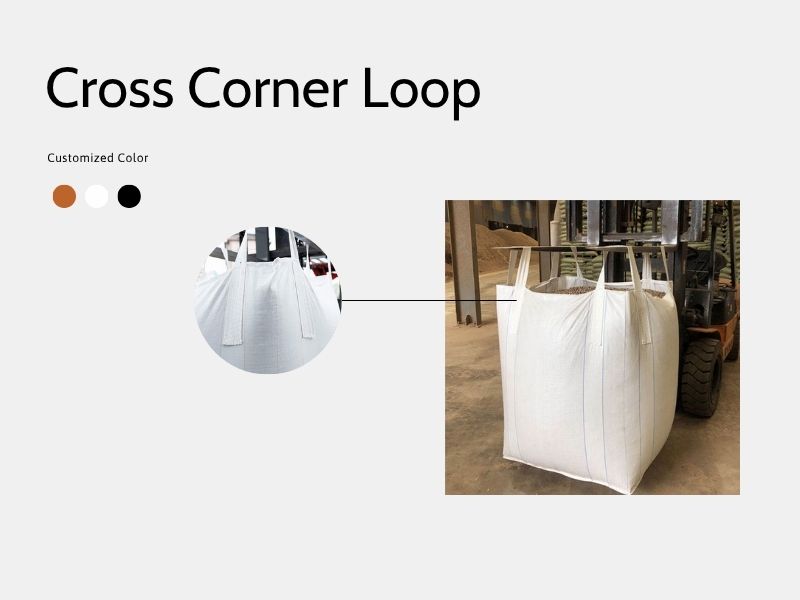
A cross corner loop configuration uses two continuous straps that each run diagonally from one bottom corner up and over the top of the bag to the opposite corner, crossing in an X pattern when viewed from above. This differs from a standard four-loop configuration, where each corner has its own independent loop sewn only to that corner of the bag.
Because each strap in a cross corner design runs continuously from one corner to the diagonally opposite corner, the load is shared across a longer, unbroken length of webbing rather than being isolated to four separate stitched points.
How Cross Corner Loops Are Constructed
Loop Anchoring Into the Body Fabric
The diagonal straps in a cross corner design are typically sewn into the top hem and down the corner seams of the bag body, distributing the anchoring stitches along a longer run of fabric rather than concentrating them at four isolated points. This spreads stress across a wider area of the top seam during lifting, which is one reason cross corner construction is often specified for heavier fill weights.
Sling Angle and Load Path
When a crane hook or forklift attachment lifts a cross corner bag, the diagonal straps naturally center the load over the bag’s midpoint, which tends to produce a more even sling angle than four independent corner loops that can pull unevenly if the load inside has shifted. This centering effect is one of the practical advantages cross corner construction offers for bags carrying dense or unevenly distributed contents.
Read more: Circular FIBC Bags: What the Jumbo Bag Specification Should Define
Types of Loops Used in FIBC Bags
Cross corner is one of several loop configurations used across the FIBC industry, and the right choice depends on fill weight, lifting equipment, and how the bag will be handled through its supply chain.
- Four-loop (corner loop): an independent loop sewn at each of the four top corners, the most common configuration for standard bulk bags with straightforward forklift or crane handling.
- Cross corner loop: two continuous diagonal straps forming an X pattern, distributing load across a longer run of fabric and centering the lift point over the bag.
- Two-loop (sleeve or tunnel loop): a single continuous strap forming two loops on opposite sides, often used where a forklift with an extended lifting bar handles the bag instead of individual hook attachments.
- Single central loop: one loop positioned at the top center, typically used on smaller bags or specific automated filling and discharge systems rather than standard bulk handling.
Each configuration routes the lifted load through the bag body differently, which is why loop type needs to be specified alongside fabric weight and safe working load rather than treated as an interchangeable detail.
Cross Corner vs Four-Loop: Key Differences
Four-loop construction is simpler to manufacture and remains the standard choice for light to medium fill weights handled with standard forklift hooks or crane shackles at each corner. Cross corner construction costs somewhat more due to the continuous strap and extended stitching pattern, but it offers better load distribution for heavier fills and reduces the risk of uneven corner loading when contents settle unevenly inside the bag during transport.
Buyers sometimes assume cross corner bags are simply a stronger version of four-loop bags, but the more accurate distinction is that cross corner construction manages load path differently rather than only adding raw strength.
Read more: 4 Panel FIBC Bags: How Construction Shapes the Bulk Bag Specs
When Cross Corner Loops Are the Right Choice
Cross corner construction tends to make sense for heavier fill weights approaching the upper range of standard FIBC capacity, for dense or unevenly settling materials where load centering matters, and for repeated multi-trip use where the extended anchoring reduces cumulative stress on any single stitch point. It is less necessary for light, evenly distributed dry goods where a standard four-loop bag already performs reliably within its rated safe working load.
Lifting Equipment Compatibility and Loop Selection
Loop type needs to match the lifting equipment used at both the filling and discharge points in the supply chain, not just the equipment at the factory of origin. A cross corner bag lifted by four separate hooks instead of a single centered crane hook does not necessarily gain the load-centering benefit the design is intended to provide, and a two-loop sleeve bag lifted by individual corner hooks rather than a forklift bar may not distribute load as intended. Confirming the receiving facility’s lifting method before finalizing loop type avoids a mismatch that only becomes apparent after the bags are already in transit.
Loop Specification Details Buyers Should Confirm
- Loop width and webbing material, since wider webbing generally distributes load over a larger contact area at the lifting point.
- Loop length and the resulting sling angle when the bag is lifted, since a sling angle that is too narrow or too wide affects how load transfers through the straps.
- Safe working load rating for the loop assembly specifically, in addition to the overall bag rating, since these are tested together but should both appear on the specification.
- Stitching pattern and thread type used to anchor the loops into the body fabric.
- Whether the loop fabric weight matches or exceeds the body fabric weight, since a mismatch can create a weak point at the seam.
How Tam Tam Packaging Constructs Cross Corner Loops
Tam Tam Packaging manufactures cross corner FIBC bags with webbing and stitching specifications matched to the rated safe working load of the order, confirming loop width, anchoring pattern, and sling angle with the buyer before production. Loop type is documented on the specification sheet alongside fabric weight and base construction, so buyers can verify the finished bags match the lifting method used at their facility before the bags are loaded and shipped.
Read more: How to Lift FIBC Bags Safely
Common Loop Selection Mistakes
- Ordering a standard four-loop bag for a fill weight that would benefit from cross corner load distribution.
- Not confirming the lifting equipment used at the discharge location before finalizing loop type.
- Assuming loop safe working load automatically matches the overall bag rating without checking the loop-specific test data.
- Overlooking sling angle when loop length is specified, which can affect how evenly the load transfers during lifting.
- Mixing loop fabric weight and body fabric weight without confirming seam compatibility.
Applications in Environmental and Waste Management Operations
Cross corner FIBC bags are commonly used in environmental and waste handling operations, where bags carrying contaminated soil, sludge byproducts, or recyclable material are frequently filled unevenly and lifted repeatedly by crane at treatment or disposal sites. The load-centering behavior of cross corner construction reduces the risk of uneven lifting when bag contents have settled or shifted, which is a common condition in this type of operation. Multi-trip use is also more typical in environmental handling than in single-trip commodity shipping, making the extended stitching pattern of cross corner loops a practical fit for the repeated lifting cycles involved.
Frequently Asked Questions
What does cross corner mean on an FIBC bag?
It refers to a loop configuration where two continuous straps run diagonally from corner to corner in an X pattern, rather than four independent loops at each corner.
Are cross corner loops stronger than four-loop construction?
They distribute load differently rather than simply being stronger. Cross corner construction spreads stress along a longer stitched section and centers the lift point, which benefits heavier or unevenly settling loads.
What is the difference between cross corner and two-loop bags?
Cross corner loops form an X pattern anchored near all four corners, while two-loop bags use a single continuous strap forming loops on two opposite sides, typically designed for forklift bar lifting rather than hook or crane attachment.
How do I know which loop type my bag needs?
The choice depends on fill weight, how evenly the material settles, and the lifting equipment used at both filling and discharge locations, which should be confirmed before finalizing the specification.
Should loop safe working load be listed separately from the bag’s overall rating?
Yes. The loop assembly is tested as part of the bag, but its rating should still appear on the specification sheet alongside the bag’s overall safe working load.
Conclusion
Cross corner FIBC bags solve a specific handling problem: distributing load evenly across a bag when fill weight is high, or contents settle unevenly during transport. Choosing this loop type over a standard four-loop configuration comes down to matching the loop design to actual fill weight and lifting equipment, details that belong in the specification from the start rather than being assumed.
Tam Tam Packaging Co. manufactures cross corner FIBC bags with documented loop specifications matched to your fill weight and lifting equipment. Contact our team to confirm the right loop type for your application.
Contact Us
Tam Tam Packaging Co.
Email: sales@tamtamjumbo.com
Website: https://tamtamjumbo.com/
Read more

FIBC Bags for Flour: Why Allergen Status Change the Specification
Flour shares the fine-particle and combustible dust characteristics of other food powders, but wheat’s status...
Aug
FIBC Bag for Starch Powder: Dustproof Bag Needs Antistatic
Starch powder occupies an unusual position in FIBC specification: it is a common food and...
Aug

FIBC Bags for Animal Feed: What Actually Makes a Clean Bulk Bag
FIBC bags for animal feed mean something more specific than a bag that looks unused....
Aug

FIBC Bag for PET Flakes: Why UV Resistance Matter More Than It
Recycled PET flakes share a base polymer with virgin resin pellets, but the two behave...
Aug

FIBC Bags for Plastic Resin: PP Fabric Packaging PP Pellets
There is a certain irony in shipping polypropylene resin pellets inside a bag woven from...
Aug
FIBC Bags for the Food Industry: Building a Food Grade Bag
Food manufacturers sourcing bulk ingredient packaging are working from a different starting point than a...
Aug