

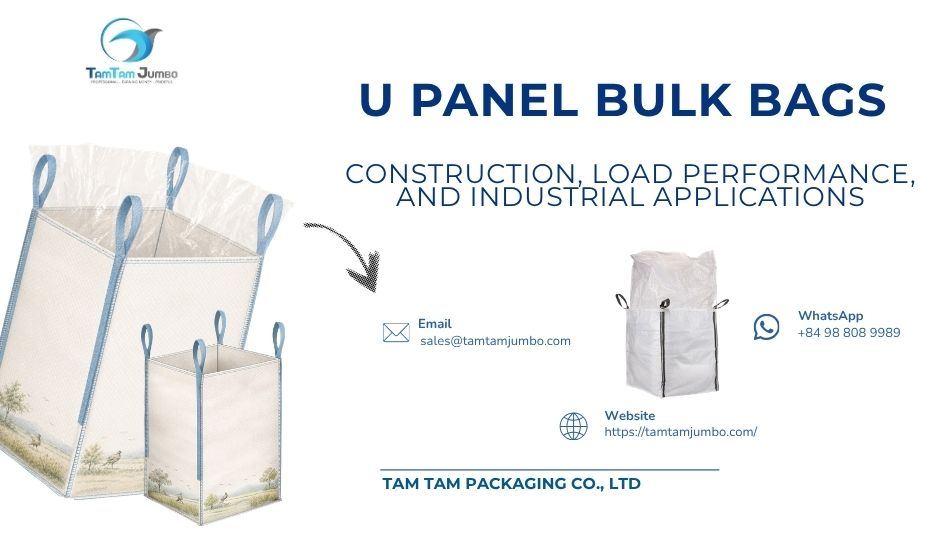
U panel bulk bags occupy a middle ground in FIBC construction, built from fewer pieces than a 4 panel bag but offering more shape control than a circular woven design. That balance makes them one of the more commonly specified constructions for buyers who need predictable fill geometry without the added fabric and seam cost of a full 4 panel build. This article explains what the U panel cut actually involves, how it compares to the alternatives, and which fields a proper FIBC bag specification needs to cover before an order is placed.
What Defines a U Panel Bulk Bag
A U panel bulk bag is constructed from two main fabric pieces: one U-shaped piece that wraps around to form the base and two opposite side walls in a single continuous fold, and two separate flat panels stitched in to form the remaining two sides. This layout results in two vertical body seams instead of the four found in a 4 panel design, while still giving the bag a more square, stable profile than a circular woven tube.
The base is typically integrated into the U-shaped piece rather than sewn on as a separate component, which reduces one of the higher-stress seam locations found in some panel and circular constructions.
How the U Panel Cut Differs From Circular and 4 Panel Designs
Seam Count and Fabric Layout
Circular FIBC bags have no vertical body seams at all, since the tube is extruded as one continuous piece. 4 panel bags have four vertical corner seams. U panel bags fall in between with two vertical seams, using less fabric and labor than a full 4 panel build while still offering a defined, engineered seam structure that a circular bag does not have.
Fill Shape and Corner Behavior
Because two sides of a U panel bag come from a single continuous fold, those sides tend to hold a flatter profile than the sewn-in panels, while the two stitched sides behave more like the corners of a 4 panel bag. The result is a bag that is more square than a circular design but not quite as uniformly cubic as a full 4 panel construction, which is usually an acceptable trade-off for buyers balancing shape control against unit cost.
Read more: 4 Panel FIBC Bags: How Panel Construction Shapes the Bulk Bag Specification
Where U Panel Bags Fit Between Circular and 4 Panel Construction
Buyers often compare these three constructions on a simple cost-versus-shape-control basis. Circular bags are the most economical but bulge when filled, reducing container and pallet utilization. 4 panel bags give the best shape control and stacking stability but cost more due to fabric usage and seam labor. U panel bags land in the middle, offering meaningfully better shape stability than a circular bag at a smaller cost increase than a full 4 panel build, which is why they are a common default choice for general industrial bulk packaging.
Core Fields an FIBC Bag Specification Must Cover for a U Panel Bag
A specification for a U panel bag needs to define the construction precisely enough to be reproduced consistently across production runs:
- Safe working load and the safety factor applied, commonly 5:1 for single-trip use or 6:1 where repeated use is expected.
- Fabric weight and denier for the U-shaped piece and the two stitched side panels, which are sometimes specified at different weights.
- Filled dimensions, noting that the U-fold sides and the stitched sides can behave differently under load even at the same nominal width.
- Base construction detail, confirming whether the base is integrated into the U-fold or reinforced separately.
- Loop type and loading configuration, since lifting loops are typically anchored into the top seams shared with the U-fold and side panels.
- Liner requirements, filling and discharge spout dimensions, and closure method.
- UN rating and packing group, if the bag will be used to transport dangerous goods.
Omitting the base construction detail is a frequent gap in specifications for this bag type, since buyers often assume all U panel bags handle the base seam the same way when factories differ in how they reinforce it.
Baffle Bags and U Panel Bags: A Common Pairing
U panel bags are frequently ordered with baffle panels added inside each corner to further improve fill shape. The baffles restrict outward bulging at the corners during filling, pushing the bag toward a more cubic profile without the fabric cost of a full 4 panel build. This combination is popular for buyers who want most of the container utilization benefit of a 4 panel bag while keeping material cost closer to a standard U panel specification.
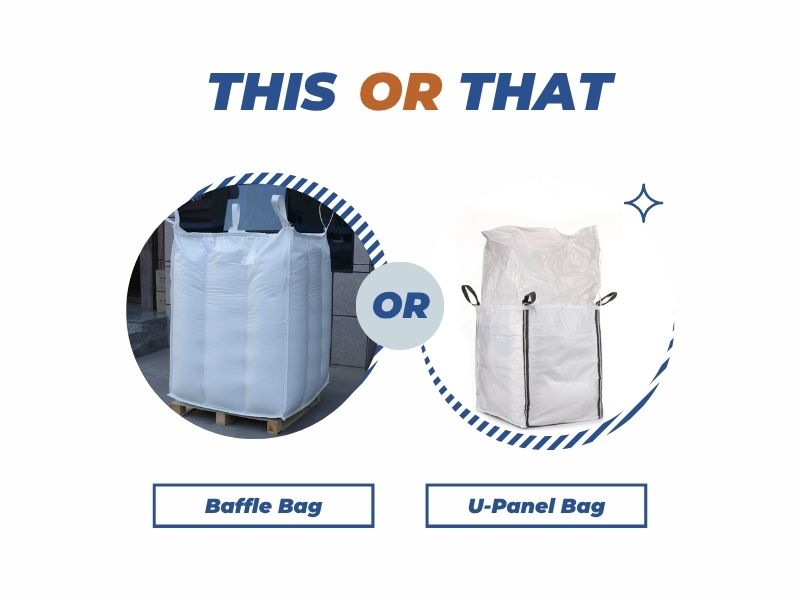
Read more: Baffle vs Standard FIBC Bags
Load Handling and Stacking Performance
The two engineered seams in a U panel bag carry a meaningful share of the load transfer during lifting and stacking, so seam strength needs to match the rated safe working load rather than following a generic default. A properly specified U panel bag holds its shape well enough for double stacking in most warehouse and container conditions, though buyers moving very dense or irregular materials should confirm stacking test data rather than assuming standard performance applies.
When U Panel Construction Is the Right Choice
U panel construction suits buyers who need better shape stability than a circular bag provides but do not require the maximum cube efficiency of a full 4 panel design, or whose budget does not support the added fabric and labor cost of four separate panels. It is also a practical choice when baffles are being added, since the combination delivers much of the shape benefit associated with 4 panel bags at a lower base cost.
How Tam Tam Packaging Manufactures U Panel Bags to Specification
Tam Tam Packaging builds U panel bulk bags to a buyer-approved specification, defining fabric weight for both the U-fold and stitched panels, base reinforcement method, loop configuration, and baffle inclusion where requested. Each specification sheet issued for a U panel order documents these details individually, so the buyer can confirm the finished bags match the agreed construction before the shipment leaves the factory.
Read more: How to Lift FIBC Bags Safely
Specification Errors That Lead to Rejected Shipments
- Treating a U panel specification as identical to a 4 panel or circular specification, missing details specific to the U-fold construction.
- Failing to confirm whether the base is integrated or separately reinforced, leading to unexpected seam performance.
- Requesting baffles without adjusting the specification for the added fabric and stitching required.
- Assuming a standard loop configuration will suit a filling or discharge process that actually requires a different loading angle.
- Not specifying liner requirements up front, resulting in a mid-order change that delays production.
Applications in the Food Industry
U panel bulk bags are widely used in food-grade bulk handling, where sugar, flour, rice, and other dry food commodities benefit from a stable, stackable shape without the added cost of full 4 panel construction. Food processors often pair U panel bags with food-grade liners to meet hygiene and contamination control requirements, and the moderate seam count keeps the bag cost-effective for high-volume, repeat orders typical of food commodity supply chains.
Frequently Asked Questions
What is the difference between a U panel bag and a 4 panel bag?
A U panel bag uses one continuous U-shaped piece for the base and two sides plus two stitched-in side panels, resulting in two vertical seams, while a 4 panel bag uses four separate panels with four vertical seams.
Are U panel bags cheaper than 4 panel bags?
Generally yes, since they use less fabric and require fewer seams, though they typically cost more than a circular woven bag of the same capacity.
Can baffles be added to a U panel bag?
Yes, baffle panels are commonly added at the corners of U panel bags to improve fill shape and container utilization.
What information should a U panel bag’s FIBC specification include?
Safe working load, safety factor, fabric weight for both the U-fold and side panels, base construction detail, loop configuration, liner requirements, and spout specifications.
Are U panel bags suitable for food-grade applications?
Yes, when manufactured with food-grade fabric and liners under appropriate hygiene controls, U panel bags are commonly used for dry food commodities.
Conclusion
U panel bulk bags offer a practical middle ground between circular and 4 panel construction, giving buyers improved shape stability without the full cost of a four-panel build. Getting the FIBC bag specification right, particularly around base construction and seam detail, is what determines whether that balance actually holds up in production and use.
Tam Tam Packaging Co. manufactures U panel bulk bags to a buyer-defined specification, with documented fabric weight, seam construction, and load rating for every order. Contact our team to confirm the right specification for your product.
Contact Us
Tam Tam Packaging Co.
Email: sales@tamtamjumbo.com
Website: https://tamtamjumbo.com/
Read more
FIBC Bags for Flour: Why Allergen Status Change the Specification
Flour shares the fine-particle and combustible dust characteristics of other food powders, but wheat’s status...
Aug
FIBC Bag for Starch Powder: Dustproof Bag Needs Antistatic
Starch powder occupies an unusual position in FIBC specification: it is a common food and...
Aug
FIBC Bags for Animal Feed: What Actually Makes a Clean Bulk Bag
FIBC bags for animal feed mean something more specific than a bag that looks unused....
Aug
FIBC Bag for PET Flakes: Why UV Resistance Matter More Than It
Recycled PET flakes share a base polymer with virgin resin pellets, but the two behave...
Aug
FIBC Bags for Plastic Resin: PP Fabric Packaging PP Pellets
There is a certain irony in shipping polypropylene resin pellets inside a bag woven from...
Aug
FIBC Bags for the Food Industry: Building a Food Grade Bag
Food manufacturers sourcing bulk ingredient packaging are working from a different starting point than a...
Aug