

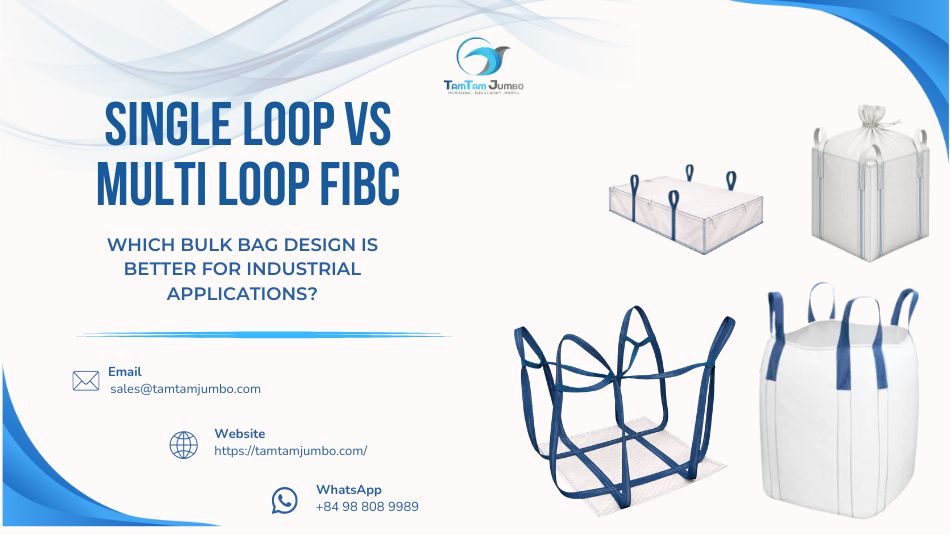
Single Loop vs Multi Loop FIBC: Understanding the Key Differences
FIBC bags are available in multiple structural designs, but one of the most important differences is the lifting configuration.
For industrial buyers, the choice between single loop vs multi loop FIBC affects:
- Handling efficiency
- Packaging cost
- Filling systems
- Transportation methods
- Operational safety
- Export logistics
Although both designs are used for bulk material handling, they serve different operational purposes and industries.
At Tam Tam Packaging Co., lifting configuration is often discussed early during product development because it directly influences production structure, logistics performance, and warehouse handling efficiency.
This article explains the technical differences between single loop and multi loop FIBC bags, including their advantages, limitations, industrial applications, and practical considerations buyers should understand before purchasing.
What Is a Single Loop FIBC?
A single loop FIBC bag is a bulk bag designed with one integrated lifting point.
The lifting loop is typically created from:
- Tubular woven polypropylene fabric
- Reinforced lifting webbing
- Integrated lifting sleeves
Single loop bags are commonly used in:
- Agricultural industries
- Fertilizer packaging
- Commodity exports
- High-volume bulk distribution
Simple Definition
A single loop FIBC is a bulk bag with one central lifting point designed for simplified handling and cost-efficient bulk transportation.
Single loop bags are often optimized for automated filling and lifting systems.
What Is a Multi Loop FIBC?
A multi loop FIBC bag uses multiple lifting loops, typically:
- 2 loops
- 4 loops
- Sling-style lifting systems
The most common industrial design is the 4-loop FIBC bag.
Simple Definition
A multi loop FIBC is a bulk bag designed with multiple lifting points for improved load stability, handling flexibility, and heavy-duty applications.
Multi loop bags dominate international industrial packaging markets due to their versatility.
Main Structural Differences
Single Loop Construction
Single loop bags are usually manufactured using tubular woven fabric with:
- One central lifting sleeve
- Lightweight structure
- Simplified sewing process
This design reduces material consumption and manufacturing complexity.
Multi Loop Construction
Multi loop FIBC bags use:
- Reinforced corner loops
- Side seam loops
- Cross-corner loops
- Heavy-duty lifting webbings
These bags typically require:
- More sewing operations
- Additional reinforcement
- More complex structural engineering
Single Loop vs Multi Loop FIBC: Comparison Table
| Feature | Single Loop FIBC | Multi Loop FIBC |
| Number of Lifting Points | 1 | 2–4+ |
| Handling Flexibility | Limited | High |
| Production Cost | Lower | Higher |
| Load Stability | Moderate | Excellent |
| Heavy Load Capability | Moderate | High |
| Automation Compatibility | Good | Excellent |
| Export Use | Commodity-focused | Broad industrial use |
| Common SWL | 500–1500 kg | 500–2000+ kg |
| Handling Equipment | Hooks, cranes | Forklifts, cranes |
| Structural Reinforcement | Basic | Advanced |
Advantages of Single Loop FIBC Bags
Lower Packaging Cost
Single loop bags require:
- Less webbing
- Fewer sewing operations
- Reduced labor time
This makes them cost-efficient for high-volume applications.
Lightweight Design
The simplified structure reduces overall bag weight, which may help optimize shipping costs for some commodity industries.
Efficient for Automated Filling Systems
Single loop bags are commonly used in automated production environments where:
- High-speed filling is required
- Hook-based lifting systems are installed
- Standardized handling processes exist
Suitable for Commodity Markets
Single loop FIBC bags are frequently used for:
- Fertilizer
- Seeds
- Animal feed
- Agricultural commodities
Particularly in price-sensitive export markets.
Limitations of Single Loop FIBC Bags
Reduced Handling Flexibility
Single loop bags are not ideal for:
- Standard forklift operations
- Complex warehouse systems
- Mixed handling environments
Lower Stability During Lifting
With only one lifting point:
- Load balance becomes more critical
- Swinging risk increases
- Stability may decrease during transport
Limited Heavy-Duty Applications
Single loop bags are generally less suitable for:
- Dense minerals
- Construction materials
- Heavy industrial powders
Advantages of Multi Loop FIBC Bags
Superior Load Stability
Multiple lifting points distribute weight more evenly throughout the bag structure.
This improves:
- Structural integrity
- Lifting safety
- Transport stability
Better Forklift Compatibility
4-loop FIBC bags are designed for:
- Forklift handling
- Warehouse operations
- Container loading
- Export logistics
This makes them the dominant choice for international industrial buyers.
Higher Safe Working Load Capacity
Multi loop bags are commonly engineered for:
- 1000 kg
- 1250 kg
- 1500 kg
- 2000 kg or higher
The reinforced structure supports demanding industrial operations.
Greater Customization Flexibility
Multi loop bags support multiple configurations:
- Cross corner loops
- Side seam loops
- Tunnel lift designs
- Baffle construction
- Conductive FIBC systems
Limitations of Multi Loop FIBC Bags
Higher Manufacturing Cost
Additional lifting loops increase:
- Material usage
- Sewing complexity
- Production time
However, operational efficiency often offsets the initial packaging cost.
More Complex Production Process
Loop alignment, reinforcement stitching, and load testing require tighter manufacturing control.
Poor-quality loop construction can create safety risks.
Industrial Applications
Where Single Loop FIBC Bags Are Commonly Used
Agriculture
- Fertilizer
- Seeds
- Animal feed
Commodity Exports
- Grain
- Powder materials
- Bulk agricultural products
High-Volume Packaging Systems
- Automated filling lines
- Hook lifting operations
Where Multi Loop FIBC Bags Are Commonly Used
Construction
- Cement
- Sand
- Aggregates
Chemical Industry
- Powders
- Resins
- Industrial additives
Mining
- Minerals
- Ore
- Industrial concentrates
Food Industry
- Sugar
- Flour
- Starch
- Food ingredients
Buyer Considerations Before Choosing
Consider Your Handling Equipment
Single Loop Bags
Best for:
- Hook systems
- Crane lifting
- Automated lines
Multi Loop Bags
Best for:
- Forklifts
- Warehouses
- Export container loading
Consider Product Density
Dense products generate higher stress during lifting.
Multi loop bags generally provide:
- Better weight distribution
- Improved structural support
- Higher operational safety
Consider Labor Efficiency
Multi loop bags typically improve:
- Forklift handling speed
- Warehouse movement
- Loading efficiency
This becomes important in high-volume export operations.
Consider Total Operational Cost
Although single loop bags may have lower unit cost, buyers should also evaluate:
- Handling efficiency
- Labor cost
- Damage reduction
- Operational speed
In many industrial environments, multi loop bags provide better long-term operational value.
Manufacturing Perspective: Why Loop Quality Matters
At Tam Tam Packaging Co., lifting loop performance is heavily influenced by:
- Webbing tensile strength
- Sewing accuracy
- Reinforcement engineering
- Fabric consistency
- Load testing standards
Two bags may appear visually similar while performing very differently during actual lifting operations.
Loop construction quality directly affects:
- Safety
- Durability
- Bag lifespan
- Export reliability
Which FIBC Design Is Better?
There is no universal answer.
The correct choice depends on:
- Product type
- Handling system
- Operational environment
- Budget structure
- Export requirements
Single Loop FIBC Is Better When:
- Cost reduction is critical
- Automated filling systems are used
- Products are lightweight commodities
Multi Loop FIBC Is Better When:
- Forklift handling is required
- Export logistics are complex
- Heavy products are involved
- Operational flexibility is important
Quick Summary
Single loop FIBC bags:
- Use one lifting point
- Offer lower packaging cost
- Work well in commodity industries
- Are suitable for automated systems
Multi loop FIBC bags:
- Use multiple lifting points
- Provide better stability
- Support heavy-duty industrial handling
- Are widely used in export logistics
The correct design depends on operational requirements rather than price alone.
FAQ
What is the difference between single loop and multi loop FIBC bags?
Single loop FIBC bags use one lifting point, while multi loop bags use multiple lifting loops for improved handling flexibility and stability.
Which FIBC type is better for forklift handling?
Multi loop FIBC bags are generally better for forklift operations.
Are single-loop FIBC bags cheaper?
Yes. Single loop bags usually have lower manufacturing cost due to reduced material and sewing requirements.
Which industries commonly use single loop FIBC bags?
Agriculture, fertilizer, seed, and commodity export industries commonly use single loop bags.
Which FIBC type is better for heavy materials?
Multi loop FIBC bags are typically better for heavy and dense industrial materials.
Conclusion
Understanding the differences between single loop vs multi loop FIBC bags helps industrial buyers select the most suitable bulk packaging solution for their operations.
Single loop bags provide cost efficiency and simplified handling for commodity applications, while multi loop FIBC bags offer greater flexibility, stability, and performance for demanding industrial environments.
For international buyers, the best solution depends on:
- Handling systems
- Product characteristics
- Operational efficiency goals
- Export logistics requirements
A properly engineered FIBC design improves both packaging performance and long-term operational reliability.
Contact Us
Tam Tam Packaging Co.
Email: sales@tamtamjumbo.com
Website: https://tamtamjumbo.com/
Read more
FIBC Bags for Flour: Why Allergen Status Change the Specification
Flour shares the fine-particle and combustible dust characteristics of other food powders, but wheat’s status...
Aug
FIBC Bag for Starch Powder: Dustproof Bag Needs Antistatic
Starch powder occupies an unusual position in FIBC specification: it is a common food and...
Aug
FIBC Bags for Animal Feed: What Actually Makes a Clean Bulk Bag
FIBC bags for animal feed mean something more specific than a bag that looks unused....
Aug
FIBC Bag for PET Flakes: Why UV Resistance Matter More Than It
Recycled PET flakes share a base polymer with virgin resin pellets, but the two behave...
Aug
FIBC Bags for Plastic Resin: PP Fabric Packaging PP Pellets
There is a certain irony in shipping polypropylene resin pellets inside a bag woven from...
Aug
FIBC Bags for the Food Industry: Building a Food Grade Bag
Food manufacturers sourcing bulk ingredient packaging are working from a different starting point than a...
Aug