

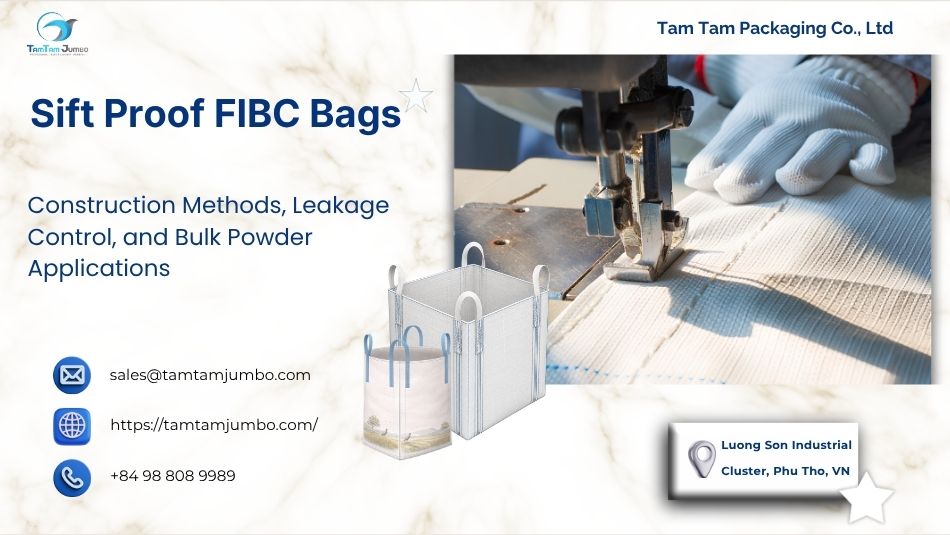
Fine powders find their way out of packaging that would hold coarser material without issue. Cement, fine mineral concentrate, and micronized chemical powders can escape through seam gaps, loose weave, and closure points that a standard bulk bag never had to resist. A sift proof FIBC bags are built specifically to close off these escape routes, and the difference between a bag that claims to be leak proof and one that actually performs that way usually comes down to a handful of construction details most buyers never think to ask about.
What Sift Proof Actually Means
Sift proof describes a bag engineered to contain fine particulate material that would otherwise pass through the small gaps present in standard FIBC construction. This is a different requirement from moisture protection or barrier packaging; a bag can be entirely waterproof and still allow fine powder to sift out through stitch holes or a loosely woven fabric structure. Sift proofing addresses particle containment specifically, independent of whether the product is also moisture sensitive.
Where Fine Material Escapes a Standard FIBC Bag
Seam Gaps
Standard sewn seams leave small needle holes and gaps between stitches, which are irrelevant for coarse granular material but become a direct escape route for fine powder under the pressure of a fully loaded bag. This is the single most common source of sifting loss in bags that were specified without sift proof requirements.
Fabric Weave Porosity
Woven polypropylene fabric has microscopic gaps between the tape yarns that make up the weave. Standard weave density is adequate for granular and coarse powder products, but very fine or micronized powders can migrate through these gaps over time, particularly under the vibration and pressure experienced during transport.
Spout and Closure Points
Filling and discharge spouts introduce additional seams and closure mechanisms, each of which is a potential leak point if not sealed correctly. A spout that is simply tied off rather than sewn, taped, or heat-sealed can allow fine material to escape even when the rest of the bag is properly sift proofed.
Read more: Circular FIBC Bags: What the Big Bag Specification Should Define
Construction Methods That Make a Bag Sift Proof
Sewn and Folded Seam Techniques
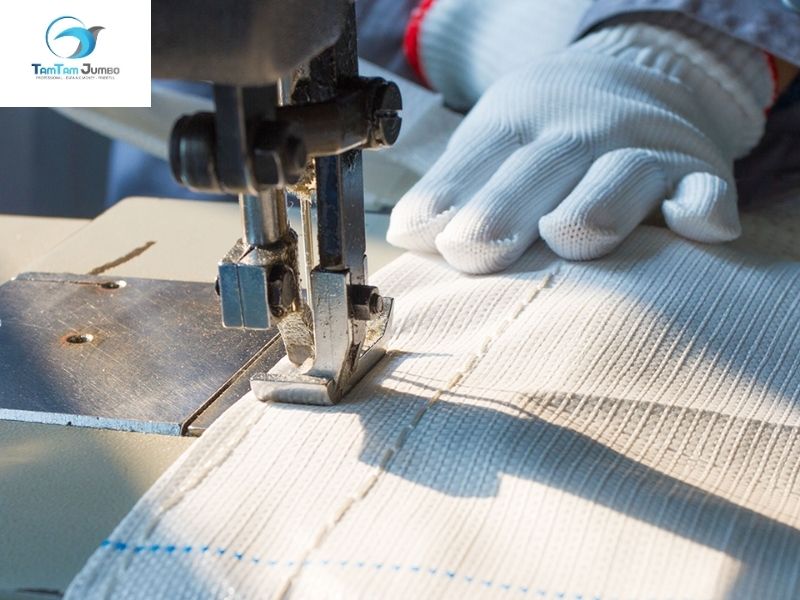
Sift proof construction typically uses a folded and double-stitched seam that closes the gap between stitch lines, sometimes combined with a sewn-in fabric strip covering the seam from the inside. This addresses the seam gap issue directly, at the cost of additional fabric and labor compared to a standard single seam.
Sift Proof Liners
An internal liner, either a loose-fitting film bag or a liner bonded to the body fabric, provides a continuous barrier independent of the outer fabric’s seams and weave. This is the most reliable method for very fine powders, since the liner does not depend on stitch quality to contain the product, though it adds material cost and requires its own compatible closure method at the top.
Read more: What Are the Different FIBC Liner Types Used in Bulk Packaging
Tighter Weave Density Fabric
Increasing the weave density of the body fabric itself reduces the size of the gaps between tape yarns, addressing fine powder migration through the fabric surface rather than through seams. This approach is often combined with sewn seam improvements rather than used alone, since a tighter weave does not resolve stitch-hole leakage at the seams.
Sift Proof vs Leak Proof: Is There a Difference
The terms are frequently used interchangeably, but leak proof more often implies protection against liquid or moisture ingress and egress, while sift proof specifically addresses dry particulate containment. A bag can be sift proof without being leak proof against liquids, and vice versa. Buyers should clarify which specific containment requirement applies to their product rather than assuming either term guarantees the other.
Specification Details for a Sift Proof Bag
- Seam construction method, specifying folded, double-stitched, or taped seams rather than a standard single stitch line.
- Fabric weave density and denier, since finer powders require tighter weave specifications.
- Liner requirement and liner material, if an internal barrier is needed in addition to seam improvements.
- Spout construction and closure method, confirming whether spouts are sewn, heat-sealed, or use another sift proof closure technique.
- Particle size of the product being packed, since sift proof requirements scale with how fine the material actually is.
Testing and Verifying Sift Proof Performance
Sift proof performance is typically verified by filling a sample bag with the actual product or a representative fine powder and monitoring for material loss under normal handling and transport vibration over a defined period. Buyers ordering sift proof bags for a new product should request a trial run or sample evaluation before committing to a full production order, since weave density and seam requirements can vary meaningfully between different fine powders with different particle characteristics.
How Tam Tam Packaging Manufactures Sift Proof Bags
Tam Tam Packaging builds sift proof FIBC bags using folded and double-stitched seam construction, combined with tighter weave density fabric or an internal liner depending on the fineness of the product being packed. Spout and closure details are confirmed with the buyer before production, and sample evaluation is available for new products to confirm the specified construction actually contains the material as intended.
Common Mistakes That Undermine Sift Proof Construction
- Specifying sift proof seams without addressing the spout closure leaves the most common leak point unresolved.
- Assuming a standard weave density fabric is adequate for a very fine or micronized powder without testing first.
- Choosing a liner without confirming the liner’s own closure method is incompatible with sift proof requirements.
- Overlooking that sift proof and moisture proof are different requirements, resulting in a bag suited to one but not the other.
- Not requesting a sample trial before committing to a full production run for a new or unusually fine product.
Applications in Construction Materials
Sift proof FIBC bags are widely used for cement, fine mineral fillers, and other construction material powders where product loss during transport is both a cost issue and a housekeeping and safety concern at job sites and distribution facilities. Cement in particular is fine enough that standard seam construction is generally not adequate, making folded and double-stitched seams a standard specification for this product category, often combined with a liner where moisture protection is also required during storage.
Frequently Asked Questions
What does sift proof mean for an FIBC bag?
It means the bag is constructed to prevent fine powder from escaping through seams, fabric weave gaps, or closure points, which standard bulk bag construction does not fully address.
Is a sift proof bag the same as a leak proof bag?
Not necessarily. Sift proof refers to containing dry fine particles, while leak proof more often refers to liquid or moisture containment, and a bag may need one, both, or neither depending on the product.
What makes a seam sift proof?
A folded and double-stitched seam, sometimes combined with a covering fabric strip, closes the small gaps between stitches that allow fine powder to escape through a standard single-stitch seam.
Do sift proof bags always need a liner?
Not always. Very fine powders often benefit from a liner, but moderately fine products can sometimes be contained with improved seam construction and tighter weave density fabric alone.
How can a buyer verify a bag is actually sift proof before a full order?
By requesting a sample trial filled with the actual product or a representative fine powder, and monitoring for material loss under normal handling and transport conditions.
Conclusion
A sift proof FIBC bag depends on seam construction, weave density, and closure details working together, not on any single feature doing all the work. Buyers packing fine powders should specify each of these elements individually and confirm performance with a sample trial rather than relying on a general sift proof or leak proof claim without supporting evidence.
Tam Tam Packaging Co. manufactures sift proof FIBC bags with seam, fabric, and liner specifications matched to your product’s particle size. Contact our team to confirm the right construction for your application.
Contact Us
Tam Tam Packaging Co.
Email: sales@tamtamjumbo.com
Website: https://tamtamjumbo.com/
Read more

FIBC Bags for Flour: Why Allergen Status Change the Specification
Flour shares the fine-particle and combustible dust characteristics of other food powders, but wheat’s status...
Aug
FIBC Bag for Starch Powder: Dustproof Bag Needs Antistatic
Starch powder occupies an unusual position in FIBC specification: it is a common food and...
Aug
FIBC Bags for Animal Feed: What Actually Makes a Clean Bulk Bag
FIBC bags for animal feed mean something more specific than a bag that looks unused....
Aug

FIBC Bag for PET Flakes: Why UV Resistance Matter More Than It
Recycled PET flakes share a base polymer with virgin resin pellets, but the two behave...
Aug
FIBC Bags for Plastic Resin: PP Fabric Packaging PP Pellets
There is a certain irony in shipping polypropylene resin pellets inside a bag woven from...
Aug
FIBC Bags for the Food Industry: Building a Food Grade Bag
Food manufacturers sourcing bulk ingredient packaging are working from a different starting point than a...
Aug