

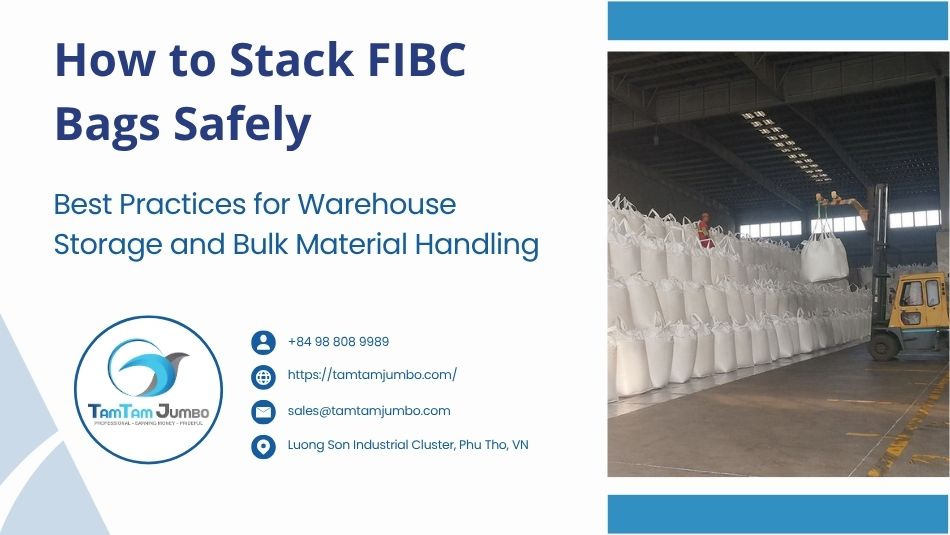
Stacking height limits aren’t a matter of judgment call or common sense alone; they come from a specific mechanical test, and bag construction genuinely changes how safely a stack behaves. A baffle FIBC bag holds its shape and distributes load differently than a circular bag, which has real consequences for how high and how confidently a stack can be built. This guide covers the engineering behind safe stacking and what changes when baffled construction is involved.
Why Stacking Safety Is Its Own Engineering Question
A FIBC bag’s safe working load rating confirms it can be lifted and handled at its rated fill weight, but stacking introduces a separate stress condition, sustained compressive load from bags stacked above, applied over time rather than momentarily during a lift. This is why stacking performance is tested and rated as its own criterion rather than assumed from a bag’s lifting SWL alone.
Read more: FIBC Safe Working Load: What a Big Bag 1000kg Actually Means
How Stacking Test Data Determines Safe Stack Height
Stacking tests apply a compressive load equivalent to a defined number of bags stacked above a test bag, held for a set duration, to confirm the bag maintains integrity under sustained pressure. The number of layers a bag is rated to support comes directly from this test result, and buyers should request this specific data rather than estimating a safe stack height from general bag strength or intuition.
Why Baffled and Panel Bags Stack More Predictably Than Circular Bags
A baffle FIBC bag uses internal corner panels to hold a more cubic shape when filled, which distributes the weight of bags stacked above more evenly across the bag beneath than a circular bag’s rounded, bulging profile does. Circular bags stacked in multiple layers are more prone to shifting or leaning, since their curved sides don’t interlock or sit flush against neighboring bags the way a squared baffle or panel bag does. This geometric stability is a genuine safety advantage independent of the bag’s raw fabric strength.
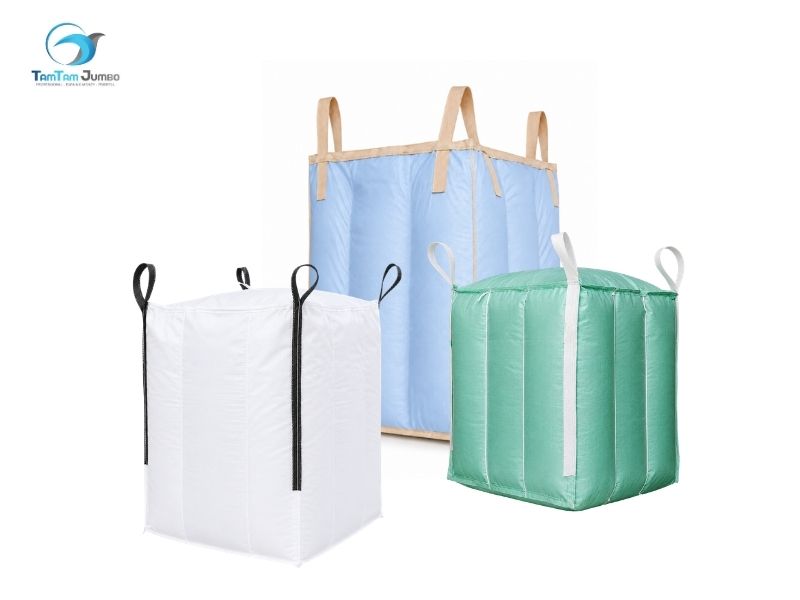
Read more: FIBC Bag Construction Types: Circular, U and 4 Panel Compared
Safe Stacking Patterns: Straight Stacking vs Interlocking
Straight stacking, placing each bag directly above the one below, works reasonably well for baffled and panel bags given their consistent shape, but circular bags often benefit from a loose interlocking pattern that helps offset their tendency to bulge and shift. Regardless of pattern, bags should be centered as closely as possible over the load-bearing bag beneath rather than stacked with significant overhang.
Multi-Layer Stacking Limits and When to Stop
Stacking limits should be treated as a hard ceiling based on tested data, not a starting point to push against when storage space is tight. A bag rated for a specific number of stacked layers has been tested at that limit, not meaningfully beyond it, and exceeding the rating removes the safety margin the test was designed to confirm.
Floor Stacking vs Warehouse Racking Considerations
Floor stacking relies entirely on the bags’ own stacking-rated strength and stability, while warehouse racking can support taller storage by transferring load through the racking structure rather than through the bags themselves at every level. Facilities storing bags at height should evaluate whether racking is a better fit than floor stacking once storage needs exceed a bag’s tested stacking limit, rather than assuming floor stacking can simply go higher with careful arrangement.
Never Stack on a Damaged or Compromised Bag
A bag with visible seam damage, fabric tears, or UV degradation should never be used as a base for additional stacked layers, since its compromised structure may not hold the compressive load a stacking test assumes for an undamaged bag. Damaged bags identified during storage inspection should be isolated and assessed before returning to the working stack rotation.
Read more: FIBC UV Protection: What Outdoor Bag Storage Actually Requires
How Product Density Affects Safe Stack Height
Denser products concentrate more weight into the same bag footprint, meaning the practical stacking limit for a very dense material may be lower than the bag’s rated layer count would suggest if that rating was established using a lighter reference product. Buyers working with unusually dense materials should confirm stacking test data reflects their actual product density rather than a generic assumption.
Building Stacking Guidance Into Site Safety Procedures
Stacking limits work best when they’re posted or communicated directly at the storage location, not left as information only procurement staff have access to. Forklift operators and warehouse staff handling bags day to day are the ones who need this data readily available to make correct stacking decisions in practice.
Read more: How to Store FIBC Bags: Getting the Most From Your Bag’s UV Additive
How Tam Tam Packaging Documents Stacking Load Data
Tam Tam Packaging provides stacking test results alongside safe working load data for each bag construction, specifying tested layer limits for baffled, circular, and panel bags individually rather than a single generic stacking guideline across all constructions.
Common Stacking Mistakes
- Estimating a safe stack height from general bag strength rather than requesting actual stacking test data.
- Assuming circular and baffled bags share the same safe stacking behavior at the same fill weight.
- Exceeding tested stacking limits when storage space runs short.
- Stacking new bags on top of a bag with visible damage or UV degradation.
- Not adjusting stacking expectations for unusually dense products that concentrate more weight per bag.
Applications in Mining and Mineral Storage
Mining and mineral processing facilities frequently store dense ore concentrate and processed mineral products in multi-layer stacks at both processing sites and export terminals, making tested stacking data and construction choice particularly consequential given the weight involved. Baffled or panel construction is common in this sector specifically because the improved stacking predictability matters more when storage volumes and individual bag weights are both high.
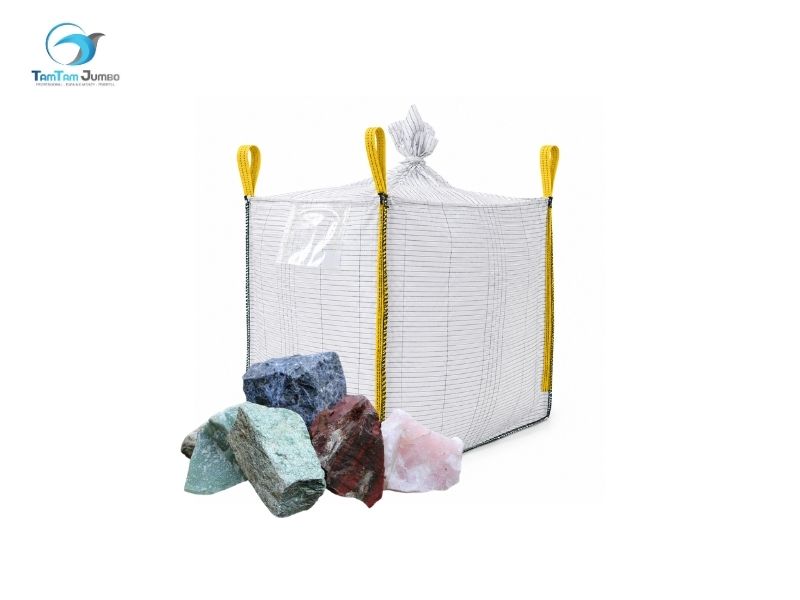
Read more: FIBC Bags for Minerals: A Jumbo Bag Specification Guide
Frequently Asked Questions
How is safe stacking height for FIBC bags determined?
Through a stacking test that applies a compressive load equivalent to a defined number of bags above a test bag, held for a set duration, with the resulting layer rating coming directly from that test result.
Why do baffle FIBC bags stack more safely than circular bags?
Baffled bags hold a more cubic shape when filled, distributing weight from stacked bags above more evenly and sitting more stably against neighboring bags than a circular bag’s rounded, bulging profile.
Can I stack bags higher than their rated limit if I’m careful?
No. The rated limit reflects actual tested performance, and exceeding it removes the safety margin the test was designed to confirm, regardless of how carefully the stack is arranged.
Does product density affect how high I can safely stack bags?
Yes. A very dense product concentrates more weight into the same bag footprint, so stacking test data should reflect the actual product density being stored, not a generic reference material.
Should I ever stack bags on top of a damaged one?
No. A bag with seam damage, tears, or UV degradation may not support the compressive load a stacking test assumes for an undamaged bag, and should be isolated rather than used as a base for additional layers.
Conclusion
Safe stacking height comes from tested data specific to a bag’s construction, not general assumptions about strength or careful arrangement. Baffle FIBC bags genuinely stack more predictably than circular bags due to their shape, and that difference, along with product density and stacking test results, should drive actual site stacking limits rather than intuition.
Tam Tam Packaging Co. provides stacking test data specific to your bag construction and product density. Contact our team to confirm safe stacking limits for your application.
Contact Us
Tam Tam Packaging Co.
Email: sales@tamtamjumbo.com
Website: https://tamtamjumbo.com/
Read more
How to Stack FIBC Bag Safely: Why Baffle Bag Behaves Differently
Stacking height limits aren’t a matter of judgment call or common sense alone; they come...
Sep
How to Store FIBC Bags: Getting the Most From UV Additive
A bag manufactured with a strong UV additive package can still fail early if it’s...
Sep
Bulk Bags for Export: What to Ask a Big Bag Supplier in Vietnam
A bag that performs perfectly in short domestic truck transport can still fail on a...
Sep
FIBC Bags for Seed Packaging: Choosing Right Liner for Viability
Seed packaging has a goal most other bulk commodities don’t share: keeping the product alive....
Sep

FIBC Bags for Sugar Packaging: What to Look for in Bag Suppliers
Sugar is deceptively demanding to package well in bulk. It is highly hygroscopic, fine enough...
Sep
FIBC Bags for Carbon Black: When a BRC Certificate Applies
Carbon black is overwhelmingly an industrial material, used as a reinforcing filler in tire and...
Sep