
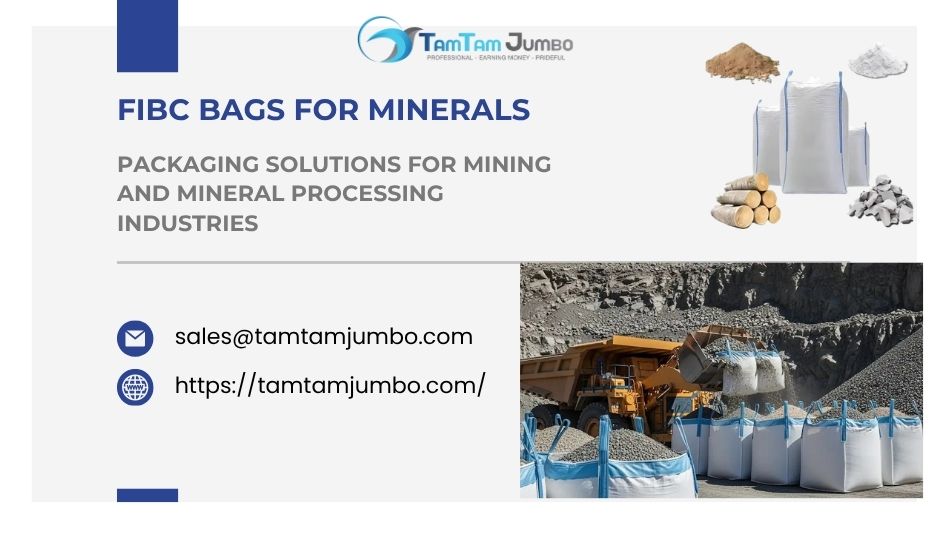
Mineral products range from dense, abrasive ore concentrate to hazardous processing reagents to fine powders sensitive to moisture, and a single jumbo bag specification does not serve all of them equally well. This guide breaks down what actually matters for the main categories of mineral products moving through FIBC packaging, from the mine site through processing and on to export.
Why Mineral Products Span Such a Wide Specification Range
Few industries handle as broad a range of material properties under one general category as mining and mineral processing. Ore concentrate, processing chemicals, and refined mineral powders each present different physical and hazard characteristics, meaning the right jumbo bag specification depends heavily on which stage of the mineral supply chain a given bag is serving.
Ore Concentrate: Abrasion Resistance and High GSM Fabric
Ore concentrate is typically dense and abrasive, placing sustained wear on fabric during repeated handling between extraction, processing, and export. This calls for fabric at the higher end of standard GSM ranges, with weave density and tape yarn quality contributing to abrasion resistance as much as raw fabric weight. Multi-trip use is common at processing and export facilities, adding durability requirements on top of raw strength.
Read more: FIBC Bag GSM Guide: How Fabric Weight Determines Strength
Mineral Reagents and Processing Chemicals: UN Rating and Anti-Static Protection
Reagents used in mineral processing, including cyanide-based compounds, flotation chemicals, and various acid salts, frequently fall under dangerous goods classification and require UN-rated construction matched to the correct packing group. Many of these products also present combustible dust or ignition risk in the presence of processing solvents, adding Type C anti-static protection as a frequent second requirement alongside UN rating.
Read more: Anti-Static Bulk Bags: How a Type C Bag Prevents Ignition Risk
Processed Mineral Powders: Dust Containment and Moisture Sensitivity
Fine processed mineral powders raise both dust containment and moisture concerns, since fine particles can escape through standard seams and many mineral powders are hygroscopic enough to degrade with humidity exposure. Sealed spout design becomes particularly relevant here, since automated discharge into downstream processing equipment is common for these products and dust exposure at that point is a workplace safety consideration.
Read more: FIBC Bottom Discharge Types: How an Iris Closure Controls Flow
Port and Terminal Handling: Spout Design and Capacity
Mineral exports frequently move through standardized port and rail terminal interfaces, where discharge spouts need to connect precisely and repeatedly with fixed equipment across high cycle volumes. Custom spout engineering, reinforced base stitching, and capacity matched to terminal handling equipment all matter more in this stage of the supply chain than they typically would for domestic distribution.
Read more: FIBC Bag Spout Design: Engineering the Right Bulk Bag Spout Size
Building a Complete Mineral FIBC Specification
Once the product category and supply chain stage are identified, a complete mineral bag specification typically addresses fabric GSM and abrasion resistance, UN rating and anti-static protection where hazard classification requires it, dust and moisture containment for fine powders, and spout and capacity matched to terminal or processing equipment.
Common Mineral FIBC Specification Combinations
| Product Example | Typical Specification Combination |
| Dense ore concentrate for export | High GSM abrasion-resistant fabric, baffled or panel construction, custom terminal spout |
| Cyanide-based flotation reagent | UN rated construction, Type C anti-static protection, standard capacity |
| Fine processed mineral powder | Dust proof seams, sealed discharge spout, moisture liner if hygroscopic |
| Multi-trip processing plant bags | Reinforced high-GSM fabric, safety stitched base and loops, UV stabilization for outdoor storage |
How Tam Tam Packaging Specifies Bags for Minerals
Tam Tam Packaging works through mineral product category and supply chain stage, ore concentrate, reagent, or processed powder, before finalizing fabric GSM, hazard classification requirements, and spout engineering, rather than applying a single standard mining bag template. Specification sheets document each relevant requirement individually, supporting the multi-standard documentation many mineral applications require.
Read more: FIBC Bag Testing Standards: A Complete Overview of ISO 21898
Common Mistakes When Sourcing Mineral FIBC Bags
- Using a standard GSM specification for abrasive ore concentrate without accounting for multi-trip wear.
- Overlooking combustible dust risk for reagents that also happen to be UN classified, treating the two hazards as one certification.
- Ordering generic spout dimensions without confirming fit against actual port or terminal equipment.
- Assuming all mineral powders need the same dust and moisture specification regardless of actual hygroscopic sensitivity.
- Not requesting separate documentation for each applicable standard when a product requires more than one certification.
Applications Across the Mining Industry
Mineral FIBC applications span the full extraction-to-export supply chain, from bulk ore handling at the mine site through chemical reagent use in processing plants to final export packaging at port terminals. Each stage tends to emphasize different specification priorities, making a stage-by-stage assessment more useful than a single blanket mining industry specification.
Frequently Asked Questions
Do all mineral products need UN rated bags?
No. UN rating is required specifically for products classified as dangerous goods, such as certain processing reagents, while raw ore concentrate typically does not require this classification.
Why does ore concentrate need higher GSM fabric?
Ore concentrate is dense and abrasive, causing more wear on fabric during handling than lighter, less abrasive materials, particularly across multiple handling cycles.
Can a single bag be both UN rated and anti-static?
Yes, and this combination is common for combustible mineral processing reagents classified as dangerous goods, with both requirements tested and documented separately.
What matters most for mineral export packaging at port terminals?
Spout design engineered to match terminal discharge equipment, along with base and loop reinforcement to handle high-cycle repeated use.
How do I know which mineral products need dust containment versus UN rating?
By assessing each product against the relevant hazard categories individually, dangerous goods classification, combustible dust risk, and particle fineness, rather than assuming one specification applies across all mineral products.
Conclusion
Mineral products span a wide enough range of physical and hazard characteristics that a single jumbo bag specification rarely fits all of them. Working through the actual product category, ore concentrate, reagent, or processed powder, alongside the relevant supply chain stage, produces a specification that matches real handling conditions rather than a generic mining industry default.
Tam Tam Packaging Co. builds jumbo bag specifications for mineral products across the extraction-to-export supply chain. Contact our team to work through the right specification for your product.
Contact Us
Tam Tam Packaging Co.
Email: sales@tamtamjumbo.com
Website: https://tamtamjumbo.com/
Read more
FIBC Bags for Construction: A Complete Guide Across Materials
Walk onto almost any construction site or materials yard and the bulk bags you see...
Aug
FIBC Bags for Flour: Why Allergen Status Change the Specification
Flour shares the fine-particle and combustible dust characteristics of other food powders, but wheat’s status...
Aug
FIBC Bag for Starch Powder: Dustproof Bag Needs Antistatic
Starch powder occupies an unusual position in FIBC specification: it is a common food and...
Aug
FIBC Bags for Animal Feed: What Actually Makes a Clean Bulk Bag
FIBC bags for animal feed mean something more specific than a bag that looks unused....
Aug
FIBC Bag for PET Flakes: Why UV Resistance Matter More Than It
Recycled PET flakes share a base polymer with virgin resin pellets, but the two behave...
Aug
FIBC Bags for Plastic Resin: PP Fabric Packaging PP Pellets
There is a certain irony in shipping polypropylene resin pellets inside a bag woven from...
Aug