

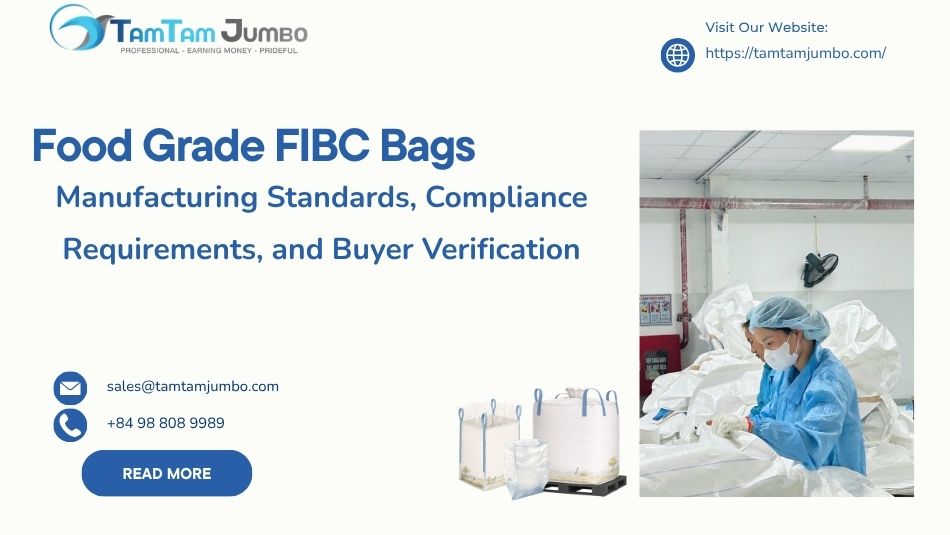
Calling a bag food grade is not the same as proving it. Food grade FIBC bags need to be manufactured under documented hygiene controls, using materials suitable for direct or indirect food contact, and backed by third-party audit evidence such as a BRC certificate. This article explains what food grade actually requires from a manufacturer, what the BRC Global Standard for Packaging audits, and what buyers should check before accepting a supplier’s food grade claim at face value.
What Food Grade Means for an FIBC Bag
A food grade FIBC bag is manufactured using fabric, liner, and thread that are safe for contact with food products, produced in a facility that follows documented hygiene and contamination control procedures. This covers everything from raw material sourcing and storage, through the weaving and stitching process, to final packing and warehousing before the bags reach the buyer. Food grade status describes the entire production environment, not just the fabric composition.
The BRC Packaging Standard and What It Covers
Who BRC Certification Applies to
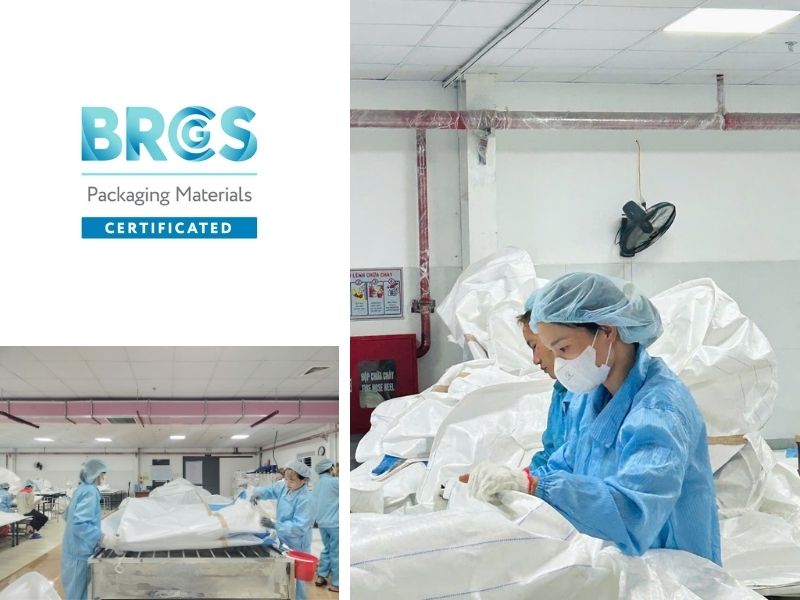
The BRC Global Standard for Packaging Materials applies to manufacturers producing packaging intended for food contact or food-adjacent use, including FIBC bags used to transport grains, sugar, flour, and other bulk food commodities. Certification is issued to the manufacturing facility itself following an independent audit, not to an individual bag design.
What Gets Audited
A BRC audit examines the facility’s hazard analysis and food safety management system, site hygiene standards, pest control procedures, staff training, traceability systems, and quality control processes across the full production line. Auditors also review contamination controls specific to packaging manufacturing, such as procedures for preventing foreign material, such as metal fragments or loose fibers, from entering finished bags.
What a BRC Certificate Should Confirm
A BRC certificate for an FIBC manufacturer should state the certified site address, the scope of certification (confirming FIBC or flexible packaging is included), the certification grade, the issuing certification body, and the certificate’s validity period. Buyers should treat a certificate listing a different site address, an expired validity date, or a scope that does not explicitly cover flexible bulk packaging as a signal to request clarification before placing an order.
- Certified site address matching the actual manufacturing location.
- Scope of certification explicitly covering flexible packaging or FIBC production.
- Certification grade issued by the audit, since BRC grades range based on audit performance.
- Issuing certification body, which should be a recognized, accredited body.
- Validity period, since BRC certification requires annual re-audit to remain current.
Food Grade Fabric and Liner Requirements
Food grade FIBC bags typically use virgin polypropylene fabric rather than recycled material, since recycled content can introduce contaminants not suitable for food contact. Where an inner liner is used for moisture or contamination protection, the liner film itself needs to meet food contact material regulations in the destination market, and stitching thread should also be food-safe rather than treated with chemicals unsuitable for indirect food contact.
Read more: What Are the Different FIBC Liner Types Used in Bulk Packaging
Hygiene and Contamination Controls During Manufacturing
Beyond material selection, food grade production requires documented procedures covering pest control, staff hygiene practices, foreign material detection, and segregation of food-grade production runs from any non-food-grade product lines within the same facility. Metal detection or visual inspection at the finishing stage is common practice to catch broken needles or other foreign material before bags are packed for shipment.
Food Grade vs Standard FIBC Bags: Key Construction Differences
A food grade bag is not necessarily built differently in terms of panel construction, loop type, or overall dimensions compared to a standard industrial bag. The differences are in material sourcing, thread selection, and the documented hygiene environment during manufacturing. This means a food grade bag can use any of the standard body constructions, circular, U panel, or 4 panel, along with ventilated designs for produce, as long as the materials and production environment meet food safety requirements.
Read more: Ventilated Bulk Bags: When a Breathable Bag Matters for Fresh Produce
How Tam Tam Packaging Manufactures Food Grade FIBC Bags
Tam Tam Packaging produces food grade FIBC bags using virgin polypropylene fabric and food-safe liner options, within a facility that maintains documented hygiene procedures for food-grade production runs. Buyers ordering food grade bags receive the relevant BRC certificate along with the certified scope confirmation, so the documentation can be checked against the specific production line supplying the order.
Verifying a Supplier’s BRC Certificate Before Ordering
- Request the current BRC certificate directly rather than relying on a claim of food grade status alone.
- Confirm the certificate scope explicitly includes flexible packaging or FIBC bags, not just general packaging categories.
- Check the certificate’s validity date against the current date, since expired certificates are not uncommon in supplier documentation.
- Verify the certified site address matches where the bags are actually being produced.
- Ask whether food-grade and non-food-grade production runs are segregated within the same facility.
Applications in the Food Industry
Food grade FIBC bags are used across grain, sugar, flour, rice, and animal feed supply chains, where bulk commodities move directly from processing facilities to food manufacturers, mills, or distributors without additional inner packaging. Buyers in these supply chains typically require BRC certification as a standard procurement condition, since food manufacturers further down the chain often audit their own suppliers’ packaging sources as part of broader food safety compliance.
Frequently Asked Questions
What does food grade mean for an FIBC bag?
It means the bag is manufactured using food-safe materials within a facility that follows documented hygiene and contamination control procedures suitable for food contact packaging.
What is a BRC certificate?
It is proof of certification against the BRC Global Standard for Packaging Materials, issued to a manufacturing facility after an independent audit of its food safety management, hygiene practices, and quality systems.
Does a BRC certificate apply to a specific bag design or the whole factory?
BRC certification applies to the manufacturing site and its processes, not to an individual product, so buyers should confirm the certificate’s scope covers flexible packaging production.
Are food grade FIBC bags built differently from standard bags?
Not necessarily in construction. The main differences are in material sourcing, food-safe thread, and the hygiene controls followed during manufacturing, rather than the panel or loop design.
How often does BRC certification need to be renewed?
BRC certification requires annual re-audit, so buyers should always check the validity date on the certificate rather than assuming it remains current indefinitely.
Conclusion
Food grade FIBC bags depend on documented material sourcing and hygiene practices as much as the fabric itself, and a BRC certificate is the evidence that a manufacturer’s facility has been independently audited against that standard. Buyers who verify certificate scope, validity, and site address before ordering avoid relying on an unverified food grade claim for products that ultimately reach food supply chains.
Tam Tam Packaging Co. manufactures food grade FIBC bags under documented hygiene controls with current BRC certification available for review. Contact our team to confirm the right specification for your food-grade application.
Contact Us
Tam Tam Packaging Co.
Email: sales@tamtamjumbo.com
Website: https://tamtamjumbo.com/
Read more
FIBC Bags for Flour: Why Allergen Status Change the Specification
Flour shares the fine-particle and combustible dust characteristics of other food powders, but wheat’s status...
Aug
FIBC Bag for Starch Powder: Dustproof Bag Needs Antistatic
Starch powder occupies an unusual position in FIBC specification: it is a common food and...
Aug
FIBC Bags for Animal Feed: What Actually Makes a Clean Bulk Bag
FIBC bags for animal feed mean something more specific than a bag that looks unused....
Aug
FIBC Bag for PET Flakes: Why UV Resistance Matter More Than It
Recycled PET flakes share a base polymer with virgin resin pellets, but the two behave...
Aug
FIBC Bags for Plastic Resin: PP Fabric Packaging PP Pellets
There is a certain irony in shipping polypropylene resin pellets inside a bag woven from...
Aug
FIBC Bags for the Food Industry: Building a Food Grade Bag
Food manufacturers sourcing bulk ingredient packaging are working from a different starting point than a...
Aug