

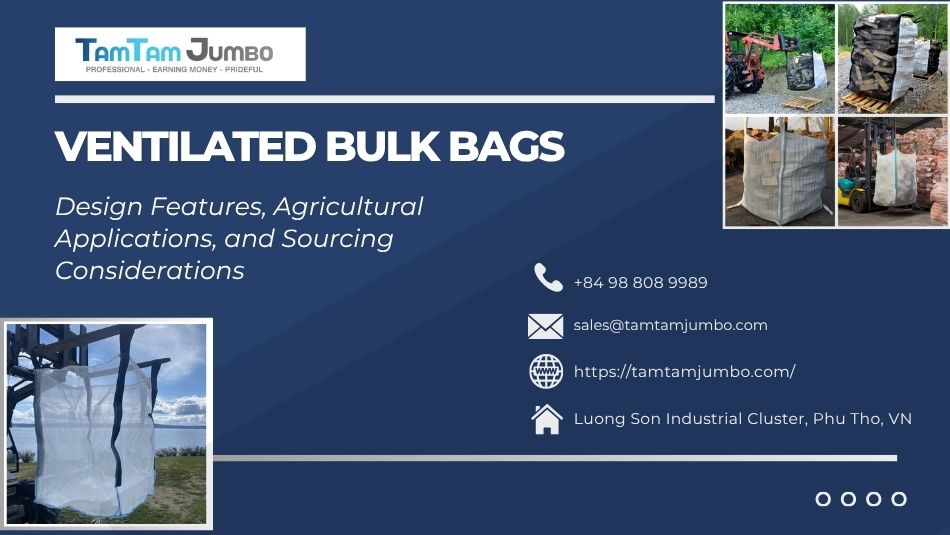
Some products lose quality faster inside a sealed bag than they would in open storage. Onions, potatoes, garlic, and firewood all generate heat and moisture as they sit in bulk, and a standard woven polypropylene bag traps both, accelerating spoilage or mold growth. A ventilated bulk bag solves this by using an open-weave or mesh fabric that allows air to pass through the bag wall, keeping produce cooler and drier during storage and transport. This article explains how a breathable bag is constructed, where ventilation should and should not be used, and what to specify when ordering one.
What Makes a Bulk Bag Ventilated
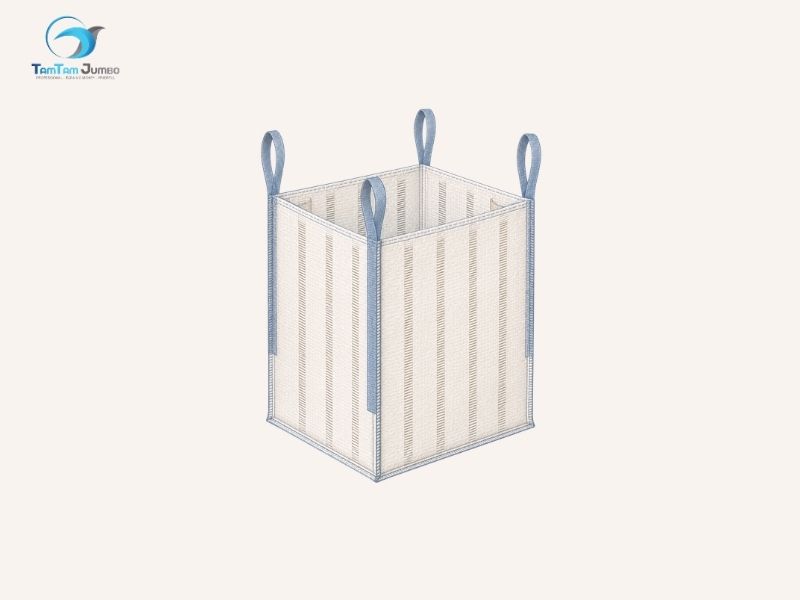
A ventilated bulk bag replaces some or all of the standard solid-weave polypropylene fabric with a more open construction that allows air to move through the bag wall. This can be achieved across the entire bag body, in alternating vertical strips, or in defined panels, depending on how much airflow the product needs versus how much containment and structural strength the bag still has to provide.
How Mesh and Leno Weave Fabric Differ From Standard PP Weave
Leno Weave Construction
Most ventilated FIBC fabric uses a leno weave, where pairs of warp yarns twist around each weft yarn instead of running straight through it, as in standard plain weave. This twisting locks the open spaces in place, so the fabric holds its mesh structure and resists unraveling even though it has far more open area than solid woven fabric. Leno weave is the standard construction across the industry for ventilated bulk bags because it balances airflow with enough mechanical stability to hold a filled load.
Airflow vs Strength Trade-off
The more open a fabric’s weave, the more air it allows through, but also the lower its tensile strength compared to a solid weave fabric of the same yarn weight. This is why most ventilated bulk bags combine mesh panels with solid fabric at load-bearing points such as the base, corners, and loop anchoring, rather than using open-weave fabric across the entire structural load path.
Read more: 4 Panel FIBC Bags: How Construction Shapes the Bulk Bag Specs
Why Certain Products Require a Breathable Bag
Fresh produce continues to respire after harvest, consuming oxygen and releasing carbon dioxide, heat, and moisture. In a sealed bag, this moisture has nowhere to go, raising humidity inside the bag and creating conditions for mold and rot. A breathable bag allows this moisture and heat to escape continuously, extending storage life and reducing the rate of spoilage compared to bulk storage in solid-walled packaging.
Full Mesh vs Partial Ventilation Designs
- Full mesh body: the entire bag body is constructed from leno weave fabric, maximizing airflow, typically used for produce with high respiration rates such as onions and garlic.
- Ventilated strip panels: alternating vertical strips of mesh and solid fabric, balancing airflow with added structural strength, common for potatoes and root vegetables.
- Ventilated base or side panels only: solid body fabric with mesh limited to specific panels, used when some airflow is needed but the product is less moisture-sensitive, such as certain firewood or bulk timber products.
The right configuration depends on how much ventilation the specific product needs balanced against how much structural strength the bag requires for its fill weight and handling method.
Specification Details for Ventilated Bulk Bag
- Mesh density and hole size, since finer mesh reduces airflow but better contains smaller produce or debris.
- Percentage of body fabric that is ventilated versus solid, and the specific placement of each.
- Fabric weight and denier for both the mesh sections and the solid reinforcement sections.
- Base and loop construction, which is almost always built from solid fabric regardless of how much of the body is ventilated.
- Safe working load and safety factor, since mesh sections generally carry less structural load than solid panels in the same bag.
- UV stabilization, since bags used for extended outdoor storage benefit from UV-treated fabric to prevent premature degradation.
Moisture Control and Spoilage Prevention
Ventilation works best as part of a broader storage strategy rather than a substitute for proper handling. Bags should be stored with enough space between them and off direct ground contact to allow airflow to actually move through the mesh rather than being blocked by adjacent bags or pallets. Produce that is wet at the time of filling will still generate excess moisture that ventilation alone cannot fully resolve, so pre-filling conditions matter as much as the bag construction itself.
Limitations of Ventilated Bags
Ventilated construction is not suitable for fine powders, granules that could sift through the mesh openings, or any product requiring protection from dust, insects, or environmental contamination. Mesh fabric also generally has lower overall strength than an equivalent weight of solid weave fabric, so ventilated bags are less commonly specified for very heavy or dense fill weights unless reinforced with solid fabric at key structural points.
Read more: Tubular Bulk Bags: Understanding Circular FIBC Construction
How Tam Tam Packaging Manufactures Ventilated Bulk Bags
Tam Tam Packaging produces ventilated bulk bags with leno weave mesh panels combined with solid fabric reinforcement at the base, corners, and loop points, specified to the buyer’s target produce and fill weight. Mesh density and panel placement are confirmed before production, and the specification sheet issued with each order documents the ratio of ventilated to solid fabric, along with fabric weight and safe working load.
Common Mistakes When Ordering Ventilated Bulk Bags
- Specifying full mesh construction for a fill weight that exceeds what the mesh fabric can safely support without solid reinforcement.
- Choosing mesh density without considering the size of the product being packed results in sifting loss through openings that are too large.
- Assuming ventilation alone will resolve spoilage issues caused by wet or damaged produce at the time of filling.
- Overlooking UV stabilization for bags that will be stored outdoors for extended periods.
- Ordering standard solid-weave bags for produce that actually requires airflow, leading to condensation and accelerated spoilage during transport.
Applications in Agriculture
A ventilated bulk bag is a standard packaging choice across agricultural produce handling, most commonly for onions, potatoes, garlic, and other root vegetables that continue to respire and release moisture after harvest. Firewood and certain bulk timber products also use ventilated construction to allow continued drying during storage and transport. Agricultural buyers typically balance mesh density against expected transit time and climate conditions, using denser mesh or higher solid fabric ratios for longer transit routes where structural durability matters more.
Frequently Asked Questions
What is a ventilated bulk bag used for?
It is used for products that continue to generate heat and moisture after packing, such as onions, potatoes, garlic, and firewood, where airflow through the bag wall helps prevent spoilage or mold.
What fabric is used to make a bag breathable?
Most ventilated bulk bags use a leno weave mesh fabric, where twisted yarn pairs hold an open structure in place without unraveling.
Are ventilated bags as strong as standard bulk bags?
Mesh sections generally carry less load than solid woven fabric, which is why most ventilated bags reinforce the base, corners, and loops with solid fabric.
Can ventilated bags be used for powders or fine granules?
No. Mesh openings allow fine material to sift through, so ventilated construction is only suitable for produce or items larger than the mesh opening size.
Do ventilated bags need UV protection?
Bags used for extended outdoor storage benefit from UV-stabilized fabric, since untreated polypropylene degrades faster under prolonged sun exposure.
Conclusion
A ventilated bulk bag exists to solve a specific problem: letting heat and moisture escape from produce that continues to respire after harvest. Choosing between full mesh, strip panels, or limited ventilation depends on the product’s moisture output, its size relative to mesh openings, and how much structural strength the bag needs for its fill weight. Getting mesh density and reinforcement right at the specification stage is what keeps a breathable bag performing as intended through storage and transport.
Tam Tam Packaging Co. manufactures ventilated bulk bags with mesh density and reinforcement matched to your produce and fill weight. Contact our team to confirm the right specification for your application.
Contact Us
Tam Tam Packaging Co.
Email: sales@tamtamjumbo.com
Website: https://tamtamjumbo.com/
Read more
FIBC Bags for Flour: Why Allergen Status Change the Specification
Flour shares the fine-particle and combustible dust characteristics of other food powders, but wheat’s status...
Aug
FIBC Bag for Starch Powder: Dustproof Bag Needs Antistatic
Starch powder occupies an unusual position in FIBC specification: it is a common food and...
Aug
FIBC Bags for Animal Feed: What Actually Makes a Clean Bulk Bag
FIBC bags for animal feed mean something more specific than a bag that looks unused....
Aug
FIBC Bag for PET Flakes: Why UV Resistance Matter More Than It
Recycled PET flakes share a base polymer with virgin resin pellets, but the two behave...
Aug
FIBC Bags for Plastic Resin: PP Fabric Packaging PP Pellets
There is a certain irony in shipping polypropylene resin pellets inside a bag woven from...
Aug
FIBC Bags for the Food Industry: Building a Food Grade Bag
Food manufacturers sourcing bulk ingredient packaging are working from a different starting point than a...
Aug