

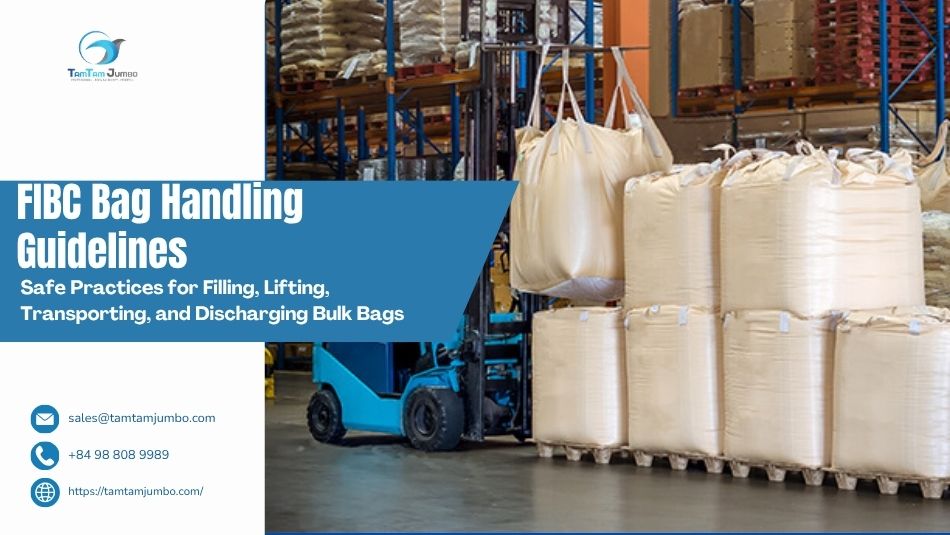
Handling technique affects bag performance just as much as fabric specification does, and it’s the one variable that stays entirely in the hands of whoever is filling, lifting, transporting, and discharging the bag day to day. This guide covers the practical handling guidelines that apply to any FIBC bags, and the additional inspection and tracking discipline a multi-trip FIBC program needs to actually deliver the reuse cycles it’s rated for.
Handling Guidelines Apply From First Lift to Final Discharge
A bag’s tested safe working load and construction quality only translate into real-world performance if handling practice stays within the conditions the testing assumed. Rough handling at any single stage, filling, transport, or discharge, can undermine a bag rated well above the actual fill weight.
Read more: FIBC Safe Working Load: What a Big Bag 1000kg Actually Means
Correct Lifting Technique and Sling Angle
Loops should be lifted with an angle and attachment method matching the loop configuration the bag was designed for, since a sling angle outside the intended range changes how load transfers through the loop and body seams. Sudden or jerking lifts introduce dynamic load well above the bag’s static fill weight, which is a common way bags fail even when comfortably within their rated static capacity.
Filling Procedures That Avoid Shock Loading
Filling should proceed at a controlled rate that allows the bag to settle and take shape gradually, since a sudden mass of material dropped into an unsupported bag creates momentary shock loading concentrated at the base seam. Bags should be adequately supported during filling, whether by a filling frame or spout connection, rather than left to hang freely under an uncontrolled fill stream.
Securing Bags During Transport
Bags should be secured against excessive shifting or vibration during transport, particularly for road transport over long distances or rough terrain, since repeated micro-movement against other bags or the vehicle structure causes abrasion wear over time. Loose stacking that allows bags to shift against each other accelerates this wear compared to a properly secured, stable load.
Discharge Handling to Avoid Spout and Seam Stress
Discharge should follow the closure method the spout was designed for, tie-off, clamp, or Iris mechanism, rather than forcing an opening method the spout wasn’t built to handle. Cutting into a bag not intended for that discharge method, or repeatedly forcing a spout connection that doesn’t fit cleanly, stresses the spout base seam in ways that shorten its service life even on a bag otherwise rated for reuse.

Read more: FIBC Bottom Discharge Types: How an Iris Closure Controls Flow
What Changes for Multi-Trip FIBC Bags
A multi-trip FIBC bag is rated to a 6:1 safety factor specifically to account for cumulative wear across repeated use cycles, but that rating assumes handling practice stays within reasonable bounds across every one of those cycles, not just the first. Multi-trip programs need handling discipline maintained consistently, since a single rough handling event can undo much of the durability margin the higher safety factor was meant to provide.
Read more: FIBC Label Requirements: Reading 5:1 vs 6:1 Markings Correctly
Inspection Checklist Between Each Trip
- Check seams, particularly the base and loop anchoring points, for any visible stitch damage or fraying.
- Inspect fabric for tears, punctures, or thinning at points of repeated contact or folding.
- Check loops for fraying, cuts, or uneven wear that could indicate an anchoring issue.
- Confirm the spout and closure mechanism still seals and functions as designed.
- Check for visible UV degradation signs, fading, chalking, or brittleness, if the bag has spent time in outdoor storage between trips.

Read more: FIBC UV Protection: What Outdoor Bag Storage Actually Requires
Tracking Trip Count Against the Rated Multi-Trip Limit
Multi-trip bags are rated for a specific number of use cycles based on their testing, and a simple tracking system, whether a physical tag marked at each use or a logged batch and trip count, keeps individual bags from exceeding that rated limit unnoticed. Bags approaching their rated trip limit should be inspected more carefully and retired proactively rather than kept in rotation until an actual failure occurs.
Training Staff on Handling Guidelines
Handling guidelines only work if the people actually filling, lifting, and discharging bags day to day know them, which makes basic training and visible reference material at the point of use more valuable than a guideline document that exists only in a procurement file. Forklift operators and filling station staff are in the best position to catch handling issues early if they understand what to look for.
Read more: Common FIBC Bag Failures: How a Jumbo Bag Supplier Prevents
How Tam Tam Packaging Supports Multi-Trip Bag Programs
Tam Tam Packaging builds multi-trip bags to the 6:1 safety factor with reinforced base and loop stitching matched to the buyer’s expected trip count, and provides guidance on realistic inspection intervals based on the specific handling conditions and cycle frequency involved.
Common Handling Mistakes That Shorten Bag Life
- Lifting with a sling angle or attachment method the loop configuration wasn’t designed for.
- Filling too quickly, creating shock loading concentrated at the base seam.
- Forcing a discharge method the spout wasn’t built to handle.
- Skipping inspection between trips on multi-trip bags, allowing damage to accumulate unnoticed.
- Not tracking trip count, leading to bags exceeding their rated reuse limit without anyone realizing it.
Applications in Multi-Trip Industrial Handling
Mining and mineral processing operations commonly run dedicated multi-trip bag fleets between processing sites and export terminals, where consistent handling discipline and inspection between trips directly affects how many cycles a fleet actually achieves before bags need replacement. Facilities running high-frequency multi-trip programs benefit most from formal inspection checklists and trip tracking, since the cumulative effect of even small handling lapses compounds significantly at that scale.
Read more: FIBC Bags for Minerals: A Jumbo Bag Specification Guide
Frequently Asked Questions
What is the most important handling guideline for FIBC bags?
Avoiding shock loading during lifting and filling, since sudden or jerking movements introduce dynamic load well above the bag’s static fill weight, a common cause of failure even within rated static capacity.
How often should a multi-trip FIBC bag be inspected?
Between every trip, checking seams, fabric, loops, and spout function, with more careful inspection as a bag approaches its rated trip limit.
What is the difference between single-trip and multi-trip handling requirements?
Multi-trip bags are rated to a higher 6:1 safety factor to account for cumulative wear, but that rating still assumes consistent, careful handling across every cycle, not just the first use.
How do I track how many trips a multi-trip bag has completed?
Through a physical tag marked at each use or a logged batch and trip count system, allowing bags approaching their rated limit to be identified and retired proactively.
Does staff training actually affect bag failure rates?
Yes. Handling guidelines only prevent failures if the people filling, lifting, and discharging bags day to day know and follow them, making training and visible reference material a practical necessity.
Conclusion
Handling technique determines whether a bag’s tested rating translates into real-world performance, and multi-trip FIBC programs specifically depend on consistent handling discipline and inspection across every cycle, not just careful treatment on day one. Formal inspection checklists and trip tracking are what actually make a multi-trip program deliver the reuse cycles it was rated for.
Tam Tam Packaging Co. builds multi-trip bags to your expected cycle count and can help establish realistic inspection intervals for your handling conditions. Contact our team to discuss your multi-trip program.
Contact Us
Tam Tam Packaging Co.
Email: sales@tamtamjumbo.com
Website: https://tamtamjumbo.com/
Read more
FIBC Bag Handling Guidelines: What Changes for a FIBC Program
Handling technique affects bag performance just as much as fabric specification does, and it’s the...
Sep
Common FIBC Bag Failures: How a Jumbo Bag Supplier Prevents
Nearly every FIBC bag failure traces back to one of a handful of root causes,...
Sep
How to Stack FIBC Bag Safely: Why Baffle Bag Behaves Differently
Stacking height limits aren’t a matter of judgment call or common sense alone; they come...
Sep
How to Store FIBC Bags: Getting the Most From UV Additive
A bag manufactured with a strong UV additive package can still fail early if it’s...
Sep
Bulk Bags for Export: What to Ask a Big Bag Supplier in Vietnam
A bag that performs perfectly in short domestic truck transport can still fail on a...
Sep

FIBC Bags for Seed Packaging: Choosing Right Liner for Viability
Seed packaging has a goal most other bulk commodities don’t share: keeping the product alive....
Sep