

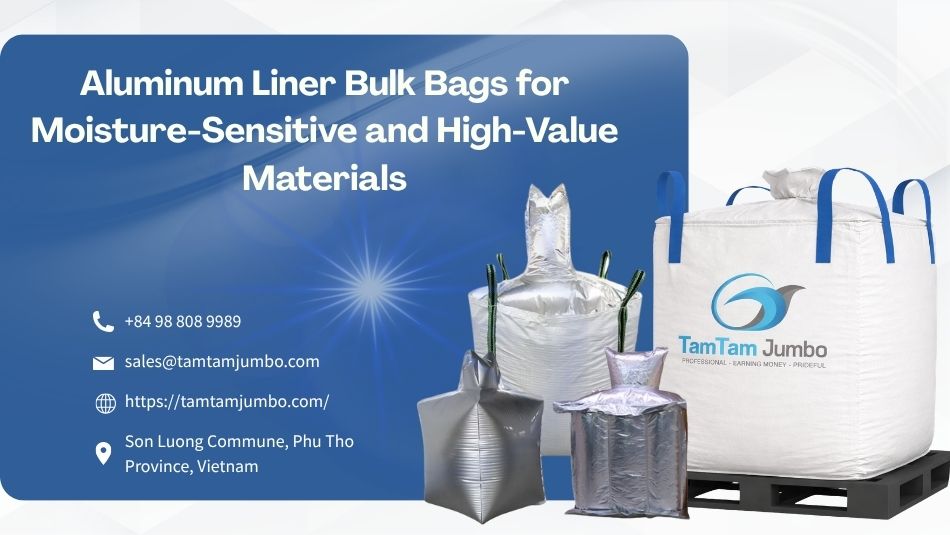
Aluminum liner bulk bags are specialized FIBC solutions designed for products that require high barrier protection against moisture, oxygen, UV light, and contamination. These bags combine the structural strength of woven polypropylene bulk bags with the barrier performance of aluminum foil or aluminum-laminated liners.
Industries handling sensitive powders, food ingredients, chemicals, pharmaceuticals, battery materials, and engineered polymers often use aluminum liner bulk bags to maintain product stability during storage and international transportation.
This article explains how aluminum liner bulk bags are constructed, where they are used, how they compare to standard PE liners, and what buyers should evaluate before sourcing them for industrial applications.
At Tam Tam Packaging Co., Ltd, aluminum liner solutions are manufactured according to product sensitivity, filling systems, transportation conditions, and export packaging requirements.
What Are Aluminum Liner Bulk Bags?
Aluminum liner bulk bags are FIBC bags equipped with an inner liner made from aluminum foil laminate or multi-layer aluminum barrier film. The liner creates a high-performance barrier inside the bulk bag to protect sensitive materials from environmental exposure.
The outer layer is typically a woven polypropylene jumbo bag, while the inner liner may consist of:
- PET/AL/PE structures
- PET/AL/PA/PE multi-layer laminates
- Aluminum foil composite films
- Vacuum-compatible barrier liners
These liners are commonly integrated into:
- U-panel FIBC bags
- Circular bulk bags
- Baffle bulk bags
- Conductive or antistatic FIBCs
Why Aluminum Liners Are Used in FIBC Bulk Bags
Standard woven polypropylene bags provide structural strength but limited barrier protection. Many industrial products require stronger protection against external environmental factors.
Aluminum liners are used because they offer:
- Extremely low moisture transmission
- Oxygen barrier protection
- UV resistance
- Odor containment
- Improved contamination control
- Better product shelf stability
Aluminum foil barrier liners can block more than 99% of water vapor and oxygen transmission, depending on the laminate structure.
This level of protection is especially important for hygroscopic powders, oxidation-sensitive products, and export cargo exposed to long shipping cycles.
Structure of Aluminum Liner Bulk Bags
Outer FIBC Construction
The external bulk bag is typically manufactured using UV-stabilized polypropylene woven fabric with lifting loops for forklift or crane handling.
Common bag constructions include:
- Circular woven bags
- U-panel bulk bags
- 4-panel FIBCs
- Baffle jumbo bags
The outer bag provides:
- Load-bearing strength
- Transportation stability
- Stacking capability
- Mechanical protection
Internal Aluminum Barrier Liner
The liner itself is produced from multi-layer laminated film.
A typical structure may include:
| Layer | Function |
| PET | Mechanical strength |
| Aluminum foil | Moisture and oxygen barrier |
| PA/Nylon | Puncture resistance |
| PE | Heat sealing and flexibility |
The aluminum layer acts as the primary vapor barrier inside the bag.
Common Types of Aluminum Liner Bulk Bags
Loose Aluminum Liners
Loose liners are inserted separately into the FIBC before filling.
Advantages:
- Lower production cost
- Flexible replacement
- Suitable for general industrial use
Limitations:
- Potential liner movement during filling
- Higher risk of wrinkling
Form-Fit Aluminum Liners
Form-fit liners are manufactured to match the shape of the bulk bag and are attached internally.
Advantages:
- Better filling efficiency
- Improved discharge flow
- Reduced liner collapse
- Better bag stability
These are commonly used in automated filling systems and pharmaceutical-grade applications.
Aluminum Baffle Liners
These liners include internal baffles to maintain a square bag shape during filling and transportation.
Benefits include:
- Better container utilization
- Improved stackability
- Reduced bag deformation
Vacuum Aluminum Liners
The liners are designed for oxygen-sensitive products and vacuum sealing operations.
They are often used for:
- Specialty chemicals
- Battery powders
- Engineered polymers
- Food ingredients
Aluminum Liner vs Standard PE Liner
| Feature | Aluminum Liner | Standard PE Liner |
| Moisture barrier | Excellent | Moderate |
| Oxygen barrier | Excellent | Limited |
| UV protection | High | Low |
| Odor containment | Strong | Moderate |
| Cost | Higher | Lower |
| Vacuum compatibility | Yes | Limited |
| Product protection | High sensitivity materials | General bulk materials |
| Typical industries | Pharma, food, chemicals | Agriculture, minerals |
For highly sensitive products, aluminum liners provide significantly stronger barrier performance compared to standard polyethylene liners.
Industries Using Aluminum Liner Bulk Bags
Food Ingredients
Food-grade bulk materials often require protection against moisture absorption and oxidation.
Applications include:
- Milk powder
- Starch
- Spice blends
- Yeast powder
- Nutritional additives
Aluminum liners help maintain product freshness and reduce contamination risk.
Chemical Industry
Chemical products sensitive to humidity or air exposure commonly use aluminum-lined FIBCs.
Examples:
- Fine chemicals
- Polymer resins
- Additives
- Reactive powders
Pharmaceutical Applications
Pharmaceutical materials require controlled packaging environments with low contamination risk.
Aluminum barrier liners support:
- Moisture control
- Oxygen protection
- Product purity
Battery and Electronic Materials
Lithium battery materials and conductive powders are highly sensitive to moisture.
High-barrier aluminum liners are increasingly used for:
- Cathode materials
- Conductive powders
- Specialty compounds
Agricultural Exports
Some agricultural products require enhanced moisture protection during long ocean transportation.
Typical applications:
- Seeds
- Food additives
- Export-grade powders
Important Technical Considerations for Buyers
Barrier Performance
Buyers should evaluate:
- Moisture vapor transmission rate (MVTR)
- Oxygen transmission rate (OTR)
- Seal integrity
High-performance aluminum liners may achieve extremely low MVTR and OTR values for sensitive cargo protection.
Liner Attachment Method
Common attachment methods include:
- Loose insertion
- Tabbed liners
- Glued liners
- Sewn liners
Attached liners generally improve filling stability and reduce liner displacement during transport.
Filling and Discharge Design
The liner configuration must match the filling system.
Options include:
- Top filling spouts
- Bottom discharge spouts
- Heat-sealed closures
- Open-top liners
Static Protection Requirements
Certain products require antistatic or conductive protection in addition to moisture barriers.
In these cases, aluminum liners may be integrated into:
- Type C FIBCs
- Type D bulk bags
- Conductive liner systems
Transportation Conditions
Export buyers should consider:
- Ocean freight humidity
- Long storage periods
- Tropical climates
- Temperature fluctuations
These factors directly influence liner selection.
Manufacturing Considerations in Aluminum Liner Bulk Bags
At Tam Tam Packaging Co., Ltd, liner production and bulk bag integration are coordinated carefully to maintain dimensional accuracy and sealing consistency.
Several production factors directly affect final performance:
Film Thickness Control
Insufficient thickness may reduce:
- Barrier performance
- Puncture resistance
- Seal reliability
Heat Sealing Quality
Poor sealing can compromise:
- Moisture resistance
- Vacuum performance
- Contamination control
Dimensional Compatibility
Improper liner sizing may create:
- Wrinkles
- Filling inefficiency
- Discharge problems
Factories with integrated liner and FIBC production typically achieve better fitting consistency.
Common Problems Caused by Incorrect Liner Selection
Using the wrong liner structure may result in:
- Powder caking
- Moisture absorption
- Product oxidation
- Odor leakage
- Reduced shelf life
- Cargo contamination
In industrial exports, these issues can lead to product rejection and financial losses.
Frequently Asked Questions
What is the purpose of an aluminum liner in bulk bags?
An aluminum liner creates a high barrier against moisture, oxygen, UV light, and contamination inside an FIBC bulk bag.
Are aluminum liner bulk bags food grade?
Yes. Food-grade aluminum liners are commonly used for food ingredients, starch, dairy powders, and nutritional products when manufactured under appropriate standards.
Can aluminum liners be vacuum sealed?
Yes. Many aluminum foil liners are designed for vacuum packaging applications.
What products typically require aluminum liner FIBCs?
Sensitive powders, pharmaceuticals, chemicals, engineered polymers, battery materials, and moisture-sensitive food ingredients commonly require aluminum liner protection.
Are aluminum liners reusable?
Reusability depends on contamination risk and product requirements.
Conclusion
Compared with standard liners, aluminum barrier liners provide significantly stronger resistance to moisture, oxygen, UV exposure, and contamination. Their performance makes them suitable for pharmaceutical ingredients, food additives, battery materials, fine chemicals, and other sensitive bulk products.
For international buyers, liner selection should be based on product sensitivity, shipping conditions, filling systems, and storage requirements rather than price alone. Small differences in liner structure, sealing quality, and integration methods can significantly affect packaging reliability.
Tam Tam Packaging Co., Ltd manufactures customized aluminum liner bulk bags for industrial export applications with tailored liner configurations, barrier structures, and FIBC designs based on customer requirements.
Contact Us
Tam Tam Packaging Co., Ltd
Email: sales@tamtamjumbo.com
Website: tamtamjumbo.com
Read more
FIBC Bags for Flour: Why Allergen Status Change the Specification
Flour shares the fine-particle and combustible dust characteristics of other food powders, but wheat’s status...
Aug
FIBC Bag for Starch Powder: Dustproof Bag Needs Antistatic
Starch powder occupies an unusual position in FIBC specification: it is a common food and...
Aug
FIBC Bags for Animal Feed: What Actually Makes a Clean Bulk Bag
FIBC bags for animal feed mean something more specific than a bag that looks unused....
Aug
FIBC Bag for PET Flakes: Why UV Resistance Matter More Than It
Recycled PET flakes share a base polymer with virgin resin pellets, but the two behave...
Aug
FIBC Bags for Plastic Resin: PP Fabric Packaging PP Pellets
There is a certain irony in shipping polypropylene resin pellets inside a bag woven from...
Aug
FIBC Bags for the Food Industry: Building a Food Grade Bag
Food manufacturers sourcing bulk ingredient packaging are working from a different starting point than a...
Aug