
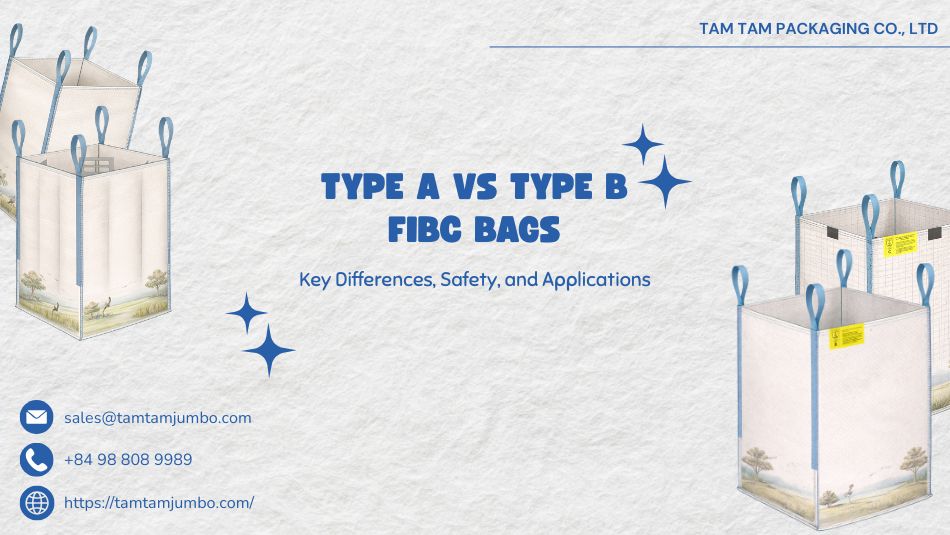
When sourcing bulk bags, many buyers compare type A vs type B FIBC bags to determine the most cost-effective and safe solution.
At first glance, both types appear similar—but in practice, choosing the wrong one can result in:
- Static-related safety risks
- Non-compliance in certain industries
- Operational inefficiencies
From a manufacturer’s perspective, the difference between Type A and Type B is not just technical—it directly impacts safety, application suitability, and regulatory compliance.
In this guide, Tam Tam Packaging Co. provides a clear, practical comparison to help B2B buyers make the right decision.
What Are Type A and Type B FIBC Bags?
Type A FIBC Bags
Standard bulk bags made from woven polypropylene with no electrostatic protection.
- No static dissipation
- No spark prevention
- Suitable for non-hazardous materials
Type B FIBC Bags
Bulk bags designed with low breakdown voltage fabric to reduce the risk of high-energy static discharges.
- Limits dangerous spark formation
- Does NOT dissipate static completely
- Offers slightly higher safety than Type A
Key Differences – Type A vs Type B FIBC Bags
| Criteria | Type A | Type B |
| Static protection | ❌ None | ⚠️ Limited |
| Spark risk | High | Reduced |
| Grounding required | ❌ No | ❌ No |
| Suitable for flammable powders | ❌ No | ⚠️ Limited |
| Suitable for flammable gases | ❌ No | ❌ No |
| Cost | Lower | Slightly higher |
👉 Key takeaway:
Type B offers improved safety over Type A, but it is not a fully anti-static solution.
How Static Electricity Affects FIBC Bags
Static electricity is generated during:
- Filling
- Discharging
- Movement and friction
Why it matters:
- Sparks can ignite flammable dust or gases
- High-energy discharge can cause explosions
Behavior by type:
- Type A:
- Generates static
- No control → high risk
- Type B:
- Reduces high-energy discharges
- Still cannot safely dissipate charge
👉 Manufacturer insight:
Most safety issues are not due to bag failure, but due to incorrect selection for the environment.
Applications – When to Use Type A vs Type B
When to Use Type A FIBC Bags
Suitable for some industries:
- Agriculture (grains, seeds)
- Construction materials (sand, cement)
- Non-flammable products
✔ Conditions:
- No flammable dust
- No explosive environment
When to Use Type B FIBC Bags
Suitable for:
- Dry powders with low ignition risk
- Industries requiring a slightly higher safety margin
✔ Conditions:
- Dust present but not highly explosive
- No flammable gases or vapors
👉 Important:
Type B is often misunderstood as “safe for chemicals”—this is NOT always true.
Read More: What Is Type B FIBC Bag? Complete Guide to Anti-Static Bulk Bags
Type A vs Type B – Cost vs Risk Analysis
From a B2B buyer perspective:
✔ Type A
- Lower cost
- Suitable for low-risk applications
✔ Type B
- Slightly higher cost
- Reduced static hazard
- Better for regulated environments
👉 Real-world insight:
Choosing Type A to save cost in borderline applications often leads to:
- Safety concerns
- Compliance issues
- Higher long-term cost
Common Mistakes Buyers Make
❌ Assuming Type B is fully anti-static
→ It is NOT equivalent to Type C or Type D
❌ Choosing Type A based only on price
→ Ignores safety requirements
❌ Ignoring environmental conditions
→ Leads to incorrect specification
❌ Not consulting the manufacturer
→ Results in a mismatch between the bag and the application
From Production & Export Experience
At Tam Tam Packaging Co., we have observed:
🔍 Key pattern:
- 70% of buyers initially choose Type A
- 30–40% later upgrade after understanding risk
👉 Expert insight:
The correct choice between Type A vs Type B FIBC bags is not about cost—it is about risk tolerance and application suitability.
How to Choose Between Type A and Type B
Use this decision framework:
✔ Step 1: Identify material
- Non-flammable → Type A
- Powder → consider Type B
✔ Step 2: Evaluate environment
- No risk → Type A
- Dust present → Type B
✔ Step 3: Check regulations
- Strict market (EU) → prefer Type B or higher
✔ Step 4: Consider future scalability
- If expanding to the chemical sector → avoid Type A
Quick Summary
- Type A = no static protection, lowest cost
- Type B = limited static control, safer than Type A
- Both:
- Do NOT require grounding
- Are NOT suitable for flammable gases
- Type B reduces spark risk but is NOT fully anti-static
- Correct choice depends on:
- Material
- Environment
- Safety requirements
FAQ – Type A vs Type B FIBC Bags
1. What is the main difference between Type A and Type B FIBC bags?
Type A has no static protection, while Type B reduces high-energy static discharges.
2. Is Type B FIBC bag anti-static?
No. It only provides limited static control and does not fully dissipate charges.
3. Which is safer: Type A or Type B?
Type B is safer due to reduced spark risk.
4. Can Type B be used for chemicals?
Only in low-risk conditions. For hazardous environments, Type C or D is required.
5. Why is Type A still widely used?
Because it is cost-effective and suitable for non-hazardous materials.
Conclusion
Understanding the difference between type A vs type B FIBC bags is essential for safe and efficient bulk packaging.
While both types are widely used, the correct choice depends on:
- Application
- Environment
- Safety requirements
Working with a manufacturer ensures that your packaging solution is both cost-effective and compliant.
Contact Us
Looking for a reliable FIBC bags manufacturer?
Tam Tam Packaging Co. provides high-quality, customizable bulk bags tailored to your industry requirements.
- 📧 Email: sales@tamtamjumbo.com
- 🌐 Website: https://tamtamjumbo.com/
👉 Contact us today for expert consultation and quotation.
Read more
FIBC Bags for Flour: Why Allergen Status Change the Specification
Flour shares the fine-particle and combustible dust characteristics of other food powders, but wheat’s status...
Aug
FIBC Bag for Starch Powder: Dustproof Bag Needs Antistatic
Starch powder occupies an unusual position in FIBC specification: it is a common food and...
Aug
FIBC Bags for Animal Feed: What Actually Makes a Clean Bulk Bag
FIBC bags for animal feed mean something more specific than a bag that looks unused....
Aug
FIBC Bag for PET Flakes: Why UV Resistance Matter More Than It
Recycled PET flakes share a base polymer with virgin resin pellets, but the two behave...
Aug
FIBC Bags for Plastic Resin: PP Fabric Packaging PP Pellets
There is a certain irony in shipping polypropylene resin pellets inside a bag woven from...
Aug
FIBC Bags for the Food Industry: Building a Food Grade Bag
Food manufacturers sourcing bulk ingredient packaging are working from a different starting point than a...
Aug