


Picking a bag size from a standard capacity chart works fine when a product’s density is close to what that chart assumed. It works poorly when it isn’t, since two products at the same target fill weight can require very different bag volumes depending on how dense the material actually is. This guide walks through calculating bag dimensions from bulk density directly, matching footprint to pallet standards, and getting the other specification fields to line up with the dimensions you land on.
Why Dimensions Start With Bulk Density, Not a Standard Chart
A standard capacity chart assumes a rough average bulk density for the product category it is built around, which works as a starting reference but breaks down for materials significantly denser or lighter than that assumption. A dense mineral powder and a light, fluffy agricultural byproduct can both target the same 1000 kilogram fill weight while needing meaningfully different bag volumes, since the mineral powder packs far more weight into the same space.
Read more: FIBC Bag Sizes Explained: Matching SWL to Common Capacity
Calculating Bag Volume From Target Fill Weight
The basic calculation divides target fill weight by the product’s bulk density to arrive at the required internal volume, then that volume is distributed across width, length, and height based on the intended construction type and footprint constraints. Bulk density should be measured for the actual product as it will be filled, including any settling or aeration effects, rather than taken from a generic reference value for the material category, since real-world bulk density can vary meaningfully based on particle size, moisture content, and handling method.
Read more: FIBC Bag Construction Types: Circular, U and 4 Panel Compared
Matching Bag Footprint to Pallet Standards
Once volume is established, footprint dimensions should be checked against the pallet standard the bag will actually sit on, since a bag that overhangs its pallet creates handling and stacking problems regardless of how well the volume calculation worked out.
Euro Pallet Footprint
Euro pallets measure 1000 by 1200 millimeters, common across European and many international supply chains, and bag footprint is often sized to sit within or close to this dimension for efficient single-bag-per-pallet loading.
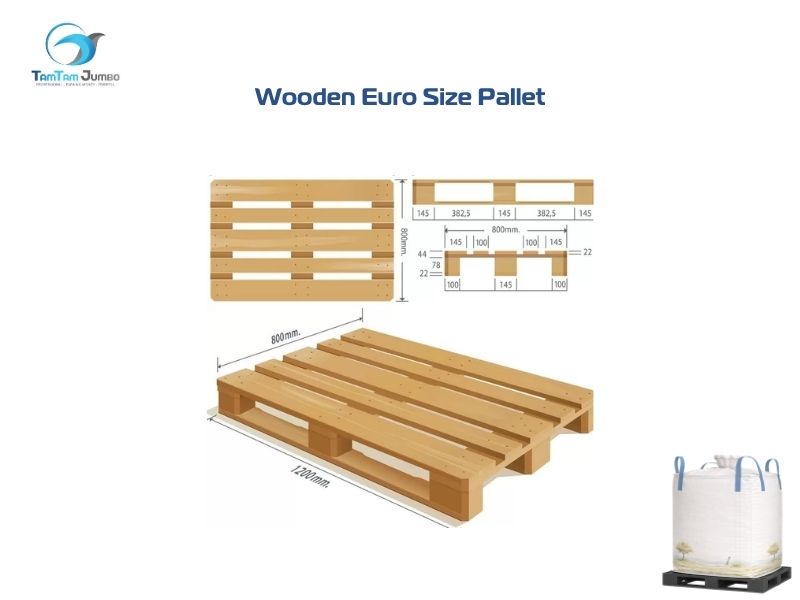
GMA Pallet Footprint
GMA pallets, the standard in North America, measure 1016 by 1219 millimeters, close to but not identical to the Euro pallet standard, which matters for buyers shipping between regions using different pallet conventions.
| Pallet Standard | Footprint Dimensions | Common Region |
| Euro Pallet | 1000 x 1200 mm | Europe and many international routes |
| GMA Pallet | 1016 x 1219 mm | North America |
| Custom Footprint | Varies by warehouse or equipment | Facility-specific automated systems |
Height-to-Footprint Ratio and Stability
A bag with a tall, narrow profile relative to its footprint is more prone to tipping during transport and single-layer storage than a bag with a more balanced height-to-footprint ratio, even at the same total volume. This becomes particularly relevant for lighter, lower-density products that require large volumes to reach target fill weight, since maintaining a stable ratio may mean widening the footprint rather than simply increasing height to accommodate the needed volume.
Filled Dimensions vs Folded (Empty) Dimensions
Filled dimensions determine warehouse and container planning once product is loaded, while folded or empty dimensions determine how efficiently unfilled bags can be shipped and stored before use. A specification sheet should list both, since a buyer receiving a large shipment of empty bags needs to plan storage and freight space for the folded dimensions, which are unrelated to the eventual filled footprint.
How Dimensions Interact With Other Specification Fields
Dimensions do not exist independently from fabric weight, loop configuration, or safe working load. A larger calculated volume at a given target fill weight generally means the product is less dense, which affects how load is distributed across the bag body and can change fabric and seam requirements even at the same overall fill weight as a denser, smaller-volume product. Buyers finalizing custom dimensions should confirm the fabric and construction specification was calculated for the actual dimensions, not carried over from a standard size assumption.
Read more: FIBC Safe Working Load: What a Big Bag 1000kg Actually Means
Specification Details for Custom Dimension Orders
- Target fill weight and measured bulk density for the actual product.
- Required footprint, referencing the specific pallet standard in use.
- Height-to-footprint ratio, confirmed for stability at the calculated volume.
- Both filled and folded dimensions, documented separately.
- Confirmation that fabric and construction specifications were calculated for the actual custom dimensions rather than adapted from a standard size.
How Tam Tam Packaging Calculates Custom Dimensions
Tam Tam Packaging calculates bag dimensions from the buyer target fill weight and actual measured bulk density, checking footprint against the relevant pallet standard and confirming height-to-footprint ratio for stability before finalizing a custom specification. Both filled and folded dimensions are documented on the specification sheet, along with fabric and construction details calculated specifically for the resulting bag volume.
Common Dimensioning Mistakes
- Using a generic bulk density assumption instead of measuring the actual product’s density.
- Sizing footprint without checking it against the actual pallet standard used in the supply chain.
- Increasing height to accommodate volume for low-density products without checking the resulting stability ratio.
- Overlooking folded dimensions when planning freight and storage space for empty bag shipments.
- Carrying over standard-size fabric and construction specifications to a custom-dimensioned bag without recalculating.
Applications in Environmental and Waste Management
Environmental and waste handling operations deal with highly variable bulk densities depending on the material, from dense contaminated soil to lightweight, aerated recyclable material, making density-based dimension calculation particularly important in this sector rather than defaulting to a standard capacity chart built around a different material category. Facilities handling multiple waste stream types often need several distinct bag dimension specifications rather than a single standard size across all materials.
Frequently Asked Questions
Why can’t I just use a standard capacity chart for bag dimensions?
Standard charts assume an average bulk density for a general product category, which can be significantly off for materials denser or lighter than that assumption, resulting in a bag volume that doesn’t match your actual product.
How do I calculate the bag volume I need?
Divide your target fill weight by the product’s measured bulk density to get the required internal volume, then distribute that volume across width, length, and height based on construction type and footprint constraints.
What is the difference between a Euro pallet and a GMA pallet footprint?
Euro pallets measure 1000 by 1200 millimeters and are common internationally, while GMA pallets measure 1016 by 1219 millimeters and are the standard in North America.
Why does height-to-footprint ratio matter?
A tall, narrow bag relative to its footprint is more prone to tipping during transport and storage, even at the same total volume as a more balanced profile.
Should a specification sheet list both filled and folded dimensions?
Yes. Filled dimensions matter for warehouse and container planning once loaded, while folded dimensions matter for shipping and storing empty bags before use.
Conclusion
Calculating FIBC bag dimensions from actual measured bulk density, rather than a standard capacity chart, produces a bag that genuinely fits your product, pallet standard, and stability requirements. Buyers working with unusual density products or custom pallet footprints get the most accurate specification by starting from this calculation rather than adapting a generic size.
Tam Tam Packaging Co. calculates custom bag dimensions from your product’s bulk density and pallet standard. Contact our team to work through the right dimensions for your application.
Contact Us
Tam Tam Packaging Co.
Email: sales@tamtamjumbo.com
Website: https://tamtamjumbo.com/
WhatsApp: +84 92 852 3288
Read more

FIBC Bags for Flour: Why Allergen Status Change the Specification
Flour shares the fine-particle and combustible dust characteristics of other food powders, but wheat’s status...
Aug
FIBC Bag for Starch Powder: Dustproof Bag Needs Antistatic
Starch powder occupies an unusual position in FIBC specification: it is a common food and...
Aug
FIBC Bags for Animal Feed: What Actually Makes a Clean Bulk Bag
FIBC bags for animal feed mean something more specific than a bag that looks unused....
Aug

FIBC Bag for PET Flakes: Why UV Resistance Matter More Than It
Recycled PET flakes share a base polymer with virgin resin pellets, but the two behave...
Aug
FIBC Bags for Plastic Resin: PP Fabric Packaging PP Pellets
There is a certain irony in shipping polypropylene resin pellets inside a bag woven from...
Aug

FIBC Bags for the Food Industry: Building a Food Grade Bag
Food manufacturers sourcing bulk ingredient packaging are working from a different starting point than a...
Aug