

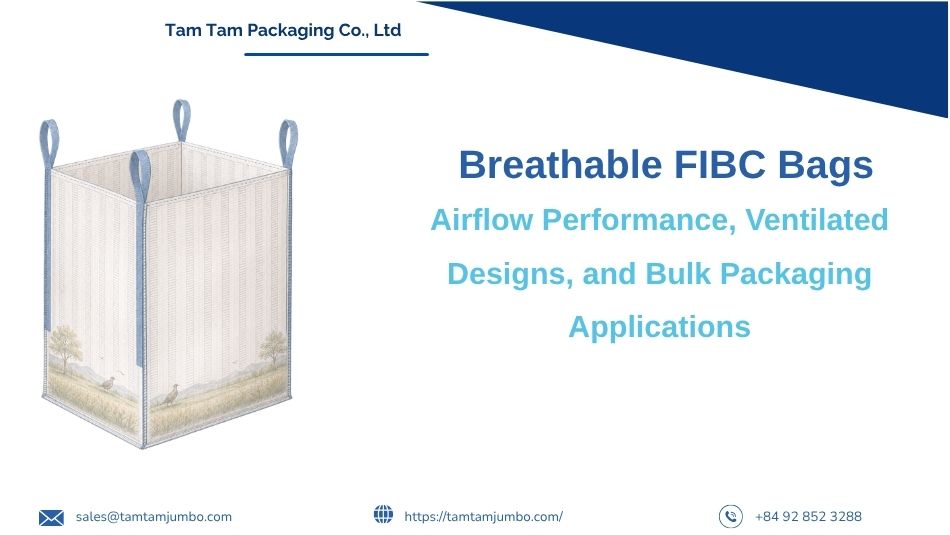
Buyers moving from small mesh sacks to bulk mesh big bags for the first time usually ask the wrong first question. The construction of the mesh fabric matters less at the buying stage than matching mesh gauge to the actual product, understanding how much structural strength a breathable bag can offer at scale, and planning for the export and handling conditions the bags will actually face. This guide walks through those buying decisions directly, from mesh gauge selection through supplier evaluation, for anyone sourcing breathable FIBC bags in bulk for the first time.
What Makes an FIBC Bag Breathable
A breathable FIBC bag replaces some or all of its solid woven body with an open leno weave mesh fabric that allows air to move through the bag wall, letting heat and moisture escape from produce that continues to respire after harvest. The construction details behind this, including weave type and how mesh sections are reinforced with solid fabric at load-bearing points, are covered in depth elsewhere; this guide focuses on the buying decisions that matter once you already know you need a breathable bag.
Read more: Ventilated Bulk Bags: When a Breathable Bag Matters for Fresh Produce
Mesh Big Bag vs Small Format Mesh Sacks: Why Buyers Choose Bulk
Operations moving from small mesh sacks, typically holding 20 to 50 kilograms, to bulk mesh big bags do so primarily to reduce handling labor and improve throughput at packing and loading stations. A single mesh big bag replacing dozens of small sacks means fewer individual units to move, stack, and load, which matters most for exporters working with forklift or crane-based handling rather than manual labor. The trade-off is that bulk bags concentrate more product per unit, so airflow and structural design both need to scale accordingly rather than simply being a larger version of the same small-format mesh construction.
Matching Mesh Gauge to Your Produce
Mesh opening size needs to be small enough to contain the product without excessive loss, but open enough to provide meaningful airflow. The right gauge depends heavily on the size and shape of what is being packed.
| Produce Type | Typical Mesh Consideration | Ventilation Priority |
| Onions and garlic | Finer gauge to contain smaller bulbs and loose skins | High, due to strong respiration and curing needs |
| Potatoes | Moderate gauge, balanced against fill weight and bruising risk | Moderate to high |
| Root vegetables (carrots, beets) | Moderate gauge with attention to fines and soil residue | Moderate |
| Firewood and bulk timber | Coarser gauge acceptable, contents are large and rigid | Lower, mainly for continued drying |
A supplier quoting a single standard mesh gauge across all produce types is generally not accounting for these differences, and buyers should ask specifically how the gauge is being matched to their product rather than accepting a generic mesh specification.
Export and Cold Chain Considerations for Breathable FIBC Bags
Produce shipped over longer export distances, particularly by sea freight, spends more time in transit, where continued respiration and temperature fluctuation both matter. Mesh big bags used in export supply chains are often specified with a higher solid fabric ratio at structural points to withstand longer handling chains, and buyers working with cold chain logistics should confirm that bag stacking patterns in refrigerated containers still allow air circulation around the mesh sections rather than sealing bags against each other or the container wall.
Read more: Food Grade FIBC Bags: What a BRC Certificate Actually Confirms
Loading and Palletizing Considerations for Airflow
Ventilation only works if air can actually reach and pass through the mesh sections once bags are loaded. Bags stacked tightly against each other, pressed against a container wall, or placed directly on solid pallets without spacing can have most of their mesh surface blocked, defeating much of the purpose of choosing a breathable construction in the first place.
Buyers should plan loading patterns that leave gaps between bags and avoid solid contact across mesh panels, particularly for produce with high respiration rates.
Durability Expectations: How Many Trips Can Breathable FIBC Bags Handle
Most mesh big bags are specified for single-trip or limited multi-trip use, since mesh fabric generally has lower abrasion resistance than solid woven fabric and sees repeated stress at the solid-to-mesh transition points during loading and unloading. Buyers planning to reuse bags across multiple harvest cycles should specify reinforced transition seams and confirm expected service life with the supplier rather than assuming mesh bags perform like standard multi-trip solid bags.
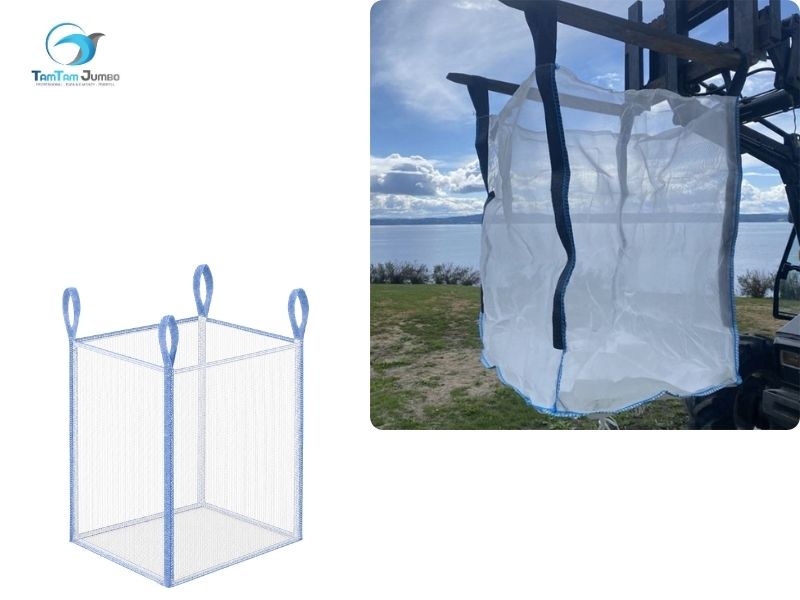
Comparing Suppliers: What to Ask Before Ordering Mesh Big Bags
- What mesh gauge is recommended for the specific produce, and why.
- What percentage of the bag body is mesh versus solid reinforcement, and where the solid sections are located.
- What fill weight the bag is rated for, and whether that rating accounts for the reduced strength of mesh sections.
- Whether the fabric is UV stabilized for bags expected to sit in outdoor storage or uncovered transport.
- What loop type and anchoring is used, since load-bearing points still need solid fabric regardless of mesh percentage elsewhere.
How Tam Tam Packaging Supports Breathable Bag Orders
Tam Tam Packaging works with buyers to match mesh gauge and solid reinforcement ratio to the specific produce and export route before committing to a full production run, rather than applying one standard mesh specification across different products. Specification sheets document mesh gauge, solid fabric placement, and safe working load together, so buyers moving from small sacks to bulk mesh big bags for the first time can compare options against their actual handling and export requirements.
Common Buyer Mistakes When Selecting Mesh Big Bags
- Choosing mesh gauge based on price alone without matching it to the produce’s size and moisture output.
- Underestimating how loading and stacking patterns can block airflow even with the right mesh fabric.
- Assuming a mesh big bag can be reused as many times as a standard solid bag without confirming durability expectations.
- Overlooking UV stabilization needs for bags stored or transported without cover.
- Not asking suppliers to explain their mesh-to-solid fabric ratio and how it affects fill weight rating.
Applications in the Food Export Industry
Breathable FIBC Bags are widely used in fresh produce export supply chains for onions, potatoes, and root vegetables moving from farm consolidation points to international buyers, where the combination of bulk handling efficiency and continued post-harvest respiration control matters across a longer transit chain than domestic distribution alone. Export buyers typically weigh mesh gauge, solid reinforcement, and container loading pattern together as part of a broader quality retention strategy for the produce rather than treating the bag as a standalone packaging decision.
Frequently Asked Questions
What is a mesh big bag?
It is a bulk FIBC bags constructed with open leno weave mesh fabric, either across the full body or in defined panels, allowing air to pass through and ventilate produce that continues to respire after harvest.
How do I choose the right mesh gauge?
Mesh gauge should be matched to the size of the produce being packed, fine enough to contain the product without excessive loss, but open enough to provide meaningful airflow for its respiration rate.
Can mesh big bags be reused across multiple harvests?
Some can, but mesh fabric generally has lower durability than solid woven fabric, so multi-trip use should be confirmed with the supplier and specified with reinforced transition seams if repeated use is planned.
Do mesh big bags need UV protection?
Bags stored or transported without cover for extended periods benefit from UV-stabilized fabric to prevent premature degradation from sun exposure.
Are mesh big bags suitable for long export routes?
Yes, provided the mesh gauge, solid reinforcement ratio, and container loading pattern are planned together to maintain airflow and structural integrity over the longer transit time.
Conclusion
Choosing breathable FIBC bags is less about the mesh fabric itself and more about matching gauge, reinforcement, and loading practices to the specific produce and export route. Buyers moving to bulk mesh big bags for the first time get the most value by asking suppliers direct questions about gauge selection and fill weight rating, rather than treating mesh construction as a single standardized product.
Tam Tam Packaging Co. supplies mesh big bags matched to your produce, export route, and handling requirements. Contact our team to confirm the right mesh gauge and construction for your application.
Contact Us
Tam Tam Packaging Co.
Email: sales@tamtamjumbo.com
Website: https://tamtamjumbo.com/
WhatsApp: +84 92 852 3288
Read more
FIBC Fabric GSM Guide: How Fabric Weight Determines Strength
GSM is the number buyers reach for first when comparing FIBC fabric across suppliers, and...
Jul
Breathable FIBC Bags: Guide to Choosing the Right Mesh Big Bag
Buyers moving from small mesh sacks to bulk mesh big bags for the first time...
Jul
Dust Proof Bulk Bags: Controlling Exposure Standard Sift Proofing
A bag that keeps fine powder from sifting out during storage is not automatically the...
Jul
Sift Proof FIBC Bags: Building a Truly Leak Proof Jumbo Bag
Fine powders find their way out of packaging that would hold coarser material without issue....
Jul
Anti-Static Bulk Bags: How a Type C Bag Prevents Ignition Risk
Filling and emptying an FIBC bag generates static charge as powder moves against fabric, and...
Jul
Food Grade FIBC Bags: What a BRC Certificate Actually Confirms
Calling a bag food grade is not the same as proving it. Food grade FIBC...
Jul