

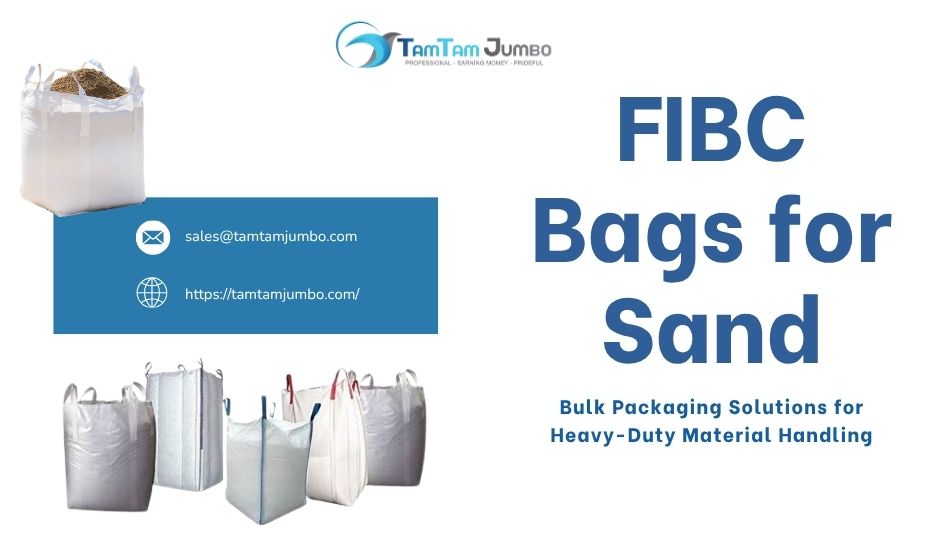
Sand and cement often get grouped together as construction materials in FIBC applications, but they push a bag’s specifications in different directions. Sand is not fine enough to sift through standard seams and does not undergo a damaging chemical reaction with moisture the way cement does, yet it introduces its own set of demands, abrasion resistance and weight variability chief among them, that a cement-focused specification would not address. This guide covers what actually matters when sourcing FIBC bag for sand.
How Sand Differs From Cement as an FIBC Industries
Where cement demands sift proof seams and moisture protection against a permanent hydration reaction, sand’s coarser particle size means standard seam construction is usually adequate, and moisture exposure, while it changes the product’s weight, does not chemically degrade the material. The specification priorities shift instead toward fabric abrasion resistance and accounting for how much a load of sand can vary in actual weight depending on its moisture content at the time of filling.
Read more: FIBC Bags for Cement: A Specification Guide for This Industry
Step 1: Abrasion Resistance and Fabric Selection
Sand’s granular, abrasive texture wears against fabric differently than fine powders like cement, causing gradual surface abrasion at points of repeated contact and movement rather than sifting through seam gaps. Fabric weave density and tape yarn quality both contribute to abrasion resistance, and multi-trip sand bags in particular benefit from fabric specified with this wear pattern in mind rather than GSM alone.
Read more: FIBC Bag GSM Guide: How Fabric Weight Determines Strength
Step 2: Accounting for Moisture Content and Weight Variability
Sand’s weight can vary substantially depending on moisture content at the time of filling, since wet sand can weigh meaningfully more than the same volume of dry sand. This matters directly for safe working load planning, since a bag filled by volume rather than verified weight could unintentionally exceed its rated SWL if the sand is wetter than assumed. Buyers should confirm fill procedures account for weighing rather than volume estimation alone, particularly for sand sourced directly from wet extraction sites.
Read more: FIBC Safe Working Load: What a Big Bag 1000kg Actually Means
Step 3: Fill Weight and Construction Type for Bulk Volume
Sand typically moves in high volumes at relatively low value per ton, making circular construction the common default for cost efficiency, though buyers moving very high shipment volumes may still find that baffled or panel construction’s improved container utilization offsets the added fabric cost. Capacity is commonly set at 1000kg to 1500kg to match standard quarry and batching plant handling equipment.
Read more: FIBC Bag Construction Types: Circular, U and 4 Panel Compared
Step 4: Drainage Considerations for Wet Sand
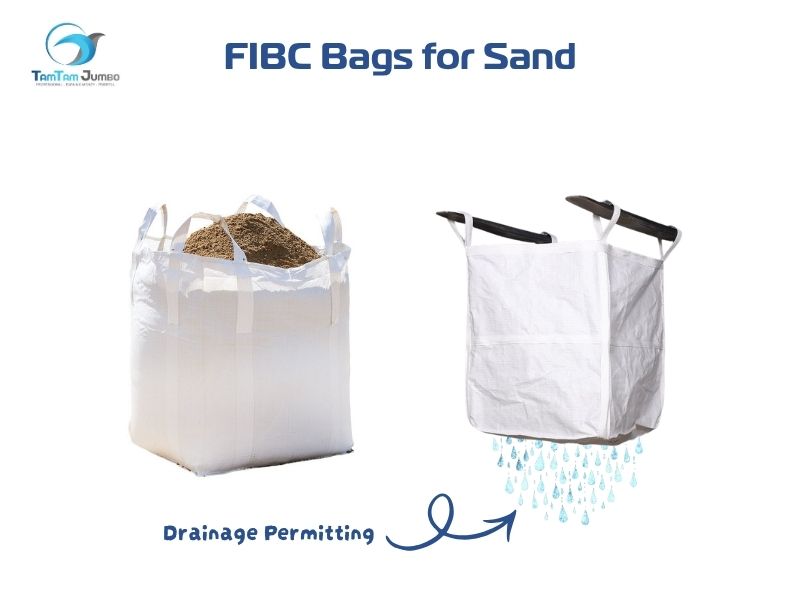
Sand extracted wet from quarry or dredging operations sometimes benefits from a bag construction that allows some moisture to drain or evaporate during transport and storage, rather than sealing the moisture in as a full moisture-proof specification would. This is effectively the opposite consideration from cement, where trapping moisture out is the priority, and buyers should clarify with their supplier whether sand will be filled wet, dry, or somewhere between, since this changes which fabric and liner approach actually fits.
Step 5: UV and Outdoor Storage for Quarry and Yard Conditions
Sand bags commonly sit outdoors at quarries, distribution yards, and job sites for extended periods, making UV-stabilized fabric a practical requirement similar to cement applications. Stabilization level should be matched to realistic storage duration at the specific facility rather than assumed from a generic construction material default.
Read more: FIBC UV Protection: What Outdoor Bag Storage Actually Requires
Building a Complete Sand FIBC Specification
Bringing these factors together, a complete sand bag specification typically addresses fabric abrasion resistance and weave quality, a safety margin in rated SWL to account for moisture-driven weight variability, construction type matched to shipment volume, a clear decision on drainage versus moisture sealing based on how the sand will be filled, and UV stabilization matched to expected outdoor storage duration.
Common Sand FIBC Specification Combinations
The following combinations reflect common approaches across bulk bag industries handling sand and similar granular construction aggregates.
| Product Example | Typical Specification Combination |
| Dry, screened construction sand | Standard circular construction, abrasion-resistant fabric, standard UV stabilization, 1000kg capacity |
| Wet quarry or dredged sand | Weight margin above nominal SWL, drainage-permitting fabric, higher UV stabilization for extended yard storage |
| Fine masonry or plaster sand | Tighter weave density fabric closer to sift proof standards, standard capacity |
| High-volume aggregate blends | Baffled or panel construction for container efficiency, 1500kg capacity |
How Tam Tam Packaging Specifies Bags for Sand
Tam Tam Packaging builds sand bag specifications around abrasion-resistant fabric, weight margin for moisture variability, and construction type matched to shipment volume, confirming with buyers whether sand will be filled wet or dry before finalizing fabric and liner approach. UV stabilization is matched to the buyer’s actual outdoor storage duration at quarry, yard, or job site locations.
Common Mistakes When Sourcing Sand FIBC Bags
- Filling bags by volume estimate rather than verified weight, risking SWL overload when sand is wetter than assumed.
- Applying a cement-style moisture-proof specification to sand that would actually benefit from some drainage capability.
- Choosing fabric based on GSM alone without considering abrasion resistance for multi-trip use.
- Underestimating UV exposure duration for sand stored outdoors at quarries or distribution yards.
- Assuming sand and cement can share an identical bag specification simply because both are construction materials.
Applications Across Bulk Bag Industries Using Sand
Sand moves through several distinct bulk bag industries beyond general construction, including foundry sand for metal casting, silica sand for glass and industrial applications, and specialty sand for water filtration and sports turf. Each of these applications carries its own particle size and purity requirements, but the core FIBC specification priorities, abrasion resistance, weight margin for moisture, and appropriate drainage or sealing, remain the starting framework across all of them.
Frequently Asked Questions
Does sand need the same seam construction as cement?
Generally no. Sand’s coarser particle size means standard seam construction is usually adequate, unlike cement, which typically requires sift proof folded and double-stitched seams.
Why does moisture content matter for sand bag weight capacity?
Wet sand can weigh meaningfully more than dry sand at the same volume, so bags filled by volume rather than verified weight risk exceeding their rated safe working load.
Should sand bags be moisture-proof like cement bags?
Not necessarily. Wet sand may actually benefit from some drainage or evaporation capability rather than a fully sealed moisture-proof construction, depending on how it is filled and stored.
What fabric consideration matters most for sand specifically?
Abrasion resistance, since sand’s granular texture wears against fabric differently than fine powders, particularly for bags intended for multi-trip use.
What capacity is typical for sand FIBC bags?
1000kg to 1500kg is common, matched to standard quarry and batching plant handling equipment, though high-volume operations sometimes move to larger capacities.
Conclusion
Sand and cement may share a category as construction material FIBC applications, but sand’s real specification priorities, abrasion resistance, weight margin for moisture variability, and the drainage-versus-sealing decision, are genuinely different from cement’s sift proofing and hydration protection needs. Treating sand as its own specification case, rather than defaulting to a cement-style approach, produces bags that actually match how sand is handled in practice.
Tam Tam Packaging Co. builds FIBC specifications for sand and related aggregates, addressing abrasion resistance, moisture-driven weight variability, and outdoor storage together. Contact our team to work through the right specification for your product.
Contact Us
Tam Tam Packaging Co.
Email: sales@tamtamjumbo.com
Website: https://tamtamjumbo.com/
Read more

FIBC Bags for Flour: Why Allergen Status Change the Specification
Flour shares the fine-particle and combustible dust characteristics of other food powders, but wheat’s status...
Aug
FIBC Bag for Starch Powder: Dustproof Bag Needs Antistatic
Starch powder occupies an unusual position in FIBC specification: it is a common food and...
Aug
FIBC Bags for Animal Feed: What Actually Makes a Clean Bulk Bag
FIBC bags for animal feed mean something more specific than a bag that looks unused....
Aug
FIBC Bag for PET Flakes: Why UV Resistance Matter More Than It
Recycled PET flakes share a base polymer with virgin resin pellets, but the two behave...
Aug
FIBC Bags for Plastic Resin: PP Fabric Packaging PP Pellets
There is a certain irony in shipping polypropylene resin pellets inside a bag woven from...
Aug
FIBC Bags for the Food Industry: Building a Food Grade Bag
Food manufacturers sourcing bulk ingredient packaging are working from a different starting point than a...
Aug