

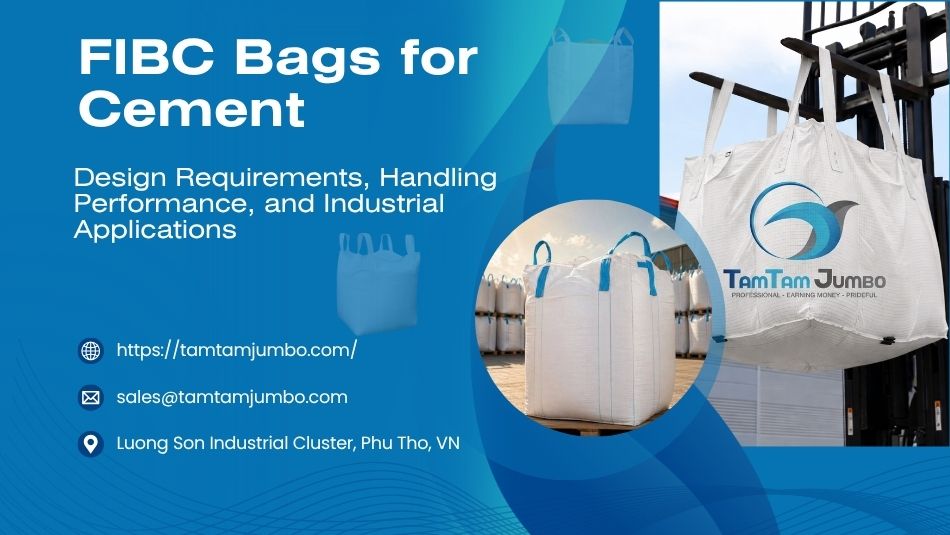
Cement is one of the most demanding products the FIBC industry packages in volume, not because it is hazardous, but because its particle fineness, hydration sensitivity, and the rough, repeated handling it goes through at job sites push several parts of a bag’s specification at once. This guide walks through what actually matters when sourcing FIBC bags for cement, covering dust containment, moisture protection, and the construction details that hold up under site conditions.
Why Cement Requires a Specific FIBC Approach
Cement combines several packaging challenges that most other bulk commodities face individually rather than together. It is fine enough to sift through standard seams, it reacts with moisture in a way that permanently degrades the product rather than just causing clumping, and it is typically handled by forklift and crane repeatedly across a supply chain that includes outdoor storage at both distribution yards and job sites. A specification built for a less demanding product will generally fall short somewhere in this list.
Step 1: Preventing Sift and Dust Loss During Handling
Cement’s fine particle size means standard single-stitch seams are generally not adequate, making folded and double-stitched seam construction a near-standard requirement for this product. Beyond storage containment, dust generated during filling and discharge is also a workplace exposure concern, which means spout design and closure method deserve as much attention as seam quality.
Read more: Sift Proof FIBC Bags: Building a Truly Leak Proof Jumbo Bag
Step 2: Choosing Fill Weight and Construction Type for Site Handling
Cement commonly moves in 1000kg or 1500kg capacity bags, matched to standard forklift and crane equipment used across construction supply chains. Construction type, circular, baffled, or full panel, should reflect how much container and pallet space efficiency matters for the specific distribution volume, since cement shipments often move in high enough volume that even modest space efficiency gains compound meaningfully across a large order.
Read more: FIBC Bag Sizes Explained: Matching SWL to Common Capacity
Step 3: Moisture Protection for Cement’s Hydration Sensitivity
Cement that absorbs moisture begins a hydration reaction that permanently degrades its strength properties, making moisture protection a functional requirement rather than a quality preference. Coated fabric combined with sealed seams addresses most standard storage conditions, while a liner adds further protection for cement stored for extended periods or shipped through humid climates.
Read more: Moisture Proof FIBC Bags: What Triple Proofed Actually Combines
Step 4: UV Protection for Outdoor Yard Storage
Cement bags routinely sit outdoors at distribution yards and job sites for extended periods before use, making UV-stabilized fabric a practical requirement rather than an upgrade for most cement supply chains. Buyers should match stabilization level to realistic storage duration rather than assuming standard fabric will hold up over months of direct sun exposure.
Read more: FIBC UV Protection: What Outdoor Bag Storage Actually Requires
Step 5: Stitching and Base Construction for Repeated Handling
Cement bags are handled repeatedly by forklift and crane through multiple stages between production and final use, placing sustained stress on base seams and loop anchoring. Safety stitching at these high-stress joints, combined with stitch density matched to the bag’s rated fill weight, is standard practice given how roughly cement bags are typically handled compared to more carefully managed commodities.
Read more: FIBC Bag Stitching Types: How Sewing Machine Choice Affect Seam
Building a Complete Cement FIBC Specification
Bringing these elements together, a complete cement bag specification typically covers seam construction for sift and dust proofing, fabric coating or liner for moisture protection, UV stabilization level matched to expected outdoor storage duration, fill weight and construction type matched to handling equipment, and reinforced stitching at base seams and loop anchoring.
Common Cement and Related Material FIBC Specification Combinations
The following combinations reflect common starting points across the FIBC industry for cement and closely related construction materials.
| Product Example | Typical Specification Combination |
| Standard bagged cement | Folded double-stitched seams, coated fabric, standard UV stabilization, 1000kg capacity |
| Cement for extended outdoor storage | As above plus higher UV stabilization level and liner for extended moisture protection |
| Fine mineral filler or fly ash | Sift proof seams, tighter weave density fabric, dust-controlled spout design |
| High-volume aggregate blends | Baffled or panel construction for container efficiency, 1500kg to 2000kg capacity |
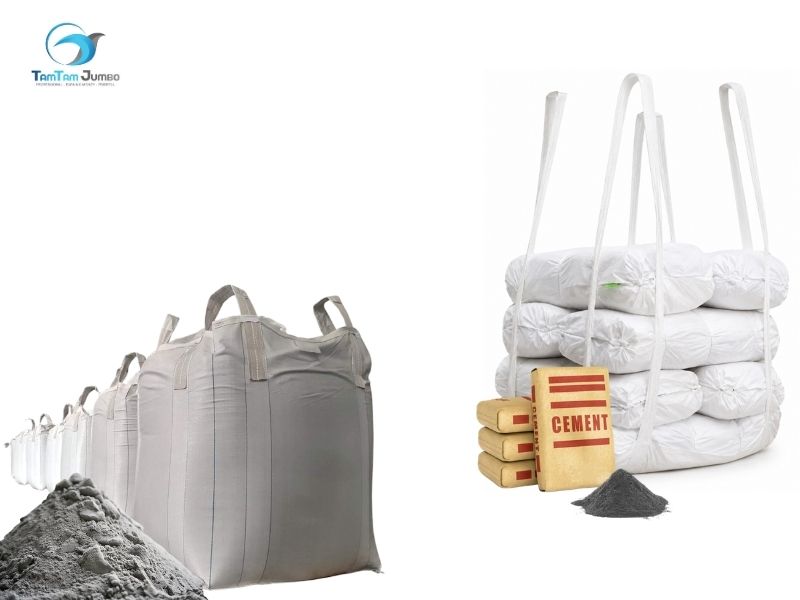
How Tam Tam Packaging Specifies Bags for Cement
Tam Tam Packaging builds cement bag specifications around sift and dust containment, moisture protection, UV stabilization matched to storage duration, and reinforced stitching for repeated handling, rather than applying a single generic industrial bag template. Fill weight and construction type are confirmed against the buyer’s actual handling equipment and distribution volume before production.
Common Mistakes When Sourcing Cement FIBC Bags
- Using standard seam construction that is not adequate for cement’s fine particle size.
- Overlooking UV stabilization for bags that will spend months in outdoor yard storage.
- Not confirming forklift or crane capacity matches the bag’s rated fill weight before increasing capacity.
- Choosing standard stitching for base seams that will see repeated rough handling across multiple supply chain stages.
- Treating moisture protection as optional for cement despite its permanent hydration sensitivity.
Applications Across the FIBC Industry for Cement and Related Materials
Cement represents one of the highest-volume applications across the FIBC industry, and the specification principles that apply to it, sift and dust control, moisture protection, UV stabilization, and reinforced stitching, extend naturally to related fine construction materials such as fly ash, mineral fillers, and dry mortar blends. Buyers sourcing packaging across this broader material category benefit from applying the same step-by-step specification approach rather than treating each material as an entirely separate sourcing exercise.
Frequently Asked Questions
Why does cement need sift proof seams?
Cement’s fine particle size allows it to escape through the small gaps in standard single-stitch seams, making folded and double-stitched construction a near-standard requirement.
Why is moisture protection so important for cement bags?
Cement undergoes a hydration reaction when exposed to moisture that permanently degrades its strength properties, unlike products that simply clump or cake.
What capacity is typical for cement FIBC bags?
1000kg and 1500kg are the most common capacities, matched to standard forklift and crane equipment used across construction supply chains.
Do cement bags need UV stabilization?
In most cases yes, since cement bags commonly sit outdoors at distribution yards and job sites for extended periods before use.
What seam type is best for cement bags handling repeated forklift use?
Safety stitching at base seams and loop anchoring points, combined with stitch density matched to the bag’s rated fill weight, holds up better under repeated rough handling than standard stitching.
Conclusion
Cement pushes several parts of an FIBC specification at once, sift and dust containment, moisture protection, UV resistance, and seam durability, making it one of the more demanding applications in the broader FIBC industry despite not involving hazardous classification. Working through each requirement deliberately produces a bag that actually holds up across cement’s real handling and storage conditions.
Tam Tam Packaging Co. builds complete FIBC specifications for cement and related construction materials, addressing dust containment, moisture protection, and durable stitching together. Contact our team to work through the right specification for your product.
Contact Us
Tam Tam Packaging Co.
Email: sales@tamtamjumbo.com
Website: https://tamtamjumbo.com/
Read more

FIBC Bags for Flour: Why Allergen Status Change the Specification
Flour shares the fine-particle and combustible dust characteristics of other food powders, but wheat’s status...
Aug
FIBC Bag for Starch Powder: Dustproof Bag Needs Antistatic
Starch powder occupies an unusual position in FIBC specification: it is a common food and...
Aug
FIBC Bags for Animal Feed: What Actually Makes a Clean Bulk Bag
FIBC bags for animal feed mean something more specific than a bag that looks unused....
Aug
FIBC Bag for PET Flakes: Why UV Resistance Matter More Than It
Recycled PET flakes share a base polymer with virgin resin pellets, but the two behave...
Aug
FIBC Bags for Plastic Resin: PP Fabric Packaging PP Pellets
There is a certain irony in shipping polypropylene resin pellets inside a bag woven from...
Aug
FIBC Bags for the Food Industry: Building a Food Grade Bag
Food manufacturers sourcing bulk ingredient packaging are working from a different starting point than a...
Aug