

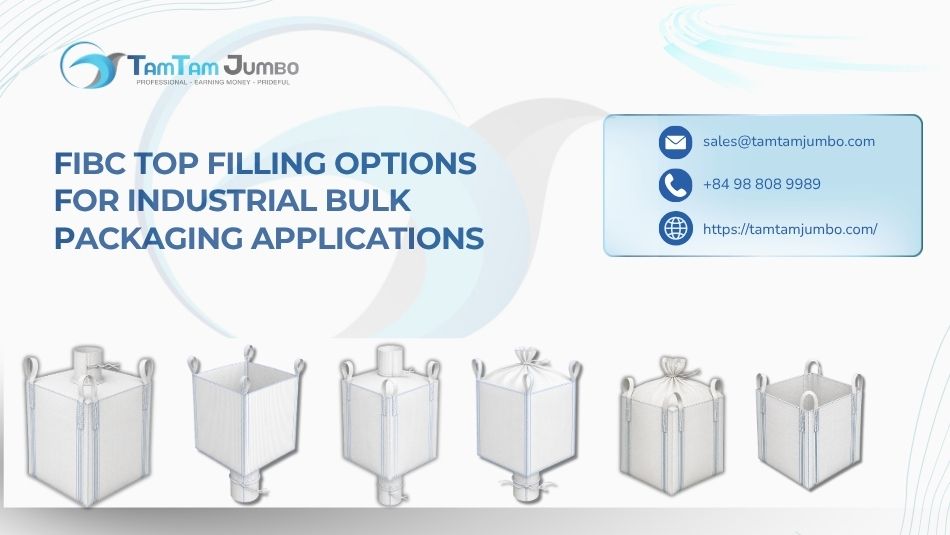
The top of an FIBC bag does more work than it gets credit for. It determines how quickly a bag fills, how much dust escapes during that process, and whether the bag will even connect properly to a facility’s filling equipment in the first place. This guide covers the main top construction types used across the industry, how top spout size affects filling performance, and what buyers should confirm before ordering bags meant to run through an existing filling line.
Why Top Construction Affects Filling, Not Just Aesthetics
Buyers sometimes treat top style as a minor cosmetic choice compared to fabric weight or loop configuration, but a mismatched top spout can slow filling operations significantly or make a bag incompatible with automated equipment entirely. Top construction should be specified with the same attention as base construction, since both ends of the bag interact directly with a facility’s material handling process.
Common Top Types on FIBC Bags
Open Top (Skirt Top)
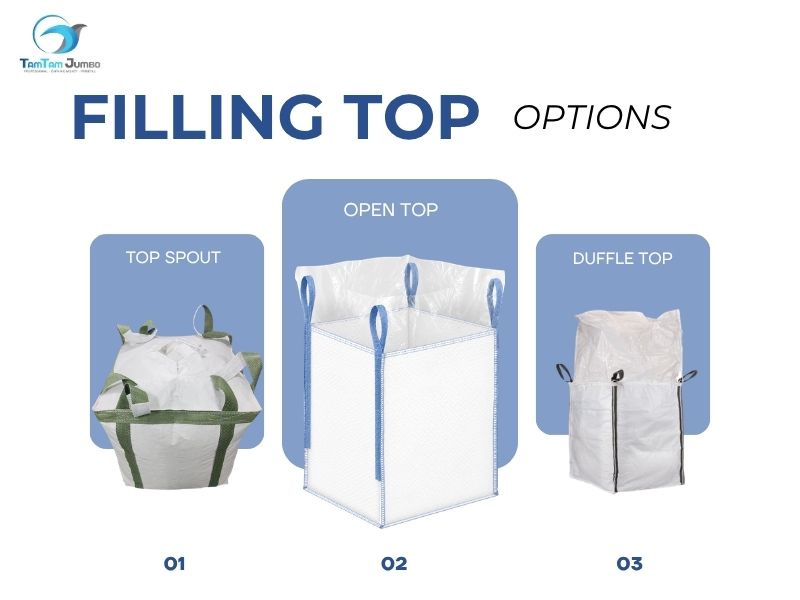
An open or skirt top consists of an extended fabric collar around the top opening with no dedicated spout, typically gathered and tied closed after filling. This construction is simple and economical, suited to manual filling operations or products where fill speed and dust containment are not major concerns.
Spout Top
A spout top adds a cylindrical fabric extension at the center of the top panel, sized to connect with a filling nozzle or chute. This is the most common configuration for automated or semi-automated filling lines, since the spout provides a defined connection point that can be sealed or clamped during the filling process to control dust and ensure a consistent fill.
Duffle Top
A duffle top uses a larger, drawstring-style closure around the full top opening, offering a wider fill opening than a standard spout while still allowing the top to be gathered and secured after filling. This configuration suits products that benefit from a wider fill opening, such as irregularly shaped or bulky material, without requiring full automated filling line compatibility.
How Top Spout Size Affects Filling Speed and Dust Control
A larger spout diameter generally allows faster fill rates, since material can flow through a wider opening with less restriction, but a spout that is too large relative to the filling equipment’s nozzle can create gaps that allow dust to escape during filling. A spout that is too small restricts flow and can slow cycle times on high-throughput filling lines. Matching spout diameter closely to the filling nozzle, rather than defaulting to a generic size, is what actually controls both fill speed and dust containment together.
Read more: Dust Proof Bulk Bags: Controlling Exposure Beyond Standard Sift Proofing
Matching Spout Diameter to Filling Equipment
Filling equipment nozzles vary in diameter across manufacturers and facility setups, and a spout specified without reference to the actual equipment in use risks a poor seal or an awkward connection that slows operations. Buyers should provide their filling equipment’s nozzle diameter and connection style to the bag manufacturer rather than requesting a standard spout size and hoping it fits, particularly for facilities running automated or semi-automated filling lines.
Spout Closure Methods
Tie-Off
The simplest closure method, gathering the spout fabric and securing it with cord or tape after filling. Adequate for many standard applications but offers the least reliable seal against dust or moisture compared to other closure methods.
Clamp or Clip Closure
A reusable clamp or clip compresses the spout fabric into a tight seal, offering better containment than a simple tie-off and working well in filling operations where consistent, repeatable closure matters.
Heat-Sealed Closure
For products requiring the highest level of containment, the spout can be heat-sealed closed after filling, typically used in combination with an inner liner rather than on the outer fabric alone. This method provides the most reliable barrier against dust and moisture ingress but requires compatible equipment at the filling stage.
Read more: Sift Proof FIBC Bags: Building a Truly Leak Proof Jumbo Bag
Automated Filling Line Compatibility
Facilities running automated filling lines typically require a spout top with a specific diameter and fabric stiffness that allows the spout to interface cleanly with the filling nozzle, sometimes including a sewn-in support ring to keep the spout opening from collapsing during connection. Buyers integrating bags into an existing automated line should treat spout compatibility as a functional requirement to be tested with a sample run, not just a dimension listed on a specification sheet.
Specification Details for Top Filling Options
- Top type, specifying open top, spout top, or duffle top based on the filling method used.
- Spout diameter and height, matched to the filling equipment’s nozzle dimensions.
- Spout closure method, confirming whether tie-off, clamp, or heat-seal is required.
- Fabric reinforcement at the spout base, since this area experiences repeated stress during connection and disconnection cycles.
- Liner compatibility, if an inner liner is used and needs its own closure method integrated with the outer spout.
Read more: Food Grade FIBC Bags: What a BRC Certificate Actually Confirms
How Tam Tam Packaging Configures Top Spouts to Order
Tam Tam Packaging manufactures top spouts to the buyer’s specified diameter and closure method, confirming compatibility with the filling equipment in use before committing to a full production run. Spout base reinforcement and liner integration are addressed as part of the same specification, so buyers receive bags that connect properly to their filling line rather than requiring on-site modification.
Common Mistakes When Specifying Top Filling Options
- Ordering a standard spout size without confirming it against the actual filling equipment nozzle diameter.
- Choosing tie-off closure for an application that actually requires dust or moisture containment better suited to a clamp or heat-sealed closure.
- Overlooking spout base reinforcement for high-cycle automated filling lines, leading to premature wear at the connection point.
- Selecting top type based on cost alone without considering fill speed and dust control needs for the specific product.
- Not testing a sample bag on the actual filling line before committing to a full production order.
Applications in the Food Industry
Food commodity filling operations, including flour, sugar, and grain, frequently run through automated or semi-automated filling lines where spout diameter and closure method need to match equipment precisely to maintain throughput and hygiene standards. A poorly matched spout on a food-grade filling line can slow production and increase product exposure to the surrounding environment, making spout specification as much a food safety consideration as a mechanical one in these applications.
Read more: Ventilated Bulk Bags: When a Breathable Bag Matters for Agriculture
Frequently Asked Questions
What is the difference between a spout top and a duffle top?
A spout top has a defined cylindrical fabric extension sized to connect with filling equipment, while a duffle top offers a wider drawstring closure suited to manual filling of bulkier or irregular material.
How do I know what spout diameter to order?
By providing the manufacturer with your filling equipment’s nozzle diameter and connection style, rather than requesting a generic standard size.
What is the best spout closure method for dust control?
A clamp or heat-sealed closure generally provides better dust containment than a simple tie-off, with heat-sealing offering the highest level of containment when combined with a liner.
Does top spout size affect filling speed?
Yes. A properly sized spout allows faster material flow, while a spout that is too small or mismatched to the filling nozzle can slow fill cycles.
Should I test a sample bag before ordering a full production run?
Yes, particularly for automated filling lines, since spout compatibility is a functional requirement best confirmed with an actual run rather than assumed from a specification sheet alone.
Conclusion
Top filling options affect fill speed, dust control, and equipment compatibility in ways that deserve the same specification attention as fabric weight or base construction. Matching spout diameter and closure method to the actual filling equipment, rather than defaulting to a standard size, is what keeps a filling operation running smoothly once the bags are in use.
Tam Tam Packaging Co. configures top spout diameter and closure method to match your filling equipment. Contact our team to confirm the right top filling specification for your operation.
Contact Us
Tam Tam Packaging Co.
Email: sales@tamtamjumbo.com
Website: https://tamtamjumbo.com/
Read more

FIBC Bags for Construction: A Complete Guide Across Materials
Walk onto almost any construction site or materials yard and the bulk bags you see...
Aug

FIBC Bags for Flour: Why Allergen Status Change the Specification
Flour shares the fine-particle and combustible dust characteristics of other food powders, but wheat’s status...
Aug
FIBC Bag for Starch Powder: Dustproof Bag Needs Antistatic
Starch powder occupies an unusual position in FIBC specification: it is a common food and...
Aug
FIBC Bags for Animal Feed: What Actually Makes a Clean Bulk Bag
FIBC bags for animal feed mean something more specific than a bag that looks unused....
Aug

FIBC Bag for PET Flakes: Why UV Resistance Matter More Than It
Recycled PET flakes share a base polymer with virgin resin pellets, but the two behave...
Aug
FIBC Bags for Plastic Resin: PP Fabric Packaging PP Pellets
There is a certain irony in shipping polypropylene resin pellets inside a bag woven from...
Aug