

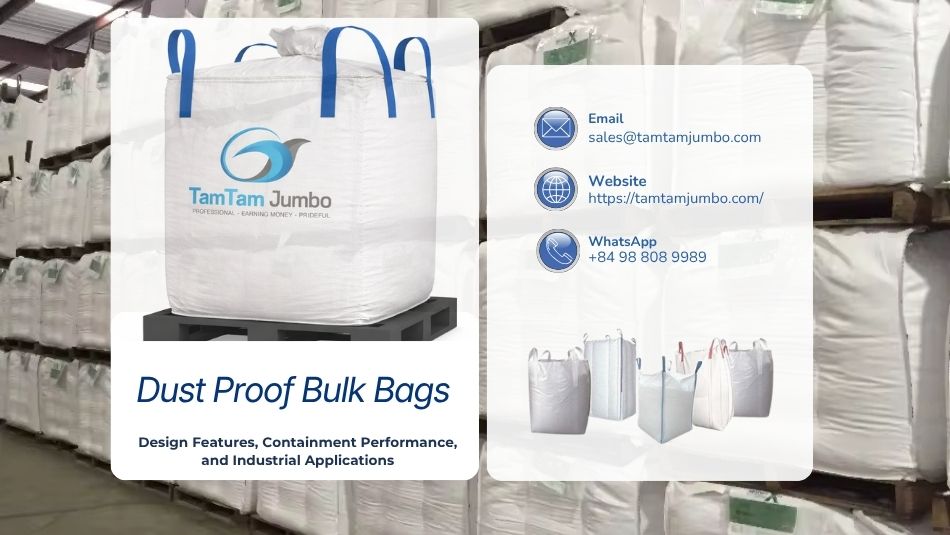
A bag that keeps fine powder from sifting out during storage is not automatically the right choice for an operation where dust exposure during active filling and discharge is the real concern. Dust proof bulk bags, sometimes called proofed big bags in European markets, need to control dust generation at the moments workers are actually handling the bag, not just prevent slow material loss in transit. This article covers what that distinction means in practice, where dust actually escapes during handling, and what a specification needs to address for genuine dust control rather than basic containment.
What Dust Proof Means Beyond Standard Sift Proofing
Sift proofing addresses fine material escaping through seams and fabric weave during storage and transport. Dust proofing is a broader requirement that also covers the airborne dust generated at the moment a bag is filled or discharged, when powder is actively moving and displacing air. A bag can have excellent seam and fabric containment and still generate a visible dust cloud during discharge if the spout and closure system are not designed to control that release.
Read more: Sift Proof FIBC Bags: Building a Truly Leak Proof Jumbo Bag
Where Dust Escapes During Handling, Not Just Storage
Discharge Spout Dust Clouds
The discharge point is where the most significant dust exposure typically occurs, since opening a spout releases a concentrated volume of fine material into the surrounding air in a short period. A spout designed only for flow rate, without a sealed connection to receiving equipment, can generate a substantial dust cloud even if the bag itself has performed well during transport.
Fabric Porosity Under Repeated Handling
Fabric that resists sifting when new can develop increased porosity after repeated folding, compression, and multi-trip use, particularly at stress points around seams and corners. Dust proof specifications for multi-trip bags need to account for this degradation over the bag’s expected service life, not just its performance when new.
Filling Point Dust Generation
Filling generates dust as material falls into the bag and displaces air outward through the fill spout and any venting points. Bags intended for dusty environments often need a filling spout designed to seal against the filling equipment, controlling this displaced air rather than allowing it to escape freely around the fill point.
Coated Fabric and Its Role in Dust Containment
A polypropylene film lamination applied to one or both sides of the body fabric significantly reduces porosity compared to uncoated woven material, addressing the fabric-based dust migration that standard sift proof seam improvements do not fully resolve. Coating adds cost and marginally increases bag weight, but for very fine or hazardous dust it is often a necessary complement to seam and spout improvements rather than an optional upgrade.
Controlled Discharge Systems for Dust Proof Bags
Dust proof bags intended for use with automated filling and discharge lines often use a spout designed to interface directly and seal against the receiving equipment, sometimes with a sleeve or clamp connection rather than a simple open or tied spout. This allows discharge to occur within a closed system, controlling dust release at the exact point it would otherwise be most concentrated.

Dust Proof Bulk Bags and Workplace Exposure Standards
Facilities handling fine mineral, chemical, or combustible dust are frequently subject to workplace exposure limits and, in some cases, explosive dust atmosphere regulations. Packaging that reduces dust generation during handling supports compliance with these standards by limiting the airborne concentration workers are exposed to at filling and discharge points, though packaging alone does not replace the ventilation, monitoring, and personal protective equipment a facility’s own safety program requires.
Read more: Anti-Static Bulk Bags: How a Type C Bag Prevents Ignition Risk
Big Bag Terminology: Regional Naming and What It Means for Buyers
Big bag is a term used widely across Europe as an informal equivalent to FIBC or bulk bag, and a proofed big bag simply refers to a big bag built with dust or sift containment features. Buyers working with European suppliers or distributors should expect this terminology to appear interchangeably with FIBC and bulk bag in quotations and technical documents, describing the same underlying product category rather than a distinct construction type.
Specification Details for a Dust Proof Big Bag
- Fabric coating specification, confirming lamination type and thickness where dust containment through the fabric surface is required.
- Seam construction, since dust proof bags generally use the same folded and double-stitched approach as sift proof construction as a baseline.
- Fill and discharge spout design, specifying sealed connection points if the bag will interface with automated filling or discharge equipment.
- Expected number of trips and fabric durability requirements, since multi-trip use changes how porosity develops over the bag’s service life.
- Whether the application involves a combustible dust hazard requiring Type C or Type B static protection in addition to dust containment.
How Tam Tam Packaging Manufactures Dust Proof Bulk Bags
Tam Tam Packaging builds dust proof bulk bags combining folded seam construction, coated fabric where required, and spout designs specified to match the buyer’s filling and discharge equipment. Fabric and seam specifications are confirmed against the intended product’s dust characteristics and expected number of trips before production, and documentation is provided so buyers can verify the finished bags match the agreed dust containment approach.
Common Mistakes When Specifying Dust Proof Bags
- Ordering standard sift proof construction for an application where discharge dust exposure, not storage sifting, is the actual concern.
- Overlooking the spout design entirely, leaving the highest-exposure point in the handling process unaddressed.
- Assuming a bag’s dust containment performance when new will hold for its full multi-trip service life without accounting for fabric wear.
- Not confirming whether the dust hazard also requires anti-static Type C construction alongside dust proofing.
- Choosing coated fabric without addressing seam quality, leaving stitch-hole leakage unresolved, despite the coating.
Applications in Mining
Dust proof bulk bags are widely specified in mining and mineral processing operations for fine ore concentrate, reagents, and processed mineral powders, where both product loss and worker exposure to airborne dust are ongoing operational concerns. Discharge into processing equipment at these sites is frequently automated, making sealed spout connections a practical requirement rather than an added feature, and coated fabric is common for concentrates fine enough to migrate through standard weave over repeated handling cycles.
Frequently Asked Questions
What is the difference between dust proof and sift proof bags?
Sift proof addresses material loss through seams and fabric during storage and transport, while dust proof also addresses airborne dust generated during active filling and discharge handling.
What is a proofed big bag?
It is the same product as a dust proof or sift proof FIBC bag, using big bag as the regional European term for bulk bag or FIBC.
Does coated fabric fully solve dust containment on its own?
No. Coating reduces porosity through the fabric surface but does not address discharge spout dust generation or seam-level leakage, both of which need their own construction solutions.
Are dust proof bulk bags required to be anti-static?
Only if the dust involved is combustible and the application falls under a hazardous area classification, in which case Type C or Type B static protection should be specified alongside dust containment features.
How does multi-trip use affect dust proof performance?
Repeated folding and compression can increase fabric porosity over time, so bags intended for multiple trips should be specified with durability in mind rather than only evaluated on first-use performance.
Conclusion
Dust proof bulk bags need to address dust generation during active handling, not only material containment during storage, which is what separates them from standard sift proof construction. Getting spout design, coating, and seam quality right together, rather than relying on any single feature, is what actually controls dust exposure for workers handling the bags at filling and discharge points.
Tam Tam Packaging Co. manufactures dust proof bulk bags with coating, seam, and spout specifications matched to your handling process. Contact our team to confirm the right construction for your application.
Contact Us
Tam Tam Packaging Co.
Email: sales@tamtamjumbo.com
Website: https://tamtamjumbo.com/
Read more

FIBC Bags for Flour: Why Allergen Status Change the Specification
Flour shares the fine-particle and combustible dust characteristics of other food powders, but wheat’s status...
Aug
FIBC Bag for Starch Powder: Dustproof Bag Needs Antistatic
Starch powder occupies an unusual position in FIBC specification: it is a common food and...
Aug
FIBC Bags for Animal Feed: What Actually Makes a Clean Bulk Bag
FIBC bags for animal feed mean something more specific than a bag that looks unused....
Aug

FIBC Bag for PET Flakes: Why UV Resistance Matter More Than It
Recycled PET flakes share a base polymer with virgin resin pellets, but the two behave...
Aug
FIBC Bags for Plastic Resin: PP Fabric Packaging PP Pellets
There is a certain irony in shipping polypropylene resin pellets inside a bag woven from...
Aug

FIBC Bags for the Food Industry: Building a Food Grade Bag
Food manufacturers sourcing bulk ingredient packaging are working from a different starting point than a...
Aug