

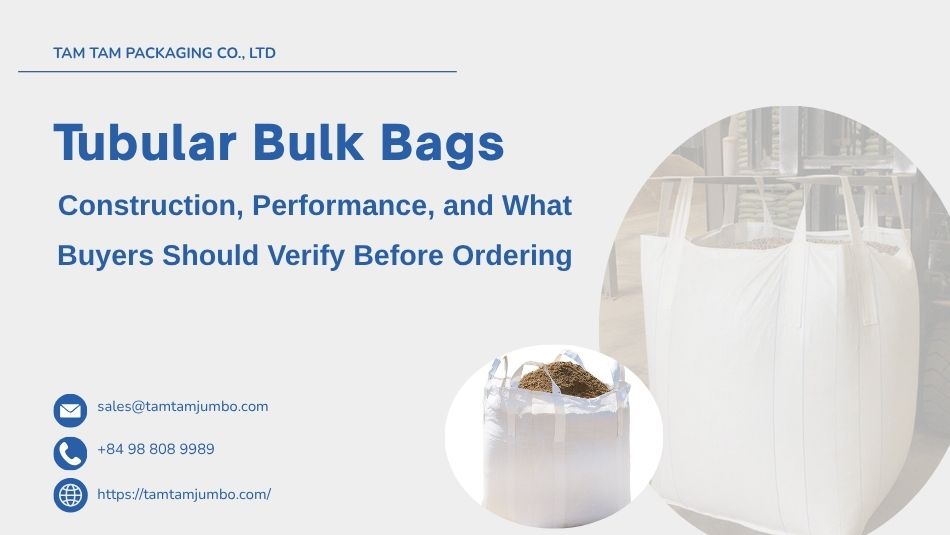
Buyers researching bulk packaging often come across two terms, tubular bulk bags and circular FIBC, used to describe what is essentially the same underlying construction. Both refer to a bag body woven as a continuous tube rather than assembled from cut fabric panels. This article looks at tubular construction from the manufacturing side: how the fabric tube is actually produced, what determines its quality, and which details buyers should confirm regardless of which term their supplier happens to use.
What Tubular Means in Bulk Bag Manufacturing
A tubular bulk bag starts as a length of fabric woven directly into a closed cylindrical shape on a circular loom, rather than being cut flat and sewn into a tube afterward. The term tubular describes the fabric itself, while circular FIBC typically refers to the finished bag made from that fabric. In practice, the two terms are used interchangeably across the industry, and a buyer asking for either one is generally describing the same seamless-body construction.
Read more: Circular FIBC Bags: What the Big Bag Specification Should Define
How Tubular Fabric Is Produced
Continuous Circular Weaving
Circular looms weave polypropylene tape yarn around a rotating set of shuttles, producing a seamless tube of fabric that comes off the loom already closed on all sides. The loom’s needle count and tape width determine the tube’s finished diameter, and this diameter needs to be held within a tight tolerance across the full production run, since even a small variance compounds into inconsistent bag dimensions once the tube is cut and finished.
Cutting to Length and Adding Base and Top
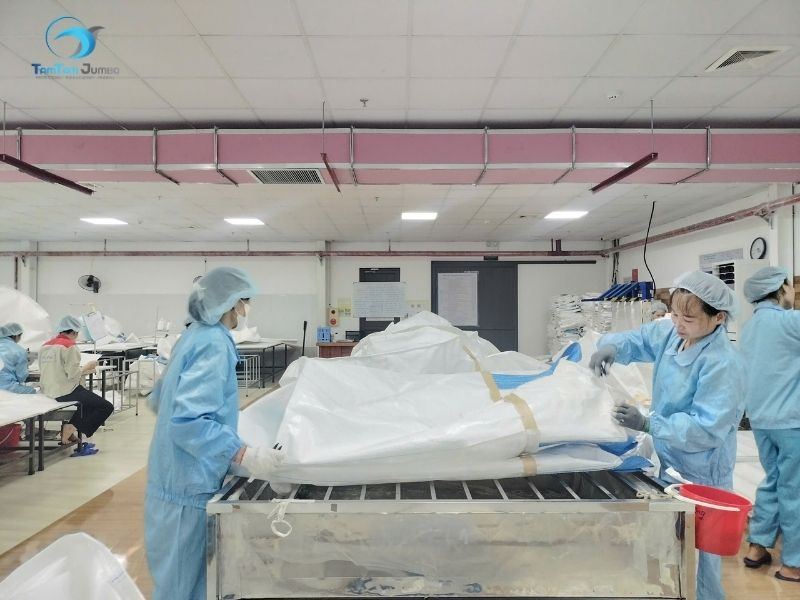
Once woven, the tube is cut to the length required for the target bag height, and the base and top are added as separate fabric pieces stitched onto the open ends. This is where the finished bag’s structural weak points are introduced, since the tube itself has no seams, but the base and top joints do. The quality of this finishing stage, not the weaving stage, is usually what determines whether a tubular bulk bag performs consistently under load.
Tubular Bulk Bags vs Circular FIBC: Same Construction, Different Terminology
Because the terms describe the same construction, buyers should not expect a meaningful technical difference between a supplier quoting tubular bulk bags and one quoting circular FIBC bags. What does vary between suppliers is the tube diameter tolerance, the fabric weight used, and the base and top construction method, all of which matter far more to bag performance than which term appears on the quotation.
Coating and Lamination Options for Tubular Fabric
Tubular fabric can be left uncoated, laminated with a thin polypropylene film on one or both sides, or paired with an internal liner for additional barrier protection. Uncoated fabric is the most economical option and suits dry, coarse materials without moisture sensitivity. Lamination reduces fine powder sifting through the weave and adds a degree of moisture resistance, which matters for products that absorb ambient humidity during storage. A separate liner offers the strongest barrier but adds cost and is generally reserved for hygroscopic chemical powders or products requiring contamination control.
Read more: How to Choose FIBC Liner for Bulk Packaging Applications
Tube Diameter Consistency and Why It Matters
A tubular bag’s finished shape depends heavily on how consistently the loom holds tube diameter across the production run. Diameter variance between individual bags in the same order can create fit problems on automated filling lines calibrated to a specific bag size, and can also affect how evenly bags stack once filled. Buyers ordering large volumes should ask suppliers what tolerance they hold on tube diameter, since this detail rarely appears on a basic product listing but has a direct effect on downstream handling consistency.
Quality Control Checks Specific to Tubular Construction
- Tube diameter is measured at multiple points along a sample run to confirm consistency.
- Fabric weight verified against the specified denier and weave density.
- Base and top seam strength are tested separately from the tube itself, since these are the joints most likely to fail under load.
- Visual inspection for weaving faults such as broken tape yarns or uneven weave density, which can create localized weak points in the tube.
- Coating or lamination adhesion is checked where applicable, to confirm the film does not delaminate under handling stress.
Buyer Considerations When Ordering Tubular Bulk Bags
Before placing an order, buyers should confirm the tube diameter and its tolerance, the fabric weight and denier, whether coating or lamination is required, the base and top construction method, loop type and anchoring, and whether the intended cargo requires a liner. These details determine actual bag performance far more than the terminology used to describe the construction, and a specification sheet that defines them clearly protects against inconsistent quality across repeat orders.
How Tam Tam Packaging Produces Tubular Bulk Bags
Tam Tam Packaging weaves tubular fabric to a defined diameter tolerance and fabric weight for each order, and documents base and top construction, coating specification, and loop type on the specification sheet issued with production. Sample measurements are taken across the production run to confirm diameter consistency before bags are finished and packed, so buyers receive bags that fit filling and handling equipment calibrated to the agreed dimensions.
Applications in Agriculture
Tubular bulk bags are widely used for agricultural commodities such as grain, seed, and animal feed, where the lower manufacturing cost of tubular construction fits the high-volume, price-sensitive nature of agricultural supply chains. Coated or laminated tubular fabric is commonly specified for seed and feed products that need protection from moisture during storage between growing seasons, while uncoated tubular bags remain a practical choice for drier, less sensitive bulk grain shipments.
Frequently Asked Questions
Is a tubular bulk bag the same as a circular FIBC bag?
Yes, both terms describe a bag body woven as a seamless tube on a circular loom, with base and top added afterward as separate fabric pieces.
What determines the quality of a tubular bulk bag?
Tube diameter consistency, fabric weight, base and top seam construction, and loop anchoring all have more effect on performance than the weaving process itself, since the tube comes off the loom with no seams to fail.
Should tubular bags be coated or uncoated?
It depends on the cargo. Dry, coarse materials without moisture sensitivity generally do not need coating, while fine powders or hygroscopic products benefit from lamination or an internal liner.
Why does tube diameter tolerance matter for buyers?
Inconsistent tube diameter across a production run can cause fit issues on automated filling lines and affect how evenly filled bags stack, even when overall bag capacity is the same.
Can tubular bulk bags be UN rated for dangerous goods?
Yes, provided the specific tubular construction, including fabric weight and base and top method, has been tested and approved under the UN Model Regulations for the intended packing group.
Conclusion
Tubular bulk bags and circular FIBC bags describe the same seamless-body construction, so the terminology itself should not drive a buyer’s decision. What matters is tube diameter consistency, fabric weight, base and top construction, and whether coating or a liner is needed for the intended cargo, details that should appear on the specification regardless of which term the supplier uses.
Tam Tam Packaging Co. manufactures tubular bulk bags to a defined diameter tolerance and fabric specification for every order. Contact our team to confirm the right construction for your product.
Contact Us
Tam Tam Packaging Co.
Email: sales@tamtamjumbo.com
Website: https://tamtamjumbo.com/
Read more

FIBC Bags for Flour: Why Allergen Status Change the Specification
Flour shares the fine-particle and combustible dust characteristics of other food powders, but wheat’s status...
Aug
FIBC Bag for Starch Powder: Dustproof Bag Needs Antistatic
Starch powder occupies an unusual position in FIBC specification: it is a common food and...
Aug
FIBC Bags for Animal Feed: What Actually Makes a Clean Bulk Bag
FIBC bags for animal feed mean something more specific than a bag that looks unused....
Aug
FIBC Bag for PET Flakes: Why UV Resistance Matter More Than It
Recycled PET flakes share a base polymer with virgin resin pellets, but the two behave...
Aug
FIBC Bags for Plastic Resin: PP Fabric Packaging PP Pellets
There is a certain irony in shipping polypropylene resin pellets inside a bag woven from...
Aug
FIBC Bags for the Food Industry: Building a Food Grade Bag
Food manufacturers sourcing bulk ingredient packaging are working from a different starting point than a...
Aug