

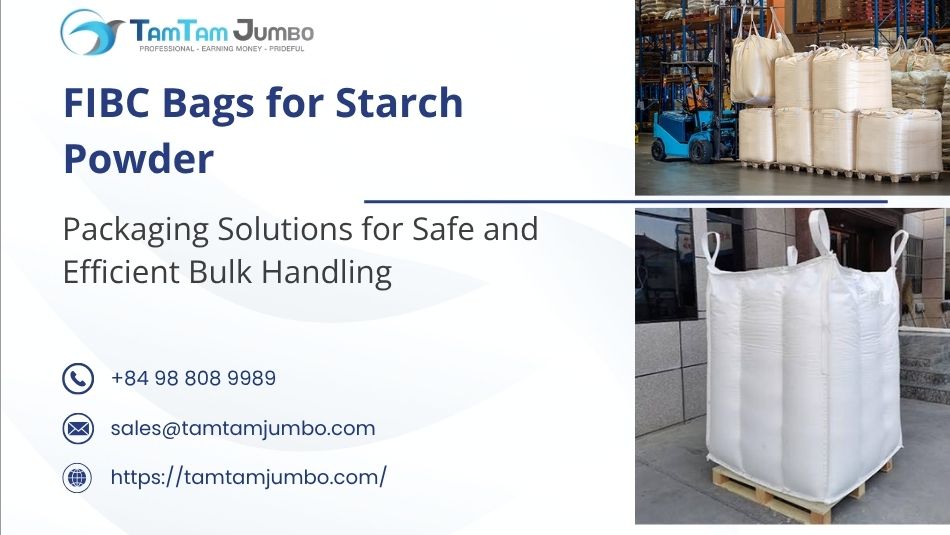
Starch powder occupies an unusual position in FIBC specification: it is a common food and industrial ingredient, and it is also a well-documented combustible dust hazard when fine starch particles become airborne in sufficient concentration. A Dustproof bag for starch needs to address both realities at once: containment for product quality and yield, and, depending on the facility’s handling process, genuine explosion risk mitigation. This guide covers what that combination actually requires.
Why Starch Powder Presents Both a Food Safety and a Dust Explosion Consideration
Most food ingredient articles treat dust containment purely as a product loss and workplace exposure issue. Starch is fine enough and combustible enough as an organic dust that facilities handling it in bulk quantities need to assess explosion risk as a genuine safety consideration alongside standard food grade sourcing, not instead of it.
Read more: FIBC Bags for the Food Industry: Building a Food Grade Bag
Combustible Dust Risk From Fine Starch Particles
Starch dust suspended in air at sufficient concentration is a recognized combustible dust hazard, capable of fueling a dust explosion in the presence of an ignition source, a risk documented across food processing safety literature for decades. Facilities handling significant volumes of starch powder, particularly during bulk bag filling and discharge where dust becomes airborne, should assess this risk formally rather than assuming it applies only to obviously industrial, non-food powders.
Read more: Anti-Static Bulk Bags: How a Type C Bag Prevents Ignition Risk
Combining Food Grade Certification With Anti-Static Protection
Where combustible dust risk is present, starch bags may need Type B or Type C anti-static construction on top of standard food grade sourcing, a combination that is not automatically included in either certification alone. This mirrors the same layered-standards logic that applies to hazardous chemical products: food safety and static protection are separate risks tested and documented independently, even when they apply to the same bag.
Read more: FIBC Bag Testing Standards: A Complete Overview of ISO 21898
Seam and Fabric Requirements for Dustproof Bag
Starch’s fine particle size means standard single-stitch seams are generally inadequate for containment, making folded and double-stitched seam construction a near-standard requirement, consistent with sift and dust proofing approaches used for other fine powders. Fabric weave density should also be specified with starch’s particle fineness in mind rather than assumed from a generic food ingredient fabric weight.
Read more: Dust Proof Bulk Bags: Controlling Exposure Standard Sift Proofing
Moisture Sensitivity of Starch Powder
Starch is hygroscopic enough to clump and lose flow characteristics when exposed to humidity, making moisture protection through coated fabric or a food-safe liner a common addition alongside dust containment. Buyers should treat moisture and dust requirements as two separate specification elements addressed together, rather than assuming one automatically covers the other.
Read more: Moisture Proof FIBC Bags: What Triple Proofed Actually Combines
Discharge Spout Design for Dust Control During Processing
Discharge into food or industrial processing equipment is where the most significant dust generation and potential explosion risk typically occurs, making sealed spout design and controlled discharge closure especially relevant for starch compared to less combustible powders. A spout that generates a visible dust cloud during discharge is both a product loss issue and, in facilities with a formal dust hazard assessment, a genuine safety gap.

Read more: FIBC Bottom Discharge Types: How an Iris Closure Controls Flow
Building a Complete Starch Powder FIBC Specification
Bringing these elements together, a complete starch bag specification typically addresses food grade certification if applicable, dust proof seam and fabric construction, anti-static protection where combustible dust risk has been identified, moisture protection through coating or liner, and sealed discharge spout design.
Common Starch Powder FIBC Specification Combinations
| Starch Application | Typical Specification Combination |
| Food grade starch for direct ingredient use | BRC certified facility, dust proof seams, moisture proof liner, virgin fabric |
| Bulk starch for automated food processing lines | As above plus sealed discharge spout matched to processing equipment |
| Industrial starch with confirmed dust hazard assessment | Dust proof seams, Type B or Type C anti-static construction, sealed spout |
| Standard industrial starch, lower volume handling | Dust proof seams, standard moisture protection, no anti-static requirement |
How Tam Tam Packaging Specifies Dustproof Bag for Starch Powder
Tam Tam Packaging builds starch bag specifications addressing dust proof seam construction, moisture protection, and food grade certification as standard, with anti-static construction added when a buyer’s facility has identified combustible dust risk in their handling process. Specification sheets document each requirement individually so buyers can confirm the bag matches their actual risk assessment.
Common Mistakes When Sourcing Starch Powder FIBC Bags
- Treating starch as a standard food powder without assessing combustible dust risk in the specific handling process.
- Assuming food grade certification automatically includes dust proof seam construction or anti-static protection.
- Overlooking moisture protection despite starch’s hygroscopic tendency to clump.
- Using generic spout dimensions without confirming compatibility with processing equipment where dust generation is a concern.
- Not consulting a facility’s own dust hazard assessment before finalizing whether anti-static construction is needed.
Applications in the Food and Industrial Starch Industry
Starch powder moves through both food ingredient supply chains, for use in baking, thickening, and processed food applications, and industrial applications including paper, textile, and adhesive manufacturing. Both categories share the same underlying dust and moisture considerations, though food-grade sourcing and BRC certification apply specifically to the food ingredient stream.
Frequently Asked Questions
Is starch powder actually a combustible dust hazard?
Yes. Fine starch dust suspended in air at sufficient concentration is a recognized combustible dust hazard, documented across food processing safety literature, relevant to facilities handling significant volumes.
Does food grade starch need anti-static bags?
Only where the facility’s handling process presents a genuine combustible dust risk, which should be confirmed through the facility’s own dust hazard assessment rather than assumed automatically.
What seam type works best for starch dust containment?
Folded and double-stitched seams, consistent with sift and dust proofing approaches used for other fine powders, since standard single-stitch seams are generally inadequate for starch’s particle size.
Does starch need moisture protection?
Yes. Starch is hygroscopic enough to clump and lose flow characteristics with humidity exposure, making moisture protection a standard addition alongside dust containment.
Can the same starch dustproof bag specification work for both food and industrial applications?
The dust and moisture considerations are similar, but food grade certification and BRC-certified manufacturing apply specifically to starch destined for food ingredient use.
Conclusion
Starch powder requires a dustproof bag that addresses both product containment and, where a facility’s handling process presents genuine risk, combustible dust safety through anti-static construction. Treating these as layered requirements, confirmed against the actual handling process rather than assumed from food grade status alone, produces a specification that protects both product quality and facility safety.
Tam Tam Packaging Co. builds FIBC specifications for starch powder addressing dust containment, moisture protection, and anti-static needs together. Contact our team to work through the right specification for your application.
Contact Us
Tam Tam Packaging Co.
Email: sales@tamtamjumbo.com
Website: https://tamtamjumbo.com/
Read more
FIBC Bags for Pharmaceutical Powders: What Sets a Pharma Bag
Pharmaceutical powder handling sits at the far end of the specification spectrum from general industrial...
Sep
FIBC Bags for Hazardous Material: How to Classify Bags Required
A UN certificate confirms a bag’s packing group and maximum weight, but it doesn’t tell...
Sep
FIBC Bags for Recycling Industry: Bulk Bag Across Material Stream
Recycling operations move an unusually wide range of material through FIBC packaging, plastic flakes, metal...
Sep
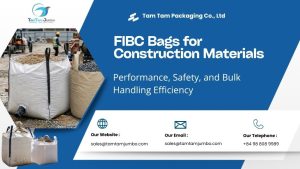
FIBC Bags for Construction: A Complete Guide Across Materials
Walk onto almost any construction site or materials yard and the bulk bags you see...
Aug
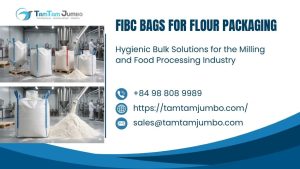
FIBC Bags for Flour: Why Allergen Status Change the Specification
Flour shares the fine-particle and combustible dust characteristics of other food powders, but wheat’s status...
Aug
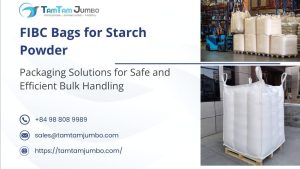
FIBC Bag for Starch Powder: Dustproof Bag Needs Antistatic
Starch powder occupies an unusual position in FIBC specification: it is a common food and...
Aug