

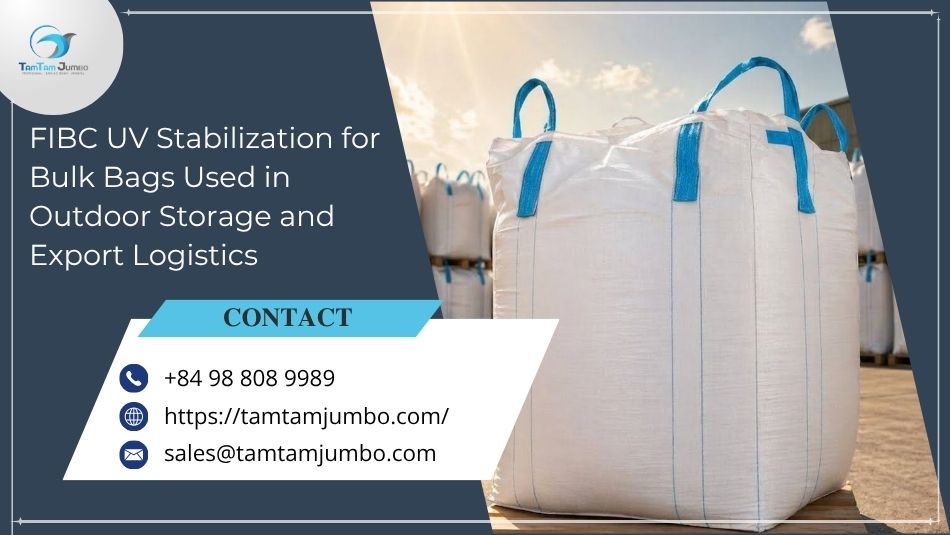
Buyers frequently assume that a bag certified to ISO 21898 has also been tested for UV performance, since both terms show up together in supplier documentation and both relate to how long a bag can be trusted to perform. They are not the same certification, and conflating them can leave a buyer with a false sense of confidence about how a bag will hold up in outdoor storage. This guide clarifies what ISO 21898 actually tests, where UV stabilization fits into a bag’s overall specification, and what to ask a supplier who references both.
What ISO 21898 Actually Certifies
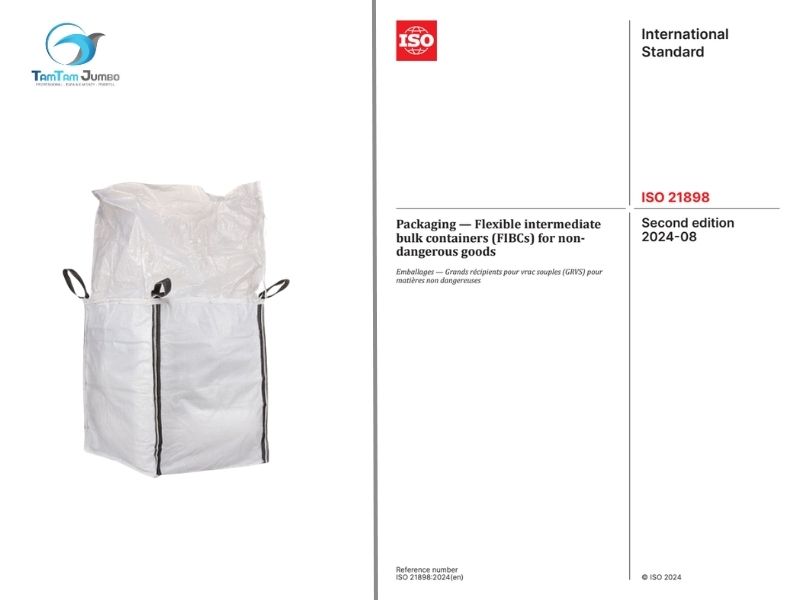
ISO 21898 is the international standard covering flexible intermediate bulk containers (FIBC Bags) for the transport of non-dangerous goods, defining requirements for materials, construction, and a specific sequence of mechanical performance tests. It establishes how a bag’s safe working load and safety factor should be verified, and it sets requirements around traceability and labeling. What it does not do is test or certify a fabric’s resistance to ultraviolet degradation over time in outdoor storage.
Read more: FIBC Safe Working Load: What a Big Bag 1000kg Actually Means
The Core Tests Under ISO 21898
Top Lift Test
The bag, filled to its rated capacity, is lifted and suspended by its loops for a defined period, confirming the lifting system and body seams hold under the rated load.
Drop Test
A filled bag is dropped from a specified height to simulate handling impact, verifying the construction withstands realistic shock loading during transport and handling.
Stacking Test
A compressive load simulating bags stacked above is applied and held for a defined period, confirming the bag maintains integrity under sustained storage pressure.
Tear Propagation Test
A controlled cut is made in the fabric and load is applied to confirm the tear does not spread uncontrollably, an important safety consideration for bag failure modes.
Read more: Bulk Bag Stitching Types: How Sewing Machine Choice Affects Seam
Does ISO 21898 Test UV Stabilization? Setting the Record Straight
ISO 21898 focuses on mechanical performance under normal handling conditions at the time of testing. It does not include a standardized accelerated weathering or ultraviolet exposure test as part of its core certification requirements. A bag can be fully compliant with ISO 21898 and still use standard, non-UV-stabilized fabric, since the standard scope simply does not address long-term outdoor sunlight exposure as a variable.
Read more: FIBC UV Protection: What Outdoor Bag Storage Actually Requires
How UV Performance Is Actually Verified
Accelerated Weathering Standards
UV resistance claims are more accurately supported by separate accelerated weathering test methods, such as those referenced under ISO 4892 or ASTM G154, which expose fabric samples to controlled ultraviolet light and measure resulting strength loss over a simulated timeframe. These are distinct testing protocols from ISO 21898 and are not automatically included when a bag is described as ISO 21898 compliant.
Manufacturer-Stated Exposure Duration
In practice, many manufacturers state a UV stabilization level or expected outdoor exposure duration based on their own accelerated weathering testing or established formulation data, rather than citing a single universally applied UV certification standard. Buyers should ask specifically which test method supports a stated UV exposure duration rather than assuming it derives from the same testing process as the bag’s mechanical SWL rating.
Why This Distinction Matters for Buyers
A buyer who assumes ISO 21898 compliance includes UV performance verification may store bags outdoors for extended periods without realizing the fabric was never actually tested for that condition. This is not a defect in ISO 21898 itself, since the standard was never designed to cover environmental weathering, but a gap in how the certification is sometimes marketed or misunderstood downstream. Confirming UV stabilization as its own separate specification protects against this gap.
What to Ask a Supplier Claiming Both ISO 21898 Compliance and UV Stabilization
- Request the ISO 21898 test report separately from any UV stabilization data, confirming they are documented as distinct test results.
- Ask which specific test method, such as ISO 4892 or ASTM G154, supports the UV stabilization claim.
- Confirm the stated UV exposure duration and the conditions under which it was determined, such as the UV intensity level assumed.
- Verify that UV stabilization applies to the specific fabric batch being ordered, not just a general product line claim.
How Tam Tam Packaging Documents Both Standards
Tam Tam Packaging tests bag constructions against ISO 21898 mechanical performance requirements and separately documents UV stabilization level and expected outdoor exposure duration based on the buyer’s storage requirements. These are provided as distinct pieces of documentation, so buyers can see clearly which claims are backed by which test method rather than assuming one certification covers both.
Common Misunderstandings About FIBC Testing Standards
- Assuming ISO 21898 compliance means a bag has been tested for outdoor UV exposure, when the standard does not cover this.
- Treating a general UV stabilization claim as equivalent to a specific, referenced accelerated weathering test result.
- Assuming all suppliers apply the same UV testing rigor simply because they reference similar-sounding standards.
- Not requesting the underlying test report behind either ISO 21898 or UV stabilization claims before a large order.
Applications in the Food Industry
Food commodity bags are frequently required to meet ISO 21898 mechanical performance standards as a baseline procurement requirement, but buyers storing filled bags outdoors at mills, ports, or distribution yards before further processing should confirm UV stabilization as a separate specification rather than assuming ISO 21898 compliance covers that need. This is particularly relevant for export supply chains where bags may sit in open storage yards for extended periods awaiting shipment.
Frequently Asked Questions
Does ISO 21898 include UV testing?
No. ISO 21898 covers mechanical performance testing, including top lift, drop, stacking, and tear propagation tests, but does not include a standardized ultraviolet exposure or accelerated weathering test.
What standard actually tests UV resistance for FIBC fabric?
Accelerated weathering test methods such as ISO 4892 or ASTM G154 are commonly used to evaluate UV resistance, separate from ISO 21898 mechanical testing.
Can a bag be ISO 21898 compliant without being UV stabilized?
Yes. ISO 21898 compliance addresses mechanical safe working load performance and does not require any specific level of UV stabilization.
Why do suppliers sometimes reference both standards together?
Because both relate to a bag’s overall reliability and are often documented together in a specification sheet, even though they test entirely different properties using different methods.
What should I ask for if I need both ISO 21898 compliance and UV protection?
Request separate documentation for each, including the specific UV test method or exposure duration data, rather than assuming one certificate covers both requirements.
Conclusion
ISO 21898 and UV stabilization address different aspects of FIBC bags performance, and treating them as interchangeable can leave a real gap in outdoor storage planning. Buyers should request documentation for each separately, confirming the specific test methods behind both mechanical performance and UV resistance claims before relying on either.
Tam Tam Packaging Co. documents ISO 21898 mechanical testing and UV stabilization separately for every order. Contact our team to confirm the right testing and documentation for your application.
Contact Us
Tam Tam Packaging Co.
Email: sales@tamtamjumbo.com
Website: https://tamtamjumbo.com/
Read more

FIBC Bags for Flour: Why Allergen Status Change the Specification
Flour shares the fine-particle and combustible dust characteristics of other food powders, but wheat’s status...
Aug
FIBC Bag for Starch Powder: Dustproof Bag Needs Antistatic
Starch powder occupies an unusual position in FIBC specification: it is a common food and...
Aug
FIBC Bags for Animal Feed: What Actually Makes a Clean Bulk Bag
FIBC bags for animal feed mean something more specific than a bag that looks unused....
Aug
FIBC Bag for PET Flakes: Why UV Resistance Matter More Than It
Recycled PET flakes share a base polymer with virgin resin pellets, but the two behave...
Aug
FIBC Bags for Plastic Resin: PP Fabric Packaging PP Pellets
There is a certain irony in shipping polypropylene resin pellets inside a bag woven from...
Aug
FIBC Bags for the Food Industry: Building a Food Grade Bag
Food manufacturers sourcing bulk ingredient packaging are working from a different starting point than a...
Aug