

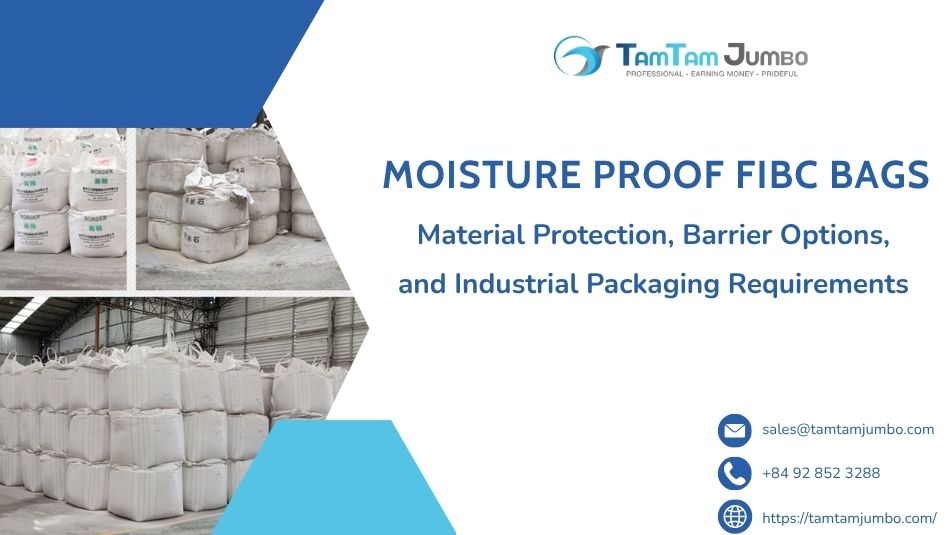
Hygroscopic powders absorb ambient moisture whenever the packaging around them allows it, and for many chemical and agricultural products, even a small amount of moisture uptake during a long sea voyage is enough to cause caking, clumping, or chemical degradation. Moisture proof FIBC bags are built to prevent this, typically through a combination of construction elements rather than any single feature, which is what suppliers are describing when they use the term triple proofed. This article explains where moisture actually gets into a standard bag, what each protective layer contributes, and what buyers should confirm when a supplier markets a bag as triple proofed.
What Moisture Proof Means for an FIBC Bag
Moisture proof FIBC bags are constructed to prevent ambient humidity and water vapor from reaching the product inside, whether during outdoor storage, transit through humid climates, or extended sea freight where temperature and humidity fluctuate inside a shipping container. This is a distinct requirement from waterproofing against direct liquid contact, since vapor transmission through fabric and seams can occur even when no liquid water ever touches the bag directly.
How Moisture Enters a Standard Bulk Bag
Vapor Transmission Through Uncoated Fabric
Standard woven polypropylene fabric is not a vapor barrier on its own. Water vapor can pass through the weave gradually over time, particularly under the temperature swings common inside a sea container, where condensation can form on the interior of the container and raise local humidity around the bags.
Seam and Stitch Hole Ingress
Sewn seams introduce needle holes and small gaps that provide a direct path for moisture, similar to the seam gap issue relevant to sift proof construction. For moisture specifically, this ingress point matters even when the product itself is coarse enough that fine particle sifting is not a concern.
Read more: Sift Proof FIBC Bags: Building a Truly Leak Proof Jumbo Bag
Spout and Closure Gaps
Fill and discharge spouts that are simply folded and tied rather than heat-sealed or clamped leave an open path for humid air to reach the product, particularly during extended storage periods where the closure is not actively monitored.
Construction Layers That Provide Moisture Protection
Laminated or Coated Outer Fabric
A polypropylene film laminated to the body fabric reduces vapor transmission through the weave itself, providing a first layer of moisture resistance before considering seams or an inner liner. Coating alone is generally not sufficient for highly hygroscopic products, since it does not address seam or spout ingress.
Inner Liner as a Vapor Barrier
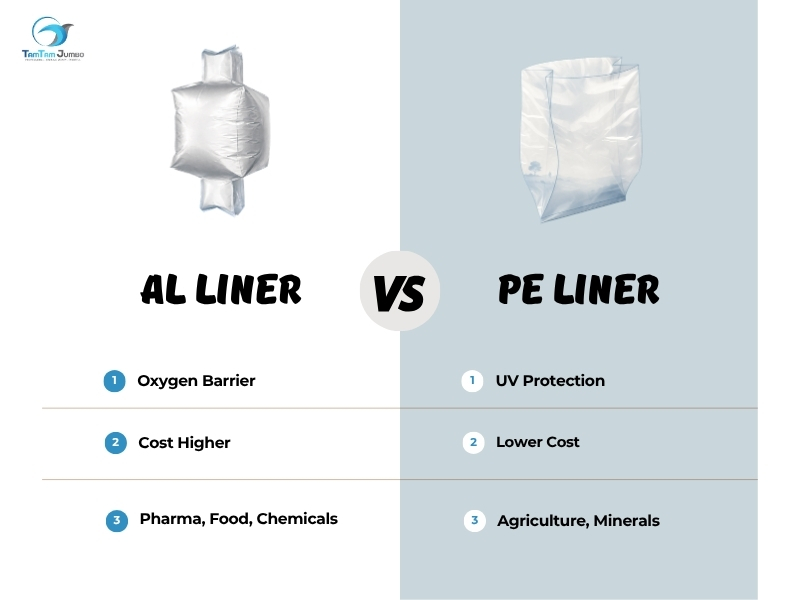
An internal liner, whether a simple polyethylene film bag or a laminated PE and aluminum foil structure, provides the primary vapor barrier independent of the outer fabric’s seams. For products with high moisture sensitivity, a PE/AL liner offers substantially better vapor barrier performance than a PE liner alone, since the aluminum layer blocks vapor transmission far more effectively than polyethylene film by itself.
Read more: What Are the Different FIBC Liner Types Used in Bulk Packaging
Heat-Sealed or Taped Seams
Closing the outer fabric seams with a heat-sealed tape or covering strip, in addition to standard stitching, addresses the needle-hole ingress point that coating and liners alone do not fully resolve. This detail is often the difference between a bag that performs well in a controlled environment and one that holds up during an extended, humid sea freight journey.
What Triple Proofed Actually Refers to
Triple proofed is an industry marketing term generally describing a bag that combines three protective elements working together: a laminated or coated outer fabric, an internal moisture barrier liner, and sealed or taped seams and closures. No single one of these elements alone provides complete moisture protection, which is the point of the term: it signals that all three layers have been addressed rather than just one. Buyers should ask suppliers to specify exactly which three elements are included under a triple proofed claim, since the term is not standardized across the industry and different suppliers may define it differently.
Moisture Proof vs Sift Proof vs Dust Proof: Where They Overlap
These three requirements address different failure modes but often share construction solutions. Sift proof and moisture proof both benefit from improved seam construction, since needle holes are a shared ingress and egress point for fine particles and vapor alike. Dust proof and moisture proof both benefit from coated fabric, since reduced porosity limits both dust migration and vapor transmission. A bag specified for one requirement is not automatically adequate for the others, but addressing seam quality and fabric coating together tends to improve performance across all three.
Read more: Dust Proof Bulk Bags: Controlling Exposure Beyond Standard Sift Proofing
Choosing the Right Liner Material for Moisture Sensitivity
A basic polyethylene liner suits moderately moisture-sensitive products and shorter transit times, while a PE/AL laminated liner is generally specified for highly hygroscopic chemical powders, products sensitive to oxidation, or long sea voyages through variable humidity conditions. The liner’s seal method at the top, whether heat-sealed, twist-tied, or clipped, also affects overall performance and should be specified alongside the liner material itself.
Specification Details for a Moisture Proof Bag
- Outer fabric coating or lamination specification, including which sides of the fabric are treated.
- Liner material, whether PE or PE/AL, and liner thickness.
- Liner seal method at the top of the bag, confirming compatibility with the filling process.
- Seam treatment, specifying whether seams are heat-sealed or taped in addition to standard stitching.
- Expected transit duration and climate conditions, since these determine how much moisture protection is actually needed.
How Tam Tam Packaging Manufactures Triple Proofed Bulk Bags
Tam Tam Packaging builds moisture proof FIBC bags combining coated outer fabric, PE or PE/AL liner options, and heat-sealed or taped seam construction, specified together to match the buyer’s product sensitivity and expected transit conditions. Each element is documented individually on the specification sheet, so buyers ordering a triple proofed bag can confirm exactly which combination of features is included rather than relying on the term alone.
Common Mistakes When Specifying Moisture Protection
- Accepting a triple proofed claim without confirming which three specific elements the supplier is referring to.
- Choosing a PE liner for a highly hygroscopic product that would perform better with a PE/AL barrier.
- Addressing fabric coating and liner, but overlooking seam treatment, leaving a known ingress point unresolved.
- Not accounting for actual transit duration and climate when specifying liner thickness and barrier type.
- Assuming moisture protection also provides sift or dust control without confirming those requirements separately.
Applications in the Chemical Industry
Moisture proof and triple proofed bulk bags are widely used across the chemical industry for hygroscopic powders such as certain fertilizer intermediates, industrial salts, and specialty chemical compounds that degrade or cake when exposed to humidity. Long sea freight routes through variable climate zones make combined fabric, liner, and seam protection a standard specification for these products, since a single point of failure in any one layer can result in product loss or quality degradation discovered only after the shipment arrives.
Frequently Asked Questions
What does moisture proof mean for an FIBC bag?
It means the bag is constructed to prevent ambient humidity and water vapor from reaching the product through a combination of coated fabric, liners, and sealed seams.
What does triple proofed mean?
It generally refers to a bag combining three protective elements: coated or laminated outer fabric, an internal moisture barrier liner, and sealed or taped seams, though the term is not standardized and should be confirmed with the specific supplier.
What is the difference between a PE liner and a PE/AL liner?
A PE/AL liner adds an aluminum foil layer that provides significantly better vapor barrier performance than polyethylene film alone, making it more suitable for highly hygroscopic products or long transit times.
Is moisture proof the same as waterproof?
Not exactly. Moisture proof addresses vapor transmission through fabric, seams, and closures, while waterproof more specifically addresses resistance to direct liquid contact.
Can a moisture proof bag also be sift proof or dust proof?
Yes, and the two often share construction solutions such as improved seam treatment and coated fabric, but each requirement should still be specified individually rather than assumed.
Conclusion
Moisture proof FIBC bags depend on coated fabric, an appropriate liner, and sealed seams working together, which is what the term triple proofed is meant to describe. Because that term is not standardized across suppliers, buyers should confirm exactly which three elements are included and match liner type and seam treatment to the product’s actual moisture sensitivity and transit conditions rather than relying on the label alone.
Tam Tam Packaging Co. manufactures moisture proof and triple proofed bulk bags with documented fabric, liner, and seam specifications matched to your product. Contact our team to confirm the right construction for your application.
Contact Us
Tam Tam Packaging Co.
Email: sales@tamtamjumbo.com
Website: https://tamtamjumbo.com/
WhatsApp: +84 92 852 3288
Read more
Moisture Proof FIBC Bags: What Triple Proofed Actually Combines
Hygroscopic powders absorb ambient moisture whenever the packaging around them allows it, and for many...
Jul
FIBC Fabric GSM Guide: How Fabric Weight Determines Strength
GSM is the number buyers reach for first when comparing FIBC fabric across suppliers, and...
Jul
Breathable FIBC Bags: Guide to Choosing the Right Mesh Big Bag
Buyers moving from small mesh sacks to bulk mesh big bags for the first time...
Jul
Dust Proof Bulk Bags: Controlling Exposure Standard Sift Proofing
A bag that keeps fine powder from sifting out during storage is not automatically the...
Jul
Sift Proof FIBC Bags: Building a Truly Leak Proof Jumbo Bag
Fine powders find their way out of packaging that would hold coarser material without issue....
Jul
Anti-Static Bulk Bags: How a Type C Bag Prevents Ignition Risk
Filling and emptying an FIBC bag generates static charge as powder moves against fabric, and...
Jul