
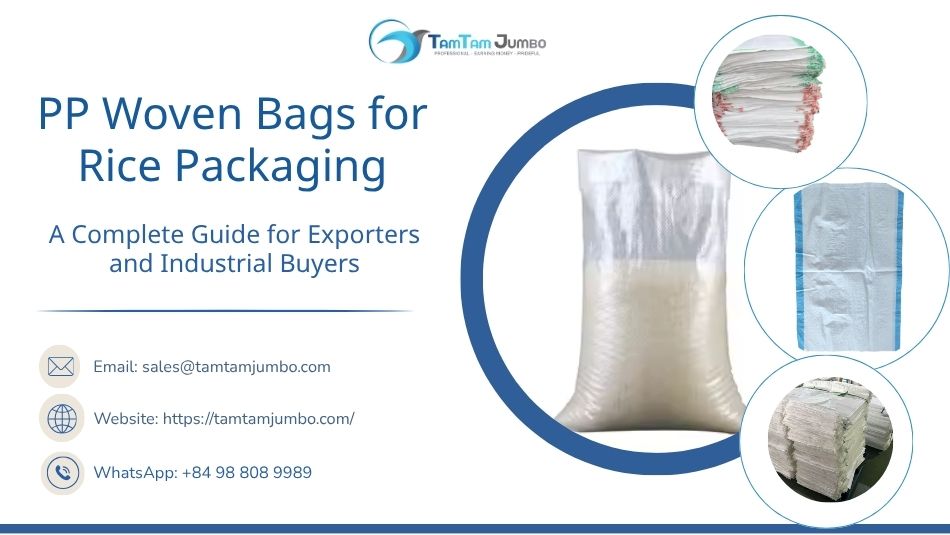
Rice packaging is not simply about containing a product. For exporters, distributors, and food manufacturers, packaging directly affects transportation efficiency, storage stability, product quality, and brand presentation.
Among industrial packaging solutions, PP woven bags for rice packaging remain one of the most widely used options worldwide because they combine strength, breathability, cost efficiency, and export durability.
At Tam Tam Packaging Co., PP woven bags are manufactured for rice exporters, rice mills, wholesalers, and food packaging companies requiring reliable packaging performance across international supply chains.
From 5 kg retail bags to 50 kg industrial sacks and jumbo bulk packaging, woven polypropylene structures continue to dominate rice packaging applications due to their balance of durability and economic efficiency.
What Are PP Woven Bags for Rice Packaging?
PP woven bags for rice packaging are bags manufactured from woven polypropylene tapes interlaced into strong fabric structures designed to hold and transport rice safely.
The woven construction creates packaging that is:
- Lightweight
- Durable
- Tear resistant
- Breathable
- Cost-efficient
Depending on packaging requirements, rice bags may include:
- Laminated coating
- PE inner liners
- BOPP printing film
- UV stabilization
- Food-grade production standards
These bags are commonly used for:
- Rice export
- Retail rice packaging
- Agricultural distribution
- Long-distance transportation
- Warehouse storage
According to industrial packaging references, woven polypropylene structures provide high tensile strength and strong resistance to handling stress during transportation and stacking.
Why PP Woven Bags Are Widely Used for Rice Packaging
High Strength-to-Weight Ratio
Rice packaging must withstand:
- Heavy stacking
- Container loading
- Forklift handling
- Long-distance transportation
PP woven bags offer excellent load-bearing performance while remaining lightweight.
Compared to paper sacks or non-woven packaging, woven polypropylene provides:
- Better tear resistance
- Higher puncture resistance
- Improved stacking stability
This is especially important for:
- 25 kg rice bags
- 50 kg rice sacks
- Export shipments
- Port handling operations
Industrial packaging sources consistently identify woven polypropylene as one of the most durable flexible packaging materials for agricultural bulk products.
Moisture Resistance for Export Logistics
Rice quality can deteriorate quickly when exposed to excessive humidity.
PP woven bags help reduce moisture-related risks during:
- Ocean freight
- Warehouse storage
- Seasonal humidity exposure
- Port operations
Laminated PP woven bags provide additional protection against:
- Water vapor
- Condensation
- Surface moisture
- External contamination
For long-distance export shipments, many buyers request:
- PE liner integration
- Laminated woven fabric
- BOPP laminated structures
These features improve rice protection during international logistics.
Breathability Helps Maintain Product Quality
One major advantage of woven polypropylene structures is controlled breathability.
Rice naturally releases small amounts of internal moisture during storage. Completely sealed packaging may trap condensation, increasing the risk of:
- Mold formation
- Product deterioration
- Odor development
The woven structure allows micro-ventilation while still protecting the product.
For certain export routes with high humidity exposure, additional liner systems may be recommended depending on:
- Rice moisture level
- Shipping duration
- Climate conditions
Manufacturing and export packaging references note that woven PP structures help balance ventilation and protection for agricultural commodities like rice.
Common Types of PP Woven Bags for Rice Packaging
Standard PP Woven Rice Bags
These are traditional woven sacks commonly used for:
- 25 kg rice
- 50 kg rice
- Bulk domestic distribution
Advantages include:
- Low packaging cost
- Good durability
- Simple printing
- Lightweight handling
They are widely used in industrial and wholesale rice markets.
Laminated PP Woven Bags
Laminated bags include an additional coating layer to improve:
- Moisture resistance
- Surface durability
- Printing appearance
These bags are commonly selected for:
- Export rice packaging
- Long-term storage
- Higher-value rice products
BOPP Laminated Rice Bags
BOPP laminated bags combine woven polypropylene strength with high-definition printed film.
Advantages include:
- Premium shelf appearance
- High-quality branding
- Better moisture protection
- Improved abrasion resistance
These bags are widely used in:
- Retail rice packaging
- Supermarket products
- Premium rice brands
PP Woven Bags with PE Liners
For sensitive rice products, PE liners provide an additional internal barrier.
PE liner systems help improve:
- Hygiene
- Moisture protection
- Contamination resistance
This structure is commonly used for:
- Food-grade rice
- Export shipments
- Long storage cycles
Typical Rice Bag Sizes
Small Retail Packaging
Common sizes:
- 1 kg
- 2 kg
- 5 kg
- 10 kg
Usually produced with:
- BOPP lamination
- Premium printing
- Food-grade specifications
Industrial Packaging
Common sizes:
- 25 kg
- 50 kg
These are widely used for:
- Rice mills
- Wholesale distribution
- Export operations
Jumbo Bags for Rice Export
FIBC jumbo bags are increasingly used for:
- Bulk rice transportation
- Port logistics
- Industrial grain handling
Large-capacity jumbo bags improve:
- Loading efficiency
- Transportation cost per ton
- Warehouse handling speed
Export-focused rice industries are increasingly adopting bulk packaging solutions for container optimization.
Key Technical Specifications Buyers Should Evaluate
Fabric GSM
Fabric weight affects:
- Strength
- Durability
- Packaging lifespan
Higher GSM typically increases:
- Load capacity
- Puncture resistance
- Stacking performance
However, excessive GSM increases:
- Material cost
- Packaging weight
- Freight expenses
Experienced manufacturers optimize GSM according to real transportation conditions rather than simply maximizing thickness.
Mesh Density
Mesh density impacts:
- Structural strength
- Breathability
- Fabric stability
Higher mesh density generally improves durability but increases production cost.
Industrial references commonly identify mesh count as a major performance factor in woven packaging.
Sewing Quality
Poor stitching is one of the most common causes of rice bag failure.
Critical stitching areas include:
- Bottom seams
- Side seams
- Valve openings
Double stitching or reinforced sewing may be required for:
- Export shipments
- Heavy stacking
- High-speed filling lines
Food-Grade Compliance
Rice packaging often requires:
- Virgin polypropylene resin
- Hygienic production environments
- Food-contact safe materials
International buyers may request:
- FDA compliance
- EU food-contact compliance
- Migration testing
- Traceability documentation
PP Woven Bags vs Paper Rice Bags
| Feature | PP Woven Bags | Paper Bags |
| Tear Resistance | High | Moderate |
| Moisture Resistance | Better | Lower |
| Cost Efficiency | High | Moderate |
| Export Durability | Excellent | Limited |
| Reusability | Higher | Lower |
| Stackability | Strong | Moderate |
| Weight | Lightweight | Heavier |
| Retail Appearance | Good with BOPP | Premium natural look |
For industrial rice transportation, woven polypropylene typically provides better durability and transportation performance.
Paper packaging may still be preferred for:
- Premium eco-branding
- Specialty retail products
- Limited distribution applications
Why Rice Packaging Failures Often Happen
In practical export operations, bag failures are rarely caused by fabric alone.
Common failure causes include:
- Weak sewing quality
- Incorrect GSM selection
- Poor lamination bonding
- Inconsistent tape stretching
- Improper stacking practices
At Tam Tam Packaging Co., production control focuses heavily on:
- Tape tensile consistency
- Fabric uniformity
- Stitching strength
- Moisture control during production
For export packaging, consistent production quality is more important than simply increasing material thickness.
Buyer Considerations Before Ordering
Transportation Conditions
Buyers should evaluate:
- Shipping distance
- Container conditions
- Climate exposure
- Warehouse environment
Long ocean freight routes may require:
- Laminated bags
- PE liners
- Enhanced moisture barriers
Filling Systems
Different filling systems require different bag structures.
Automated filling lines may require:
- Stable dimensions
- Valve bag systems
- Consistent seam positioning
Branding Requirements
Retail rice products often require:
- High-quality printing
- Glossy surfaces
- Strong shelf appearance
BOPP laminated structures are commonly preferred for branded rice products.
Cost Optimization
The lowest bag price does not always create the lowest total packaging cost.
Low-quality packaging may increase:
- Product loss
- Transportation damage
- Warehouse handling issues
- Customer complaints
Experienced buyers evaluate:
- Total logistics performance
- Packaging consistency
- Failure rate
- Long-term supplier reliability
Quick Summary
PP woven bags for rice packaging are widely used because they offer:
- High strength
- Good moisture resistance
- Excellent export performance
- Cost efficiency
- Lightweight handling
- Strong customization capability
Common structures include:
- Standard woven bags
- Laminated woven bags
- BOPP laminated bags
- PE liner bags
These bags are used for:
- Retail rice packaging
- Industrial distribution
- International rice export
- Bulk grain transportation
FAQ
Why are PP woven bags used for rice packaging?
PP woven bags are strong, lightweight, breathable, and cost-effective, making them suitable for rice transportation and storage.
Are PP woven bags safe for food packaging?
Yes. Food-grade PP woven bags manufactured with virgin polypropylene resin and hygienic production processes are widely used for rice packaging.
What size PP woven bags are used for rice?
Common sizes include 5 kg, 10 kg, 25 kg, and 50 kg. Jumbo FIBC bags are also used for bulk rice export.
Are laminated PP woven bags better for rice export?
Laminated bags generally provide better moisture resistance and surface durability during international transportation.
Can PP woven rice bags be customized?
Yes. Buyers can customize:
- Size
- Fabric GSM
- Printing
- Lamination
- Valve systems
- PE liners
- UV protection
Conclusion
PP woven bags continue to be one of the most practical and reliable packaging solutions for rice transportation and storage.
Their combination of:
- Durability
- Lightweight structure
- Moisture resistance
- Export performance
- Cost efficiency
makes them highly suitable for global rice supply chains.
The right packaging specification depends on:
- Transportation conditions
- Rice type
- Storage duration
- Branding requirements
- Filling systems
Well-designed rice packaging improves not only product protection but also logistics efficiency and long-term customer satisfaction.
Contact Us
Tam Tam Packaging Co.
Email: sales@tamtamjumbo.com
Website: https://tamtamjumbo.com/
Read more
FIBC Bags for Flour: Why Allergen Status Change the Specification
Flour shares the fine-particle and combustible dust characteristics of other food powders, but wheat’s status...
Aug
FIBC Bag for Starch Powder: Dustproof Bag Needs Antistatic
Starch powder occupies an unusual position in FIBC specification: it is a common food and...
Aug
FIBC Bags for Animal Feed: What Actually Makes a Clean Bulk Bag
FIBC bags for animal feed mean something more specific than a bag that looks unused....
Aug
FIBC Bag for PET Flakes: Why UV Resistance Matter More Than It
Recycled PET flakes share a base polymer with virgin resin pellets, but the two behave...
Aug
FIBC Bags for Plastic Resin: PP Fabric Packaging PP Pellets
There is a certain irony in shipping polypropylene resin pellets inside a bag woven from...
Aug
FIBC Bags for the Food Industry: Building a Food Grade Bag
Food manufacturers sourcing bulk ingredient packaging are working from a different starting point than a...
Aug