

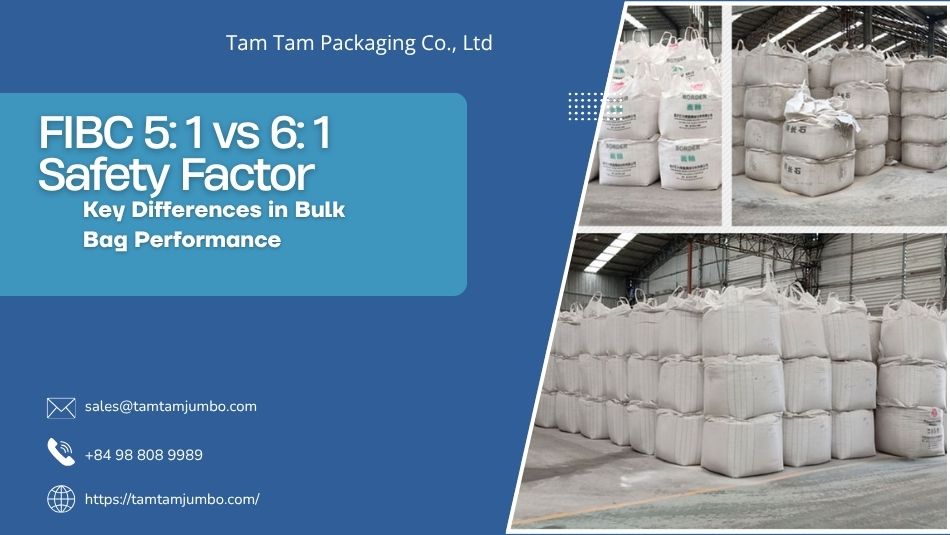
The sewn-in label on an FIBC bag is a compliance document, not a brand tag. It is meant to tell a warehouse worker, forklift operator, or safety inspector everything they need to know about how much weight the bag can carry and under what conditions, at a glance, without needing to track down a separate specification sheet. This guide covers what should actually appear on that label, including how single-trip 5:1 and multi-trip 6:1 safety factor bags are marked differently, and how to spot a label that is missing information it should include.
What an FIBC Label Is Actually For
Unlike a specification sheet, which supports procurement and quality verification before an order ships, the physical label stays with the bag through its entire working life. It is the reference point available on the warehouse floor when someone needs to confirm a bag’s rated capacity, safety factor, or handling requirements without pulling paperwork, which is exactly why the standard requires certain information to be present directly on the bag rather than only in accompanying documents.
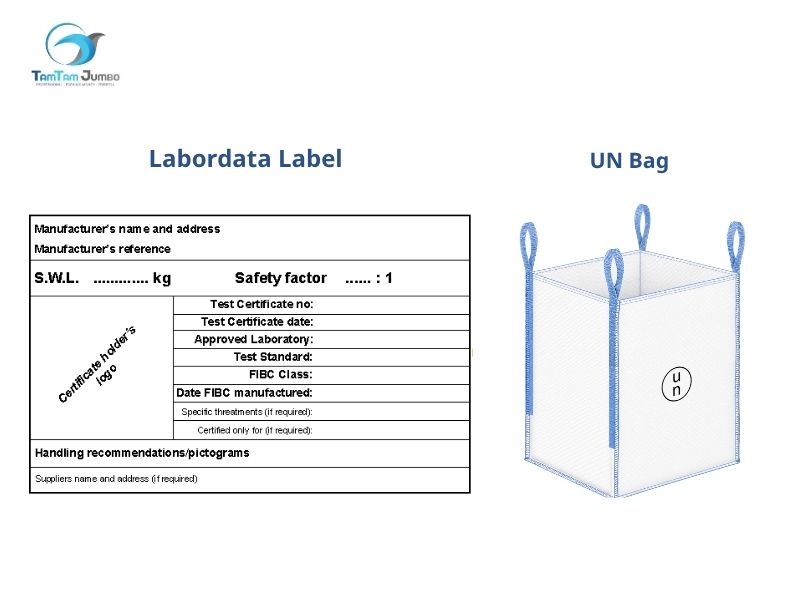
Required Information on a Standard FIBC Label
- Manufacturer name or identification code.
- Safe working load, stated clearly with its unit of measurement.
- Safety factor classification, indicating whether the bag is rated 5:1 for single-trip use or 6:1 for multi-trip use.
- Date of manufacture, typically shown as month and year.
- Maximum safe stacking height or top load rating, where applicable.
- UN mark and associated classification code, if the bag is rated for dangerous goods transport.
- Batch or production lot number, supporting traceability back to the specific manufacturing run.
Read more: FIBC Safe Working Load: What a Big Bag 1000kg Actually Means
How 5:1 and 6:1 Bags Are Marked Differently
A single-trip bag rated to a 5:1 safety factor should have that classification stated explicitly on the label, often alongside wording indicating the bag is intended for one fill and discharge cycle only. A multi-trip bag rated to 6:1 should be marked accordingly, and reputable manufacturers typically include guidance on the expected number of trips or a maximum service life the rating supports. A label that states only a fill weight capacity without specifying which safety factor applies leaves the person handling the bag unable to confirm whether reuse is appropriate.
Why the Safety Factor Marking Matters on the Floor, Not Just on Paper
Warehouse and logistics staff generally do not have access to a bag’s original specification sheet once it is in circulation, which means the label is the only practical way to confirm whether a bag has already been used once and whether it is rated for continued reuse. A facility that reuses 5:1 single-trip bags because the label did not clearly distinguish them from 6:1 multi-trip stock is operating outside the bag’s tested safety margin without necessarily realizing it.
Read more: FIBC Bag GSM Guide: How Fabric Weight Determines Strength
UN Marking on Labels for Dangerous Goods Bags
Bags rated for dangerous goods transport carry an additional UN code directly on the label or printed on the bag body itself, following the packaging type, packing group, and approval reference format used across UN-rated flexible packaging. This marking needs to remain legible and permanently affixed, since a faded or damaged UN mark can create the same verification problem at customs or during a safety audit as a bag with no mark at all.
Read more: UN Certified Bulk Bags: What the Jumbo Bag Certificate Actually Covers
Batch Traceability and What It Enables
The batch or lot number on a label connects an individual bag back to its specific production run, fabric source, and quality control records. This becomes important if a defect is discovered after bags are already in circulation, since batch traceability allows a manufacturer or buyer to isolate which bags might be affected rather than treating an entire order as suspect.
Common Label Deficiencies to Watch For
- Missing or unclear safety factor classification, leaving reuse status ambiguous.
- Capacity stated without a unit of measurement or without specifying gross versus net weight.
- Labels printed with ink or methods that fade or become illegible after normal handling and outdoor exposure.
- Batch numbers that do not match records the manufacturer can actually trace back to a specific production run.
- UN marking present on the bag but not matched by supporting certificate documentation available on request.
How Tam Tam Packaging Labels FIBC Bags
Tam Tam Packaging labels each bag with manufacturer identification, safe working load, safety factor classification, date of manufacture, and batch number as standard, with UN marking added for dangerous goods rated constructions. Label printing uses methods selected for durability under normal handling and outdoor storage conditions, and batch numbers are tied directly to production and quality control records for traceability.
Verifying Label Accuracy Against Supplier Documentation
Buyers receiving a new bag design or a new supplier relationship should cross-check the label information against the specification sheet and any test certificates provided, confirming the safety factor, SWL, and batch identification system are all consistent across the physical bag and the paper documentation. A mismatch between what the label states and what the specification sheet claims is a signal to request clarification before the bags enter regular use.
Frequently Asked Questions
What information is required on an FIBC label?
Manufacturer identification, safe working load, safety factor classification, date of manufacture, batch number, and, where applicable, maximum stacking height and UN dangerous goods marking.
How can I tell if a bag is rated 5:1 or 6:1 from the label?
A properly labeled bag states the safety factor classification directly, often with accompanying wording indicating single-trip or multi-trip intended use. If this is not stated clearly, the classification should be confirmed with the supplier before reuse.
Why does the safety factor need to be on the physical label and not just the specification sheet?
Because warehouse and logistics staff handling the bag after it leaves procurement generally do not have access to the original specification sheet, making the label the only practical reference available on the floor.
What is a batch number used for on an FIBC label?
It connects the individual bag back to its specific production run, supporting traceability if a defect or quality issue is identified after bags are already in circulation.
Should I be concerned if a bag’s label is missing safety factor information?
Yes. A label that only states capacity without safety factor classification makes it impossible to confirm whether the bag is safe to reuse, and this should be raised with the supplier.
Conclusion
An FIBC label is the practical reference point available to anyone handling the bag after it leaves procurement, which is why safety factor classification, SWL, batch number, and UN marking where applicable all need to be present and legible directly on the bag. Buyers should treat a missing or unclear label as seriously as a missing specification sheet, since the two documents serve different purposes across the bag’s working life.
Tam Tam Packaging Co. labels every bag with safety factor classification, SWL, batch traceability, and UN marking where applicable. Contact our team to confirm labeling requirements for your order.
Contact Us
Tam Tam Packaging Co.
Email: sales@tamtamjumbo.com
Website: https://tamtamjumbo.com/
Read More

FIBC Bags for Flour: Why Allergen Status Change the Specification
Flour shares the fine-particle and combustible dust characteristics of other food powders, but wheat’s status...
Aug
FIBC Bag for Starch Powder: Dustproof Bag Needs Antistatic
Starch powder occupies an unusual position in FIBC specification: it is a common food and...
Aug
FIBC Bags for Animal Feed: What Actually Makes a Clean Bulk Bag
FIBC bags for animal feed mean something more specific than a bag that looks unused....
Aug
FIBC Bag for PET Flakes: Why UV Resistance Matter More Than It
Recycled PET flakes share a base polymer with virgin resin pellets, but the two behave...
Aug
FIBC Bags for Plastic Resin: PP Fabric Packaging PP Pellets
There is a certain irony in shipping polypropylene resin pellets inside a bag woven from...
Aug
FIBC Bags for the Food Industry: Building a Food Grade Bag
Food manufacturers sourcing bulk ingredient packaging are working from a different starting point than a...
Aug