

FIBC bag sizes and safe working load are often treated as the same decision, but they involve different trade-offs. Capacity determines how much product moves per bag and how many bags a given shipment requires, while SWL determines what fabric, seam, and loop specification the bag actually needs to carry that weight safely. This guide compares the standard FIBC capacity ratings buyers encounter most often, from 500kg through 2000kg, and covers how to choose capacity based on more than just how much product needs to move.
Why Bag Size and SWL Aren’t the Same Decision
Increasing a bag’s rated capacity does not simply mean making the same bag bigger. Higher SWL ratings generally require heavier fabric GSM, stronger seam construction, and loop configurations rated for the increased load, meaning capacity and construction specification move together rather than capacity being a standalone dimension choice.
Read more: FIBC Safe Working Load: What a Big Bag 1000kg Actually Means
Standard FIBC Capacity Ratings and Typical Dimensions
While exact specifications vary by supplier and product density, the following ranges represent common starting points across the industry.
| Capacity (SWL) | Typical Dimensions | Typical Fabric GSM | Common Use |
| 500 kg | Approximately 75 x 75 x 100 cm | 120 to 150 GSM | Lighter products, higher-value goods, manual handling |
| 1000 kg | Approximately 90 x 90 x 120 cm | 150 to 200 GSM | General industrial standard, most common capacity globally |
| 1500 kg | Approximately 100 x 100 x 130 cm | 180 to 220 GSM | Dense materials, fewer bags per shipment |
| 2000 kg | Approximately 110 x 110 x 140 cm | 200 to 250 GSM | Heavy bulk commodities, high-volume operations |
These figures are general industry reference points rather than fixed standards, since actual dimensions and fabric requirements should be confirmed against the specific product’s density and the bag’s tested safe working load.
Read more: FIBC Bag GSM Guide: How Fabric Weight Determines Strength
500kg Bags: When Smaller Capacity Makes Sense
Smaller capacity bags suit products where manual handling is still part of the process, where higher product value makes smaller batch sizes preferable for inventory control, or where the material itself is light enough that a 1000kg bag would be oversized relative to typical order quantities. Smaller bags also reduce the consequences of a single bag failure, since less product is at risk per unit.
1000kg FIBC Bags: The Industry Standard Size
The 1000kg bag, often called a one-ton bag, is the most widely produced and stocked capacity across the FIBC industry, largely because it aligns conveniently with metric ton-based logistics calculations, standard forklift capacities, and common truck and container loading patterns. Buyers defaulting to 1000kg capacity without a specific reason to deviate are generally aligning with the most readily available and cost-competitive option in the market.
1500kg and 2000kg Bags: Handling Considerations at Higher Capacity
Higher capacity bags reduce the number of bags needed per shipment, which can lower per-unit packaging cost and reduce handling cycles, but they also demand more from lifting equipment, warehouse floor loading capacity, and loop and seam construction. Buyers moving to 1500kg or 2000kg capacity should confirm their forklift, crane, or hoist equipment is rated for the increased weight before committing to a larger bag size, since equipment limitations rather than bag capability often become the practical ceiling on usable capacity.
How Bag Dimensions Change (or Don’t) as SWL Increases
Capacity increases are not achieved purely by making a bag taller or wider. Fabric GSM, seam type, and loop rating all need to scale alongside dimensional changes to maintain the required safety factor at the higher fill weight. A bag simply built larger without these adjustments would not achieve a genuinely higher SWL rating regardless of its physical size.
Read more: FIBC Bag Construction Types: Circular, U and 4 Panel Compared
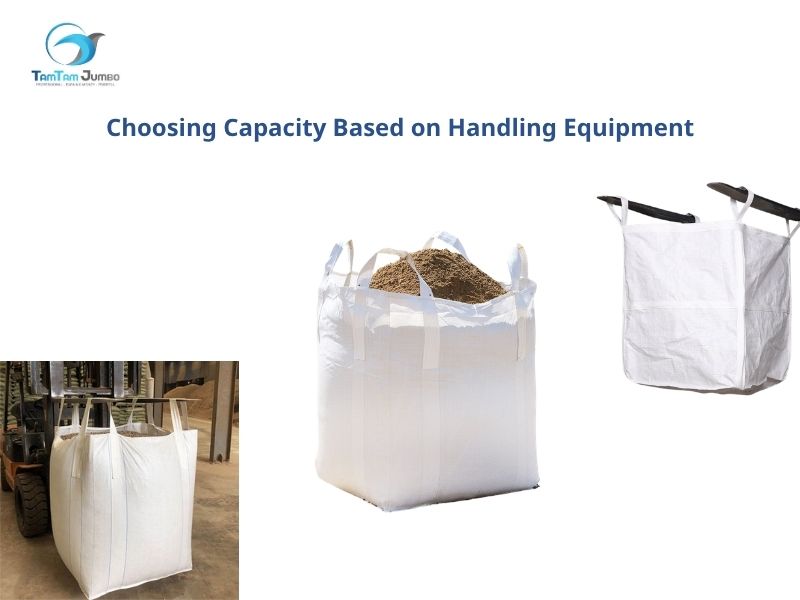
Choosing Capacity Based on Handling Equipment, Not Just Product Volume
- Confirm the rated lifting capacity of forklifts, cranes, or hoists used at both filling and destination sites.
- Check warehouse floor loading limits if bags will be stored in multi-layer stacks at higher capacity.
- Consider truck and container loading patterns, since capacity affects how many bags fit per shipment and how weight is distributed.
- Weigh the cost trade-off between fewer, larger bags and more, smaller bags for the specific product and shipping volume involved.
Custom Capacity Bags Outside Standard Sizes
Capacities outside the common 500kg to 2000kg range are available for specialized applications, though they typically require custom fabric and seam engineering rather than being pulled from standard stock specifications. Buyers considering a non-standard capacity should expect longer lead times and should request specific SWL test documentation for the custom design rather than assuming standard testing data applies at an unusual capacity.
How Tam Tam Packaging Sizes Bags to Your SWL Requirement
Tam Tam Packaging produces bags across the standard 500kg to 2000kg capacity range and can engineer custom capacities outside this range when needed, adjusting fabric GSM, seam construction, and loop rating together to match the target SWL rather than treating dimension and capacity as separate decisions. Specification sheets document the tested SWL and safety factor alongside dimensions for every capacity ordered.
Common Mistakes When Selecting Bag Size and Capacity
- Choosing a higher capacity bag without confirming handling equipment is rated for the increased weight.
- Assuming a larger bag automatically comes with proportionally stronger fabric and seams without confirming the actual SWL test data.
- Defaulting to 1000kg capacity without evaluating whether a different size better fits the specific product and handling process.
- Overlooking warehouse floor loading limits when moving to higher capacity, multi-layer stacked storage.
- Requesting a custom capacity without accounting for the longer lead time and dedicated testing this typically requires.
Applications in Construction Materials
Construction material suppliers commonly use the full range of standard capacities depending on the specific product, with cement and fine aggregate often moving in 1000kg bags for compatibility with standard forklift and crane equipment at job sites, while heavier bulk aggregate operations sometimes move to 1500kg or 2000kg capacity to reduce the number of handling cycles per shipment, provided site equipment can accommodate the increased weight.
Frequently Asked Questions
Why is 1000kg the most common FIBC bag capacity?
It aligns conveniently with metric ton-based logistics, standard forklift capacities, and common truck and container loading patterns, making it the most widely available and cost-competitive standard size.
Does a bigger bag automatically mean a stronger bag?
No. Higher capacity requires fabric GSM, seam construction, and loop rating to scale together to maintain the required safety factor, not just an increase in physical dimensions.
What should I check before moving to a higher capacity bag?
Confirm that forklifts, cranes, or hoists at both filling and destination locations are rated for the increased weight, and check warehouse floor loading limits if bags will be stacked.
Can I order a custom capacity outside the standard range?
Yes, though custom capacities typically require dedicated fabric and seam engineering along with their own SWL test documentation, and generally involve longer lead times than standard sizes.
Is a smaller capacity bag always cheaper per ton of product moved?
Not necessarily. While unit cost is lower for smaller bags, more bags are needed per shipment, so total packaging cost per ton depends on the specific product volume and handling process.
Conclusion
Choosing an FIBC bag sizes involves matching capacity to handling equipment, warehouse conditions, and shipping logistics, not just selecting a dimension that holds the right volume of product. The 1000kg bag remains the industry default for good reason, but buyers moving to higher or lower capacities should confirm the fabric, seam, and loop specification actually support the target SWL rather than assuming size alone determines strength.
Tam Tam Packaging Co. produces FIBC bags across the standard capacity range and engineers custom SWL specifications when needed. Contact our team to confirm the right size and rating for your application.
Contact Us
Tam Tam Packaging Co.
Email: sales@tamtamjumbo.com
Website: https://tamtamjumbo.com/
Read more
FIBC Bags for Flour: Why Allergen Status Change the Specification
Flour shares the fine-particle and combustible dust characteristics of other food powders, but wheat’s status...
Aug
FIBC Bag for Starch Powder: Dustproof Bag Needs Antistatic
Starch powder occupies an unusual position in FIBC specification: it is a common food and...
Aug
FIBC Bags for Animal Feed: What Actually Makes a Clean Bulk Bag
FIBC bags for animal feed mean something more specific than a bag that looks unused....
Aug
FIBC Bag for PET Flakes: Why UV Resistance Matter More Than It
Recycled PET flakes share a base polymer with virgin resin pellets, but the two behave...
Aug
FIBC Bags for Plastic Resin: PP Fabric Packaging PP Pellets
There is a certain irony in shipping polypropylene resin pellets inside a bag woven from...
Aug
FIBC Bags for the Food Industry: Building a Food Grade Bag
Food manufacturers sourcing bulk ingredient packaging are working from a different starting point than a...
Aug