

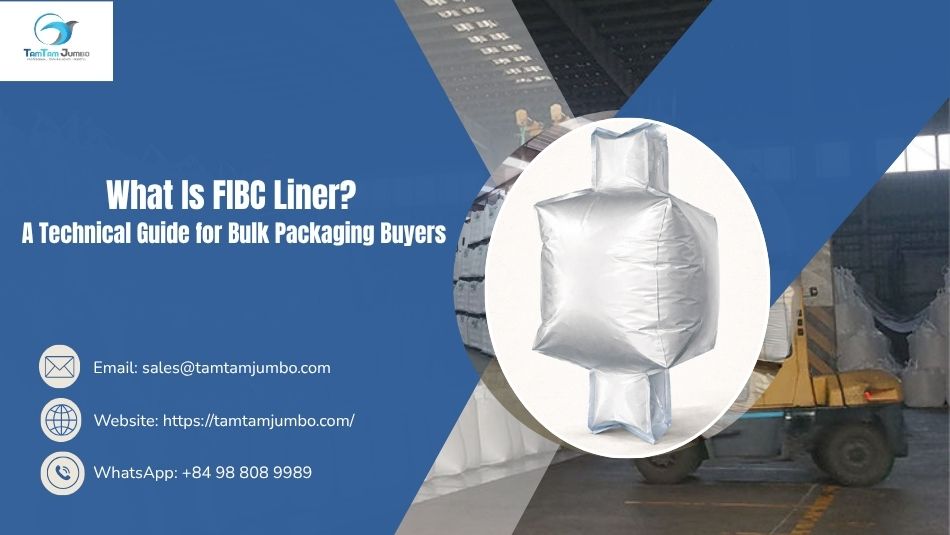
An FIBC liner is an inner plastic liner inserted inside a Flexible Intermediate Bulk Container (FIBC), also known as a jumbo bag or bulk bag. The liner acts as an additional protective barrier between the product and the external environment.
FIBC liners are commonly used when handling products that require higher moisture protection, contamination control, sift-proof performance, or hygienic packaging conditions. They are widely applied in industries such as food processing, chemicals, pharmaceuticals, minerals, agriculture, and specialty powders. So what is FIBC liner?
At Tam Tam Packaging Co., Ltd, FIBC liners are frequently integrated into bulk bags designed for export shipments where product stability, cleanliness, and transportation reliability are critical.
Why FIBC Liners Are Used in Bulk Packaging
Standard woven polypropylene FIBC bags provide strong mechanical performance, but woven fabric naturally contains micro gaps between tapes. For many dry bulk products, this is acceptable. However, fine powders, hygroscopic materials, and food-grade products often require additional internal protection.
An FIBC liner helps solve these issues by creating a sealed internal layer.
Main Functions of an FIBC Liner
- Prevent moisture penetration
- Reduce product contamination
- Improve sift-proof performance
- Protect against oxygen exposure
- Minimize material leakage
- Improve discharge efficiency
- Maintain food-grade hygiene conditions
- Protect sensitive powders during export
For international shipments involving long transit times, temperature fluctuations, and humid storage conditions, liners can significantly reduce cargo risk.
What Materials Are Used for FIBC Liners?
Most FIBC liners are manufactured from polyethylene (PE), although material selection depends on the application.
Common Liner Materials
| Material | Characteristics | Typical Applications |
| LDPE (Low-Density Polyethylene) | Flexible and economical | General powders and granules |
| LLDPE (Linear Low-Density Polyethylene) | Higher strength and puncture resistance | Chemicals and industrial materials |
| HDPE (High-Density Polyethylene) | Stronger and stiffer | Heavy-duty industrial products |
| Aluminum Foil Barrier Liners | Excellent oxygen and moisture barrier | Food and pharmaceutical products |
| EVOH Barrier Liners | High gas barrier performance | Sensitive specialty chemicals |
| Conductive Liners | Static dissipation | Hazardous powder environments |
The liner thickness usually ranges from 50 to 200 microns, depending on the required barrier performance and product characteristics.
Main Types of FIBC Liners
Different liner constructions are designed for different filling systems, discharge requirements, and product sensitivities.
Form-Fit Liners
Form-fit liners are shaped to match the exact dimensions of the FIBC bag.
They are attached to the bag body through tabs, buttons, or sewing points to reduce liner movement during filling and transportation.
Advantages
- Better filling stability
- Improved bag shape retention
- Reduced liner collapse during discharge
- Cleaner unloading process
Common Applications
- Food ingredients
- Fine chemicals
- Pharmaceutical powders
- High-value mineral powders
Loose Liners
Loose liners are inserted freely inside the FIBC without being attached to the bag structure.
They are more economical and suitable for less sensitive products.
Advantages
- Lower production cost
- Faster manufacturing
- Flexible for general applications
Limitations
- Less stable during filling
- Possible liner shifting
- Reduced discharge efficiency
Tabbed Liners
Tabbed liners are partially attached to the bag using fixing tabs.
This design balances cost efficiency and operational stability.
Baffle Liners
Baffle liners are designed for baffle FIBC bags to maintain square bag shape and maximize container utilization.
These liners are commonly used in industries where storage efficiency is important.
FIBC Liners vs Standard FIBC Bags
| Feature | Standard FIBC | FIBC with Liner |
| Moisture Protection | Limited | High |
| Sift-Proof Performance | Moderate | Excellent |
| Food Safety Protection | Basic | Enhanced |
| Contamination Control | Moderate | High |
| Cost | Lower | Higher |
| Export Protection | Standard | Improved |
| Fine Powder Handling | Limited | Excellent |
For products sensitive to humidity or contamination, the additional liner cost is often justified by reduced cargo loss and improved customer acceptance.
Industries That Commonly Use FIBC Liners
Food Industry
Food-grade liners are used for products such as:
- Sugar
- Flour
- Starch
- Rice powder
- Milk powder
- Food additives
Food manufacturers often require liners that comply with FDA or EU food-contact regulations.
Chemical Industry
Chemical products frequently require liners for:
- Moisture-sensitive powders
- Fine pigments
- Specialty resins
- Additives
- Hazardous powders
Barrier liners help maintain product consistency during overseas transportation.
Pharmaceutical Industry
Pharmaceutical bulk packaging requires high cleanliness standards and contamination prevention.
Linings may include:
- Anti-static properties
- Aluminum barriers
- Clean-room production conditions
Agriculture Industry
FIBC liners are also used for:
- Seeds
- Fertilizers
- Feed additives
- Agricultural chemicals
Moisture protection is especially important in tropical export markets.
Key Considerations When Selecting an FIBC Liner
Choosing the correct liner requires more than simply selecting a plastic insert. The liner must match both the product behavior and operational process.
Product Characteristics
Buyers should evaluate:
- Particle size
- Moisture sensitivity
- Static generation
- Bulk density
- Flowability
- Oxygen sensitivity
Very fine powders may require fully sealed liners with specialized discharge designs.
Filling and Discharge Systems
The liner design must match the customer’s production line.
Important considerations include:
- Top filling method
- Bottom discharge system
- Filling speed
- Vacuum filling requirements
- Degassing requirements
Improper liner configuration can slow operations or create handling problems.
Export Conditions
Long-distance export shipments introduce risks such as:
- Condensation
- Temperature fluctuations
- Port humidity
- Mechanical stress
In many export projects handled by Tam Tam Packaging Co., Ltd, liners are selected specifically to reduce moisture damage during ocean transportation.
Food Safety and Regulatory Compliance
For food or pharmaceutical applications, buyers should verify:
- Food-grade resin certification
- Migration compliance
- Clean manufacturing conditions
- Traceability documentation
Documentation requirements vary by destination market.
Common FIBC Liner Designs
Tubular Liners
Simple cylindrical liner design suitable for general applications.
Bottle-Shaped Liners
Designed to fit the bag structure more precisely and reduce dead corners.
Gusseted Liners
Allow better space utilization and improve bag stability.
Conductive Liners
Used in static-sensitive environments where electrostatic discharge risks exist.
Aluminum Foil Liners
Provide superior oxygen and moisture barrier performance.
These are often used for high-value specialty chemicals and sensitive food ingredients.
Manufacturing Considerations for FIBC Liners
From a manufacturing perspective, liner performance depends heavily on process consistency.
Important Production Factors
- Film extrusion quality
- Thickness uniformity
- Seal strength
- Clean-room conditions
- Static control
- Leak testing
At Tam Tam Packaging Co., Ltd, liner compatibility is evaluated together with the FIBC structure to ensure both components work as a complete packaging system rather than as separate products.
Common Problems Caused by Incorrect Liner Selection
Liner Collapse During Discharge
This usually occurs when airflow compensation is insufficient.
Product Bridging
Improper liner friction characteristics may reduce product flow.
Condensation Inside the Bag
Barrier mismatch can trap moisture under changing temperatures.
Static Build-Up
Some powders generate electrostatic charges during filling and discharge.
This may require conductive or anti-static liner solutions.
How Buyers Can Reduce Packaging Risk
Before ordering FIBC liners, buyers should provide suppliers with:
- Product technical data sheets
- Filling method details
- Target bag dimensions
- Export destination
- Storage conditions
- Safety requirements
Sample testing is highly recommended for new applications.
In industrial bulk packaging, small liner adjustments can significantly improve filling efficiency, transportation safety, and unloading performance.
Frequently Asked Questions
What is the purpose of an FIBC liner?
An FIBC liner provides additional protection against moisture, contamination, leakage, and oxygen exposure inside a bulk bag.
Are all FIBC bags supplied with liners?
No. Many standard FIBC bags do not require liners. Liners are mainly used for sensitive powders, food-grade products, and moisture-sensitive materials.
What is the difference between a liner and coating?
A coating is applied directly onto woven fabric to reduce porosity, while a liner is a separate internal plastic layer inserted into the bag.
Can FIBC liners be food grade?
Yes. Food-grade liners are manufactured using approved virgin resin and controlled production conditions.
How do I choose the correct liner type?
The correct liner depends on product characteristics, filling system, discharge method, moisture sensitivity, and transportation conditions.
Conclusion
Understanding what an FIBC liner is becomes increasingly important as bulk packaging requirements become more specialized. Liners are no longer limited to niche applications. They are widely used across food, chemical, agricultural, and industrial supply chains where contamination control and moisture protection directly affect product quality.
For international buyers, selecting the right liner configuration can reduce cargo claims, improve unloading efficiency, and enhance packaging reliability during export transportation.
At Tam Tam Packaging Co., Ltd, liner selection is integrated into the overall FIBC design process to ensure compatibility between product behavior, bag construction, and logistics requirements.
Contact Us
Tam Tam Packaging Co., Ltd
Email: sales@tamtamjumbo.com
Website: tamtamjumbo.com
Read more
FIBC Bags for Flour: Why Allergen Status Change the Specification
Flour shares the fine-particle and combustible dust characteristics of other food powders, but wheat’s status...
Aug
FIBC Bag for Starch Powder: Dustproof Bag Needs Antistatic
Starch powder occupies an unusual position in FIBC specification: it is a common food and...
Aug
FIBC Bags for Animal Feed: What Actually Makes a Clean Bulk Bag
FIBC bags for animal feed mean something more specific than a bag that looks unused....
Aug
FIBC Bag for PET Flakes: Why UV Resistance Matter More Than It
Recycled PET flakes share a base polymer with virgin resin pellets, but the two behave...
Aug
FIBC Bags for Plastic Resin: PP Fabric Packaging PP Pellets
There is a certain irony in shipping polypropylene resin pellets inside a bag woven from...
Aug
FIBC Bags for the Food Industry: Building a Food Grade Bag
Food manufacturers sourcing bulk ingredient packaging are working from a different starting point than a...
Aug