
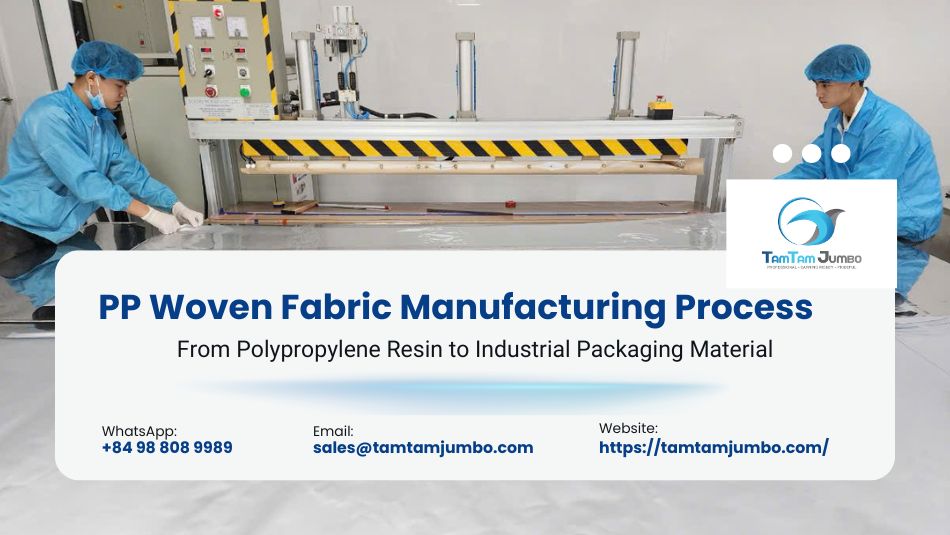
PP woven fabric is the foundation material behind a large portion of industrial packaging used worldwide. It is widely converted into woven sacks, BOPP laminated bags, FIBC jumbo bags, agricultural packaging, construction fabrics, and bulk transportation solutions.
For international buyers, understanding the PP woven fabric manufacturing process is important for evaluating product quality, consistency, strength, performance, and supplier capability. The production method directly affects tensile strength, GSM stability, UV resistance, printability, and long-term durability.
This article explains how PP woven fabric is manufactured step by step, what technical parameters influence performance, and what buyers should verify before sourcing from a factory.
At Tam Tam Packaging Co., Ltd, PP woven fabric production is integrated into the manufacturing process for industrial woven bags and FIBC packaging systems, allowing tighter quality control from raw material to finished packaging.
What Is PP Woven Fabric?
PP woven fabric is a material made by weaving stretched polypropylene tapes in warp and weft directions to create a strong and lightweight industrial fabric.
The fabric is produced from polypropylene resin pellets through a multi-stage manufacturing process that includes:
- Resin blending
- Tape extrusion
- Tape stretching
- Winding
- Circular or flat weaving
- Lamination or coating
- Printing and conversion
The final material combines high tensile strength with low weight, making it suitable for heavy-duty industrial packaging.
Read more: What Is PP Woven Fabric
Main Raw Materials Used in PP Woven Fabric Production
Virgin Polypropylene Resin
Virgin PP resin provides:
- Higher tensile strength
- Better tape consistency
- Improved weaving stability
- Cleaner fabric appearance
- Better long-term durability
Industrial export packaging generally uses virgin resin for food-grade, chemical-grade, and FIBC applications.
Recycled Polypropylene
Some manufacturers blend recycled resin to reduce cost. However, excessive recycled content can lead to:
- Lower tensile strength
- Uneven tape thickness
- Reduced UV stability
- Shorter product lifespan
Experienced buyers often request information about virgin-to-recycled resin ratios before approving production.
Additives and Masterbatch
Additional materials may include:
- UV stabilizers
- Color masterbatch
- Anti-slip additives
- Anti-static additives
- Calcium carbonate filler
The formulation depends on the end-use application and export market requirements.
Step-by-Step PP Woven Fabric Manufacturing Process
Step 1: Resin Mixing and Feeding
The process starts with blending polypropylene resin and additives in controlled proportions.
Typical extrusion temperatures range between 190°C and 250°C, depending on resin grade and production configuration.
Consistent raw material mixing is essential because it affects:
- Tape uniformity
- Fabric strength
- Surface quality
- Production stability
Step 2: Tape Extrusion and Film Formation
The molten polypropylene passes through a flat die to create a thin plastic sheet or film.
This film is then:
- Rapidly cooled using water or chill rollers
- Slit into narrow tapes
- Directed into stretching units
Tape width usually ranges from 2 mm to 5 mm, depending on fabric specification.
Why Tape Quality Matters
Tape extrusion is one of the most critical stages in PP woven fabric manufacturing because poor tape quality causes:
- Weak tensile performance
- Tape breakage during weaving
- Uneven GSM
- Fabric defects
- Reduced bag load capacity
Factories with modern extrusion lines typically achieve better tape consistency and lower defect rates.
Step 3: Tape Stretching and Orientation
After extrusion, the tapes pass through heated stretching ovens.
This process aligns the polymer molecules and significantly improves tensile strength. Draw ratios commonly range between 5x and 7x.
Proper stretching improves:
- Load-bearing capacity
- Fabric stability
- Tear resistance
- Dimensional consistency
Overstretching can make tapes brittle, while insufficient stretching reduces fabric strength.
Step 4: Tape Winding
The stretched tapes are wound onto bobbins for weaving preparation.
Uniform winding tension is essential because inconsistent tension creates weaving problems, such as:
- Fabric distortion
- Uneven weaving density
- Tape breakage
- Surface irregularities
Advanced winding systems help maintain equal tape lengths and stable tension during high-speed production.
Step 5: Circular or Flat Loom Weaving
The tapes are woven into fabric using either circular looms or flat looms.
Circular Loom Production
Circular looms produce tubular woven fabric and are commonly used for:
- Standard PP woven sacks
- Fertilizer bags
- Rice bags
- Cement packaging
Flat Loom Production
Flat looms produce flat woven panels used for:
- Baffle FIBC bags
- High-strength industrial packaging
- Specialized technical fabrics
The weaving process determines:
- Fabric density
- Fabric strength
- Surface smoothness
- Weight consistency
Typical fabric specifications include:
| Parameter | Typical Range |
| Fabric GSM | 60–200 g/m² |
| Tape Width | 2–5 mm |
| Warp Density | 50–150 EPI |
| Weft Density | 50–100 PPI |
Step 6: Heat Setting and Fabric Stabilization
After weaving, the fabric may pass through heat-setting equipment.
Heat stabilization helps:
- Reduce shrinkage
- Improve dimensional stability
- Enhance flatness
- Improve printing quality
This process is especially important for export packaging exposed to varying temperatures and humidity during international transportation.
Step 7: Lamination or Coating
Some PP woven fabrics remain uncoated, while others receive lamination or extrusion coating.
Laminated PP Woven Fabric
Laminated fabric includes an additional coating layer that improves:
- Moisture resistance
- Printability
- Air barrier properties
- Surface smoothness
Common Lamination Types
| Lamination Type | Typical Application |
| PP Coating | Standard woven sacks |
| PE Coating | Moisture protection |
| BOPP Lamination | Retail packaging |
| Kraft Lamination | Premium industrial packaging |
Step 8: Printing and Conversion
The woven fabric can then move to printing and bag conversion stages.
Common printing technologies include:
- Flexographic printing
- Rotogravure printing
- BOPP reverse printing
The fabric is then converted into:
- PP woven bags
- Valve sacks
- Laminated bags
- FIBC jumbo bags
- Agricultural packaging
Quality Control During Manufacturing
Reliable PP woven fabric manufacturers perform testing throughout production.
Key Quality Tests
| Test | Purpose |
| Tensile Strength Test | Measures load capacity |
| Fabric GSM Test | Confirms weight consistency |
| UV Resistance Test | Evaluates outdoor durability |
| Adhesion Test | Verifies lamination strength |
| Seam Strength Test | Ensures bag integrity |
| Drop Test | Simulates transportation conditions |
Factories producing export-grade industrial packaging generally implement stricter quality controls because bulk transportation failures can create major supply chain losses.
Applications of PP Woven Fabric
PP woven fabric is used across multiple industrial sectors.
Agriculture
Applications include:
- Rice bags
- Flour sacks
- Animal feed packaging
- Seed bags
Chemical Industry
Used for:
- Resin packaging
- Powder chemicals
- Industrial minerals
Construction Materials
Common for:
- Cement bags
- Sand packaging
- Dry mortar bags
FIBC Jumbo Bags
Heavy-duty woven fabric is converted into:
- Type A FIBC bags
- Type B FIBC bags
- Conductive Type C bags
- Type D anti-static bags
Logistics and Export Packaging
PP woven fabric is also used for:
- Bulk transportation
- Container loading
- Export packaging systems
Factors Buyers Should Evaluate Before Purchasing
Fabric Weight Consistency
Uneven GSM is a common issue in low-quality production.
GSM inconsistency affects:
- Bag strength
- Printing quality
- Load performance
Virgin Resin Ratio
Industrial buyers should verify whether the supplier uses:
- 100% virgin PP
- Mixed virgin and recycled material
- High recycled content
This directly affects product durability.
Loom Technology
Modern circular looms improve:
- Fabric uniformity
- Production efficiency
- Surface appearance
Older machines may generate inconsistent weaving density.
UV Protection
Outdoor storage applications require UV stabilization.
Without proper UV additives, woven fabric may degrade quickly under sunlight exposure.
Integrated Manufacturing Capability
Factories with in-house extrusion, weaving, lamination, printing, and conversion typically maintain better production consistency compared with outsourced operations.
Manufacturing Insight From Export Production
From a factory perspective, one of the most important factors in woven fabric production is balancing strength performance with production efficiency.
Higher tape orientation improves tensile strength but may reduce flexibility. Higher filler content lowers cost but can weaken fabric performance. Faster loom speeds increase output but may reduce weaving consistency if machine calibration is poor.
For export-oriented manufacturers, maintaining stable quality across large production volumes is often more difficult than producing small sample quantities.
This is why experienced international buyers often audit:
- Tape extrusion lines
- Loom conditions
- Lamination systems
- Quality testing procedures
- Raw material storage systems
before approving long-term supply contracts.
Frequently Asked Questions
What is the difference between PP woven fabric and non-woven fabric?
PP woven fabric is made by weaving polypropylene tapes together, while non-woven fabric is bonded through heat or chemical processes without weaving.
Woven fabric generally provides higher tensile strength for industrial packaging applications.
Is laminated PP woven fabric waterproof?
Laminated PP woven fabric provides improved moisture resistance but may not be fully waterproof unless additional barrier layers are applied.
What GSM is commonly used for PP woven bags?
Most industrial woven bags use fabric between 60 and 120 GSM, while heavy-duty FIBC applications may use thicker specifications.
Can PP woven fabric be recycled?
Yes. Polypropylene woven fabric is recyclable and can be reprocessed depending on contamination levels and local recycling infrastructure.
Why is virgin PP resin preferred for export packaging?
Virgin resin provides more stable mechanical properties, a cleaner appearance, and better long-term performance compared with high recycled-content formulations.
Conclusion
The PP woven fabric manufacturing process involves much more than simple plastic conversion. Each stage — from extrusion and stretching to weaving and lamination — affects the final packaging performance.
For industrial buyers, understanding how the material is manufactured helps evaluate supplier capability, packaging reliability, and long-term product consistency.
Factories with integrated production systems, controlled raw material management, and stable quality control procedures generally deliver more reliable woven packaging for export markets.
At Tam Tam Packaging Co., Ltd, PP woven fabric production supports a wide range of industrial packaging applications, including woven sacks, laminated bags, and FIBC bulk packaging solutions designed for international supply chains.
Contact Us
Tam Tam Packaging Co., Ltd
Email: sales@tamtamjumbo.com
Website: tamtamjumbo.com
Read more
FIBC Bags for Flour: Why Allergen Status Change the Specification
Flour shares the fine-particle and combustible dust characteristics of other food powders, but wheat’s status...
Aug
FIBC Bag for Starch Powder: Dustproof Bag Needs Antistatic
Starch powder occupies an unusual position in FIBC specification: it is a common food and...
Aug
FIBC Bags for Animal Feed: What Actually Makes a Clean Bulk Bag
FIBC bags for animal feed mean something more specific than a bag that looks unused....
Aug
FIBC Bag for PET Flakes: Why UV Resistance Matter More Than It
Recycled PET flakes share a base polymer with virgin resin pellets, but the two behave...
Aug
FIBC Bags for Plastic Resin: PP Fabric Packaging PP Pellets
There is a certain irony in shipping polypropylene resin pellets inside a bag woven from...
Aug
FIBC Bags for the Food Industry: Building a Food Grade Bag
Food manufacturers sourcing bulk ingredient packaging are working from a different starting point than a...
Aug