
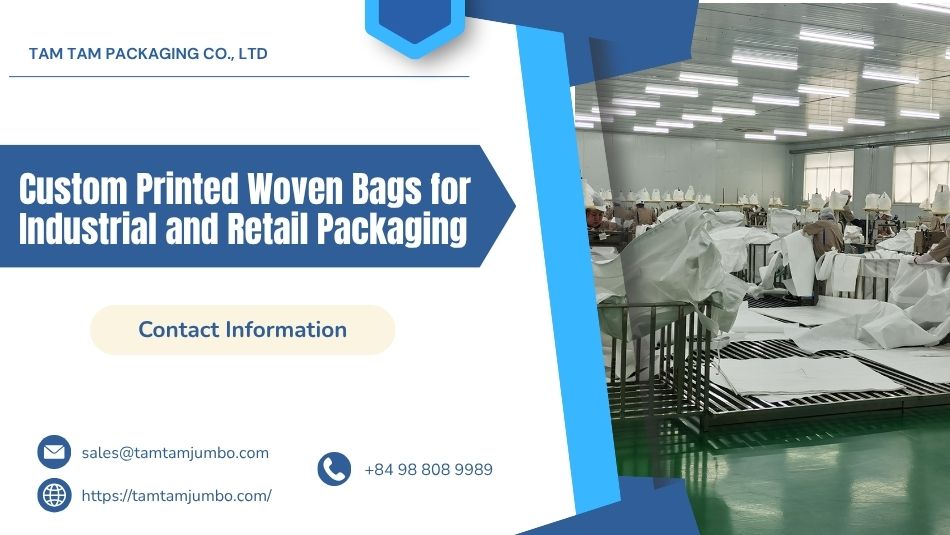
Custom printed woven bags are widely used across industrial packaging, agriculture, retail distribution, animal feed, fertilizers, chemicals, and consumer goods packaging. Their combination of durability, printability, moisture resistance, and cost efficiency makes them a practical packaging solution for both bulk transport and branded retail presentation.
For manufacturers and importers, woven polypropylene bags are no longer viewed only as transport packaging. In many sectors, the packaging itself has become part of the product identity. High-quality printing, consistent bag construction, and reliable supply capability are now critical requirements for international buyers.
At Tam Tam Packaging Co., custom printed woven bags are manufactured for export markets including Europe, Canada, and South Korea, with production focused on stable quality, scalable supply, and customized industrial packaging solutions.
What Are Custom Printed Woven Bags?
Custom printed woven bags are polypropylene (PP) woven packaging bags manufactured with printed branding, product information, graphics, or handling instructions directly on the bag surface.
These bags are produced from woven polypropylene tapes, creating a strong and lightweight structure suitable for industrial packaging applications. Depending on the printing and lamination method, the bags can support simple logo printing or high-resolution full-color graphics.
Common formats include:
- Standard PP woven sacks
- BOPP laminated woven bags
- Gusseted woven bags
- Valve bags
- Block bottom woven bags
- Shopping woven bags
- Food-grade woven packaging
- Heavy-duty industrial sacks
Why Businesses Use Custom Printed Woven Bags
Brand Visibility
Printed woven bags allow manufacturers and distributors to display:
- Company logo
- Product information
- Handling instructions
- Certification marks
- Batch tracking
- Multilingual export labeling
In retail packaging sectors such as rice, pet food, flour, and animal feed, packaging appearance directly affects shelf visibility and customer perception.
Strong Mechanical Performance
Woven polypropylene fabric offers:
- High tensile strength
- Tear resistance
- Moisture protection
- Stackability
- Lightweight handling
- Reusability
This makes woven bags suitable for products ranging from agricultural commodities to industrial minerals.
Cost Efficiency for Large Volumes
Compared with rigid packaging formats, woven bags provide:
- Lower transport cost
- Reduced storage space
- Efficient pallet loading
- Competitive unit pricing
- High-volume manufacturing capability
For export buyers managing container shipments, packaging optimization directly affects logistics efficiency.
Common Printing Technologies for Woven Bags
Selecting the correct printing method depends on artwork complexity, product positioning, and budget.
Flexographic Printing
Flexographic printing is commonly used for industrial sacks with simple branding requirements.
Suitable for:
- Text printing
- Basic logos
- 1–4 color layouts
- Large-volume production
Advantages:
- Lower production cost
- Fast printing speed
- Good ink adhesion
- Efficient for commodity packaging
Limitations:
- Lower image resolution
- Limited photo-quality graphics
Gravure Printing with BOPP Lamination
BOPP laminated woven bags use gravure printing technology to achieve high-resolution graphics and a premium visual presentation.
Suitable for:
- Retail packaging
- Premium consumer products
- Pet food packaging
- Rice packaging
- Fertilizer brands
- Export retail markets
Advantages:
- High-definition printing
- Excellent color consistency
- Gloss or matte finish
- Better moisture resistance
- Improved shelf appearance
Limitations:
- Higher setup cost
- Longer cylinder preparation time
Comparison of Printing Methods
| Feature | Flexographic Printing | Gravure BOPP Printing |
| Print Quality | Standard | High-definition |
| Color Accuracy | Moderate | Excellent |
| Suitable Artwork | Simple graphics | Complex designs |
| Cost Efficiency | Better for simple bags | Better for premium packaging |
| Surface Finish | Basic | Gloss or matte laminated |
| Moisture Resistance | Moderate | Higher |
| Typical Applications | Feed, fertilizer, industrial use | Retail and branded products |
Materials Used in Custom Printed Woven Bags
The material structure significantly affects bag performance and print quality.
Woven Polypropylene Fabric
The woven base fabric determines:
- Strength
- Fabric density
- Load capacity
- Durability
Fabric specifications are selected according to bag size and application.
Laminated Structure
Lamination improves:
- Moisture resistance
- Print appearance
- Surface smoothness
- Product protection
Common laminated options include:
- PP coating
- BOPP film lamination
- Matte lamination
- Gloss lamination
Optional Additions
Industrial buyers often request additional features such as:
- PE liners
- UV stabilization
- Anti-slip coating
- Micro perforation
- Easy-open systems
- Handles
- Valve openings
Industries Using Custom Printed Woven Bags
Agriculture
Applications include:
- Rice
- Seeds
- Animal feed
- Fertilizers
- Flour
- Sugar
Agricultural packaging often requires moisture protection and strong stacking performance.
Construction Materials
Used for:
- Cement additives
- Sand mixtures
- Mortar
- Minerals
- Chemical powders
Heavy-duty woven bags help reduce tearing during transportation and warehouse handling.
Chemical Industry
Chemical packaging may require:
- Moisture barriers
- Anti-static protection
- UV resistance
- Inner liners
Retail and Consumer Packaging
BOPP laminated woven bags are increasingly used for:
- Pet food
- Premium rice
- Charcoal
- Garden products
- Household goods
High-quality printing improves retail presentation and brand recognition.
Key Technical Considerations Before Ordering
Bag Dimensions and Filling Equipment
Bag size must match:
- Filling systems
- Product density
- Pallet dimensions
- Container loading plans
Incorrect sizing often leads to filling inefficiency and transport instability.
Fabric GSM and Strength
Fabric weight directly affects:
- Load capacity
- Tear resistance
- Stacking performance
Lighter fabric may reduce cost but can increase damage risk during export shipment.
Printing Artwork Preparation
For gravure printed bags, artwork preparation should include:
- Pantone color references
- Bleed areas
- High-resolution files
- Correct print cylinder dimensions
Buyers should confirm artwork approval before cylinder production begins.
UV Resistance for Export Markets
For outdoor storage or long shipping exposure, UV stabilization becomes important.
This is especially relevant for:
- Construction materials
- Agricultural products
- Chemical storage
Moisture Protection
Products sensitive to humidity may require:
- BOPP lamination
- PE liner insertion
- Heat sealing
Manufacturing Considerations for International Buyers
When sourcing custom printed woven bags from Vietnam or other Asian manufacturing hubs, buyers typically evaluate several operational factors beyond pricing.
Production Capability
A reliable manufacturer should demonstrate:
- In-house weaving capability
- Printing control
- Sewing consistency
- Quality inspection systems
- Export experience
Buyers increasingly verify actual production operations before approving long-term supply partnerships.
Lead Time Stability
Consistent lead times are critical for:
- Seasonal agricultural demand
- Retail promotions
- Inventory planning
- Contract packaging schedules
Quality Control
Industrial woven bag production requires monitoring of:
- Fabric strength
- Stitching quality
- Printing accuracy
- Color consistency
- Bag dimensions
Export buyers commonly request pre-shipment inspection and production samples before mass production approval.
Sustainability and Reusability
Reusable woven bags are increasingly preferred in markets emphasizing packaging reduction and sustainability initiatives.
PP woven bags offer:
- Long service life
- Reusability
- Recyclable material structure
- Reduced packaging waste compared with single-use alternatives
Some buyers also request recycled-content or RPET-based woven packaging solutions.
Frequently Asked Questions
What is the difference between woven bags and non-woven bags?
Woven bags are manufactured from interwoven polypropylene tapes, giving them higher tensile strength and load capacity. Non-woven bags use bonded fibers and are generally softer but less durable for heavy industrial use.
What printing method is best for premium packaging?
BOPP gravure printing is typically preferred for premium retail packaging because it provides high-resolution graphics and strong visual presentation.
Can custom printed woven bags be used for food products?
Yes. Food-grade woven bags can be manufactured using approved raw materials and controlled production conditions suitable for food contact applications.
What is the typical MOQ for custom printed woven bags?
MOQ depends on bag type and printing method. For gravure-printed BOPP bags, minimum order quantities are commonly higher due to cylinder setup requirements.
How long does production usually take?
Production lead time depends on bag specification, printing complexity, and order quantity. Export production commonly ranges from several weeks to full container scheduling depending on manufacturing capacity.
Conclusion
Custom printed woven bags have evolved into an important packaging solution for both industrial transport and branded retail applications. The combination of structural strength, customizable printing, and cost efficiency makes them suitable for a wide range of global industries.
For international buyers, selecting the right manufacturing partner involves more than comparing prices. Production consistency, printing capability, technical support, and export experience directly affect packaging performance and supply chain reliability.
As packaging requirements continue to develop across agriculture, food, chemicals, and retail sectors, high-quality woven bag manufacturing remains an essential part of industrial packaging operations.
Contact Us
Tam Tam Packaging Co.
Email: sales@tamtamjumbo.com
Website: tamtamjumbo.com
Read more
FIBC Bags for Flour: Why Allergen Status Change the Specification
Flour shares the fine-particle and combustible dust characteristics of other food powders, but wheat’s status...
Aug
FIBC Bag for Starch Powder: Dustproof Bag Needs Antistatic
Starch powder occupies an unusual position in FIBC specification: it is a common food and...
Aug
FIBC Bags for Animal Feed: What Actually Makes a Clean Bulk Bag
FIBC bags for animal feed mean something more specific than a bag that looks unused....
Aug
FIBC Bag for PET Flakes: Why UV Resistance Matter More Than It
Recycled PET flakes share a base polymer with virgin resin pellets, but the two behave...
Aug
FIBC Bags for Plastic Resin: PP Fabric Packaging PP Pellets
There is a certain irony in shipping polypropylene resin pellets inside a bag woven from...
Aug
FIBC Bags for the Food Industry: Building a Food Grade Bag
Food manufacturers sourcing bulk ingredient packaging are working from a different starting point than a...
Aug