
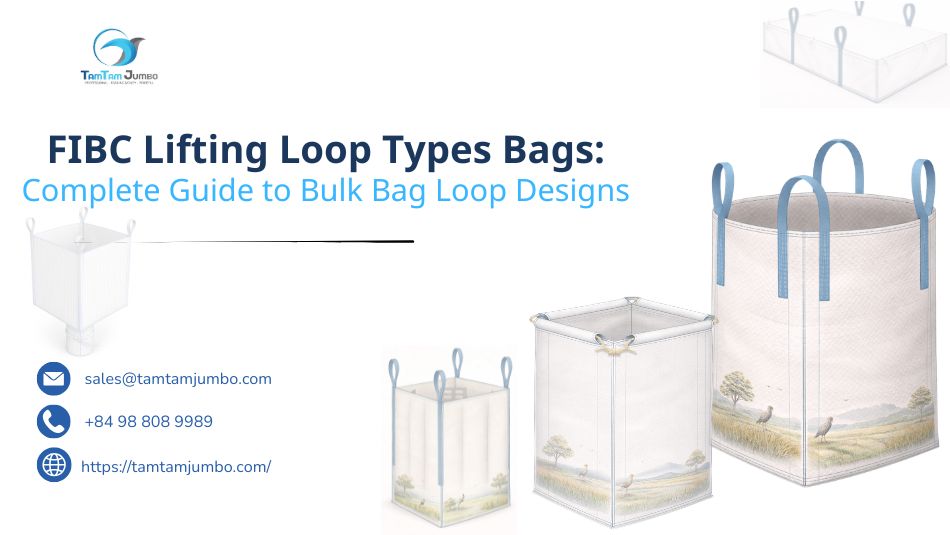
In bulk packaging operations, lifting loops are one of the most critical structural components of an FIBC bags.
While buyers often focus on bag dimensions, fabric weight, or safe working load, the lifting loop configuration directly affects:
- Handling efficiency
- Equipment compatibility
- Warehouse operations
- Safety performance
- Loading speed
For international importers and industrial users, understanding different FIBC lifting loop types bags is essential for selecting the correct bulk packaging solution.
At Tam Tam Packaging Co., we manufacture a wide range of FIBC bags for export markets, and lifting loop configuration is often one of the first technical discussions during product development.
This guide explains the main types of FIBC lifting loops, their applications, advantages, limitations, and the practical considerations buyers should understand before purchasing.
What Are FIBC Lifting Loops?
FIBC lifting loops are reinforced woven polypropylene straps attached to the bulk bag body that allow lifting and transportation using:
- Forklifts
- Cranes
- Hoists
- Automated handling systems
These loops are engineered to support the full load of the bag during:
- Filling
- Transport
- Storage
- Discharge operations
Simple Definition
FIBC lifting loops are structural lifting components designed to safely handle and transport bulk bags during industrial operations.
The design of the lifting loop affects both operational efficiency and handling safety.
Why Lifting Loop Design Matters
Different industries use different handling systems.
For example:
- Warehouses commonly use forklifts
- Construction sites may use cranes
- Automated filling facilities often require tunnel lift systems
Using the wrong loop configuration can result in:
- Slow loading operations
- Equipment incompatibility
- Increased handling damage
- Safety risks
- Higher labor costs
The correct lifting loop design improves:
- Operational flow
- Loading efficiency
- Worker safety
- Logistics performance
Main Types of FIBC Lifting Loops
Cross Corner Loops
What Are Cross Corner Loops?
Cross corner loops are sewn diagonally across the corners of the bag body.
This design allows forklift forks to enter from all four sides without manually positioning the loops.
Key Characteristics
- Most common FIBC loop design
- Flexible forklift handling
- Efficient warehouse operations
- Suitable for automated systems
Advantages
- Faster forklift access
- Improved loading efficiency
- Reduced labor handling
- Good compatibility with export logistics
Applications Industries
- Food ingredients
- Plastic resins
- Agricultural products
- Chemical powders
Buyer Insight
Cross-corner loops are widely preferred in Europe and North America due to warehouse automation and forklift efficiency requirements.
Side Seam Loops
What Are Side Seam Loops?
Side seam loops are stitched directly into the side seams of the bag.
The loops remain upright and visible, making forklift insertion easier in some operations.
Key Characteristics
- Traditional loop configuration
- Strong structural integration
- Upright loop positioning
Advantages
- Good lifting stability
- Durable seam reinforcement
- Simple handling process
Limitations
- Slightly slower forklift insertion
- Less optimized for automation
Applications Industries
- Minerals
- Fertilizer
- Construction materials
- Industrial powders
Corner Loops
What Are Corner Loops?
Corner loops are attached directly to each corner of the FIBC bag.
This is one of the oldest and simplest FIBC loop configurations.
Advantages
- Cost-effective production
- Simple construction
- Suitable for basic applications
Limitations
- Forklift handling can be slower
- Loops may require manual positioning
Best Applications
- Local transportation
- Basic industrial handling
- Cost-sensitive projects
Tunnel Lift Loops
What Are Tunnel Lift Loops?
Tunnel lift loops are fabric sleeves integrated into the bag body that allow forklift forks to pass directly through.
Key Characteristics
- Forklift-oriented design
- No external loops required
- Fast handling process
Advantages
- Extremely fast forklift operation
- Reduced handling time
- Ideal for automated facilities
Limitations
- Limited crane compatibility
- Less flexible for mixed handling systems
Applications
- High-volume warehousing
- Automated filling lines
- Resin and polymer industries
Manufacturing Insight
Tunnel lift bags require precise dimensional control during production to ensure compatibility with forklift specifications.
Single Loop FIBC Bags
What are Single-loop Bags?
Single-loop bags use one central lifting point rather than four individual loops.
These bags are commonly manufactured using tubular woven fabric.
Advantages
- Lower production cost
- Lightweight structure
- Efficient filling and transport
Limitations
- Lower handling flexibility
- Limited heavy-duty applications
Applications
- Fertilizer
- Agricultural products
- Commodity packaging
Single-loop bags are common in high-volume commodity export markets.
Two Loop FIBC Bags
What are Two-Loop Bags?
Two-loop bags use two integrated lifting points connected to the body structure.
Advantages
- Faster handling
- Reduced manufacturing complexity
- Lower packaging cost
Applications
- Food products
- Powder materials
- Agricultural exports
Comparison Table: FIBC Lifting Loop Types
| Loop Type | Handling Equipment | Loading Speed | Automation Compatibility | Common Applications |
| Cross Corner Loops | Forklift | High | Excellent | Food, chemicals |
| Side Seam Loops | Forklift, crane | Medium | Moderate | Minerals, fertilizer |
| Corner Loops | Forklift | Medium | Limited | Basic industrial use |
| Tunnel Lift Loops | Forklift only | Very High | Excellent | Automated facilities |
| Single Loop | Crane, hook systems | Medium | Limited | Agriculture |
| Two Loop | Forklift, hooks | Medium | Moderate | Commodity exports |
How to Choose the Right FIBC Lifting Loop Type
Consider Your Handling Equipment
The first consideration should always be operational equipment.
Forklift Operations
Recommended:
- Cross corner loops
- Tunnel lift loops
Crane Operations
Recommended:
- Side seam loops
- Sling-style lifting systems
Consider Loading Speed Requirements
For high-volume operations:
- Tunnel lift loops improve handling efficiency significantly
- Cross-corner loops reduce labor time
Consider Product Weight
Heavy products require:
- Reinforced stitching
- High-strength loop fabric
- Proper load distribution engineering
Consider Export Logistics
International shipping operations often require:
- Fast container loading
- Warehouse compatibility
- Pallet optimization
Cross-corner loops are often preferred for export-oriented supply chains.
Common Buyer Mistakes
At Tam Tam Packaging Co., several issues frequently appear during technical consultations.
Focusing Only on Bag Cost
Lower-cost loop designs may increase:
- Labor costs
- Loading time
- Handling damage
Ignoring Equipment Compatibility
Some buyers select loop types without checking:
- Forklift width
- Crane hook dimensions
- Warehouse systems
This creates operational inefficiencies.
Underestimating Stitching Quality
The loop attachment area is one of the highest stress points in an FIBC bag.
Poor stitching quality can significantly reduce safety performance.
Manufacturing Considerations for Lifting Loops
From a production perspective, loop performance depends on:
- Polypropylene yarn quality
- Webbing strength
- Sewing accuracy
- Reinforcement design
- Load testing procedures
At Tam Tam Packaging Co., lifting loop construction is tested according to required safety factors and operational conditions.
Quick Summary
FIBC lifting loop types bags are designed for different industrial handling systems.
Main loop types include:
- Cross corner loops
- Side seam loops
- Corner loops
- Tunnel lift loops
- Single loop bags
- Two loop bags
The correct loop configuration improves:
- Safety
- Handling efficiency
- Logistics performance
- Operational speed
Loop selection should be based on:
- Equipment compatibility
- Product weight
- Handling method
- Export requirements
FAQ
What is the most common FIBC lifting loop type?
Cross corner loops are among the most widely used due to forklift efficiency and warehouse compatibility.
Which lifting loop type is best for automated warehouses?
Tunnel lift loops and cross corner loops are typically best for automated handling systems.
Are side seam loops stronger than corner loops?
Side seam loops often provide better structural integration and load stability.
What lifting loop type is best for export operations?
Cross-corner loops are commonly preferred for export due to faster handling and logistics efficiency.
Can lifting loop designs be customized?
Yes. Manufacturers can customize lifting loops based on handling systems, load requirements, and operational conditions.
Conclusion
Understanding FIBC lifting loop types bags helps buyers improve handling efficiency, safety, and logistics performance.
The lifting loop design should never be treated as a minor detail. In many industrial operations, it directly affects:
- Loading speed
- Warehouse efficiency
- Equipment compatibility
- Long-term operational cost
Working with an experienced FIBC manufacturer allows buyers to select the most suitable loop configuration for their application and export requirements.
Contact Us
Tam Tam Packaging Co.
Email: sales@tamtamjumbo.com
Website: https://tamtamjumbo.com/
Read more

FIBC Bags for Flour: Why Allergen Status Change the Specification
Flour shares the fine-particle and combustible dust characteristics of other food powders, but wheat’s status...
Aug
FIBC Bag for Starch Powder: Dustproof Bag Needs Antistatic
Starch powder occupies an unusual position in FIBC specification: it is a common food and...
Aug
FIBC Bags for Animal Feed: What Actually Makes a Clean Bulk Bag
FIBC bags for animal feed mean something more specific than a bag that looks unused....
Aug
FIBC Bag for PET Flakes: Why UV Resistance Matter More Than It
Recycled PET flakes share a base polymer with virgin resin pellets, but the two behave...
Aug
FIBC Bags for Plastic Resin: PP Fabric Packaging PP Pellets
There is a certain irony in shipping polypropylene resin pellets inside a bag woven from...
Aug
FIBC Bags for the Food Industry: Building a Food Grade Bag
Food manufacturers sourcing bulk ingredient packaging are working from a different starting point than a...
Aug