
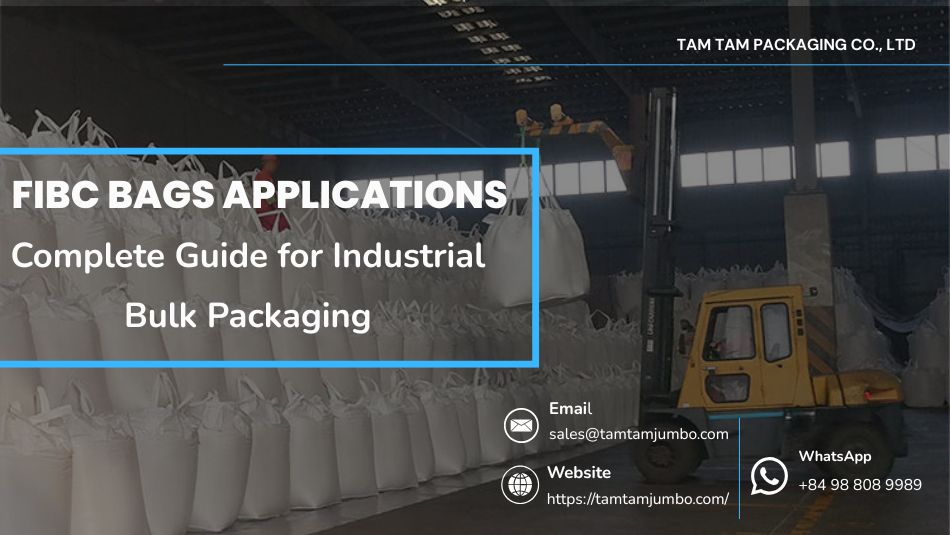
FIBC bags applications continue to expand across global industries due to their efficiency, durability, and cost-effectiveness in transporting and storing bulk materials. From food ingredients and agricultural products to minerals, chemicals, and construction materials, Flexible Intermediate Bulk Containers (FIBCs), commonly known as Jumbo Bags or Bulk Bags, have become a standard packaging solution for industrial supply chains.
This article explores the most common FIBC bags applications, industry-specific requirements, and practical considerations buyers should evaluate when sourcing bulk packaging. Readers will also gain insight into how manufacturers of jumbo bags in Viet Nam support international markets with customized and export-ready solutions.
Understanding FIBC Bags and Their Role in Industrial Packaging
FIBC bags are large woven polypropylene containers designed for the storage, transportation, and handling of dry flowable products. Typical capacities range from 500 kg to 2,000 kg, depending on the bag design and application.
These bags are widely used because they offer:
- High payload capacity
- Efficient storage and transportation
- Reduced packaging waste
- Compatibility with automated filling and discharge systems
- Lower logistics costs compared with small bags
As global industries seek more efficient bulk material handling solutions, FIBC bags have become a preferred choice for manufacturers, exporters, distributors, and end users.
Major FIBC Bags Applications by Industry
Different industries require different bag constructions, safety features, and compliance standards. Understanding these requirements helps buyers select the most suitable packaging solution.
Food Industry Applications
Food manufacturers use FIBC bags for transporting and storing:
- Sugar
- Flour
- Starch
- Rice
- Salt
- Coffee beans
- Cocoa products
- Animal feed ingredients
Food-grade FIBC bags are manufactured under strict hygiene controls to minimize contamination risks.
Common requirements include:
- Food-grade virgin polypropylene
- Clean-room production environments
- Food-contact compliant materials
- Liner integration for moisture protection
- Traceability documentation
Food processing companies often select coated bags with PE liners to maintain product quality throughout export and storage operations.
Mining Industry Applications
Mining operations represent one of the largest FIBC bags applications globally.
Typical products include:
- Copper concentrate
- Zinc concentrate
- Nickel ore
- Mineral sands
- Industrial minerals
- Bentonite
- Graphite
Mining products are often heavy, abrasive, and difficult to handle, making bag strength a critical factor.
Key requirements include:
- High safety factor construction
- Reinforced lifting loops
- Abrasion-resistant fabric
- Dust-proof filling and discharge systems
- UV stabilization for outdoor storage
For export shipments, many mining companies also require UN Certified Bags when transporting hazardous materials.
Construction Materials
Construction and infrastructure projects frequently rely on bulk bags for:
- Sand
- Cement
- Aggregates
- Fly ash
- Limestone powder
- Construction chemicals
Compared with small sacks, FIBC bags improve loading efficiency and reduce labor requirements.
Common bag styles include:
- U-panel bags
- Circular bags
- Four-panel bags
- Baffle bags for improved pallet stability
Construction companies often prioritize cost efficiency, durability, and rapid unloading performance.
Agriculture and Fertilizer Applications
Agricultural producers and distributors use FIBC bags for:
- Seeds
- Grain
- Corn
- Soybeans
- Fertilizers
- Animal feed
- Agricultural minerals
These applications often require:
- Moisture protection
- UV resistance
- Long-term storage capability
- Easy discharge systems
Agricultural exporters commonly use jumbo bags in Viet Nam due to the country’s strong agricultural production and established export packaging infrastructure.
Chemical Industry Applications
Chemical manufacturers use specialized FIBC bags for products such as:
- Resins
- Plastic pellets
- Powders
- Pigments
- Industrial additives
Some chemical products create electrostatic risks during filling and discharge.
Depending on the material characteristics, buyers may require:
- Type B FIBC bags
- Type C conductive bags
- Type D static dissipative bags
Proper bag selection is essential for safe operation in hazardous environments.
Read more: Type B FIBC bags – Understanding Anti Static Bulk Bags
Environmental and Recycling Industries
Environmental companies increasingly utilize bulk bags for:
- Recyclable plastics
- Industrial waste
- Scrap materials
- Environmental remediation projects
- Recovered raw materials
These applications often require:
- Heavy-duty construction
- Tear resistance
- UV protection
- Reusability options
As sustainability initiatives expand, reusable and recyclable FIBC solutions continue gaining popularity.
Common FIBC Bag Types Used Across Applications
Different applications require different bag designs.
| Bag Type | Typical Application | Key Advantage |
|---|---|---|
| U-Panel Bag | Agriculture, chemicals | Cost-effective |
| Circular Bag | General industrial use | Good strength distribution |
| Four-Panel Bag | Food and chemical products | Better shape retention |
| Baffle Bag | Export logistics | Improved stacking efficiency |
| Conductive Type C Bag | Flammable environments | Electrostatic protection |
| Static Dissipative Type D Bag | Hazardous powders | Enhanced safety |
| UN Certified Bag | Dangerous goods | Regulatory compliance |
Selecting the right bag construction directly impacts operational efficiency and product protection.
Why Jumbo Bags in Viet Nam Are Increasingly Popular
International buyers are increasingly sourcing jumbo bags in Viet Nam due to the country’s growing manufacturing capabilities and export expertise.
Advantages include:
- Access to high-quality virgin polypropylene materials
- Experienced production teams
- Competitive manufacturing costs
- Flexible customization options
- Strong export logistics infrastructure
- Compliance with international quality standards
At Tam Tam Packaging Co., manufacturing processes are designed to support the requirements of customers across food, agriculture, mining, construction, and chemical industries.
The ability to customize dimensions, fabric weight, lifting loops, liners, and printing allows buyers to optimize packaging performance for specific applications.
Key Factors Buyers Should Evaluate Before Purchasing
Understanding product characteristics is more important than simply comparing prices.
Product Characteristics
Evaluate:
- Bulk density
- Particle size
- Moisture sensitivity
- Abrasiveness
- Flowability
Each factor affects the bag design specification.
Filling and Discharge Systems
Consider:
- Filling equipment type
- Discharge method
- Automation level
- Handling equipment
Matching bag design to operational processes reduces downtime and product loss.
Storage Conditions
Questions buyers should ask include:
- Will bags be stored outdoors?
- How long will products remain in storage?
- Is UV protection required?
- Are moisture barriers necessary?
Environmental conditions significantly influence bag performance.
Regulatory Requirements
Depending on the product and destination market, buyers may require:
- Food-grade certification
- UN certification
- Static protection compliance
- Customer-specific quality standards
Early discussion with the manufacturer helps avoid costly redesigns.
Manufacturing Considerations That Impact Performance
Not all bulk bags are produced to the same standard.
Critical manufacturing factors include:
Fabric Quality
The quality of woven polypropylene fabric directly influences:
- Tensile strength
- Tear resistance
- Durability
Sewing Integrity
Poor stitching remains one of the most common causes of bag failure.
Manufacturers should maintain:
- Controlled stitch density
- Reinforced stress points
- Consistent sewing quality inspections
Quality Testing
Reliable manufacturers conduct:
- Safe working load tests
- Top lift tests
- Cyclic testing
- Seam strength verification
- Visual inspections
These procedures help ensure consistent performance in demanding industrial environments.
Frequently Asked Questions
What are the most common FIBC bags applications?
The most common applications include food products, fertilizers, minerals, chemicals, construction materials, agricultural commodities, and recyclable materials.
Which industries use jumbo bags in Viet Nam?
Industries such as agriculture, food processing, mining, chemicals, and construction regularly source jumbo bags in Viet Nam for domestic use and export operations.
Are FIBC bags suitable for food products?
Yes. Food-grade FIBC bags are specifically manufactured using virgin polypropylene and controlled production environments to meet food packaging requirements.
Can FIBC bags be reused?
Some FIBC bags are designed for multiple uses. Reusability depends on the bag’s safety factor, condition, inspection history, and intended application.
What is the maximum weight an FIBC bag can carry?
Most FIBC bags carry between 500 kg and 2,000 kg. Specialized designs can accommodate higher capacities depending on application requirements.
Conclusion
The range of FIBC bags applications continues to grow as industries seek safer, more efficient, and more economical bulk packaging solutions. Whether transporting agricultural products, construction materials, food ingredients, chemicals, or mining products, selecting the correct FIBC design is essential for operational efficiency and product protection.
Buyers should evaluate product characteristics, handling methods, storage conditions, regulatory requirements, and manufacturing quality before making procurement decisions. Working with an experienced manufacturer helps ensure that bag specifications align with real-world operating conditions and international supply chain requirements.
Looking for customized FIBC bags for your industry?
Tam Tam Packaging Co. manufactures high-quality FIBC Bags, Jumbo Bags, Bulk Bags, Food Grade Packaging, and customized PP Woven Packaging solutions for global customers. Our team supports buyers with technical guidance, product customization, quality assurance, and export documentation to help ensure reliable bulk material handling performance.
Contact Us
Tam Tam Packaging Co., Ltd
Email: sales@tamtamjumbo.com
Website: https://tamtamjumbo.com/
Read more
FIBC Bags for Flour: Why Allergen Status Change the Specification
Flour shares the fine-particle and combustible dust characteristics of other food powders, but wheat’s status...
Aug
FIBC Bag for Starch Powder: Dustproof Bag Needs Antistatic
Starch powder occupies an unusual position in FIBC specification: it is a common food and...
Aug
FIBC Bags for Animal Feed: What Actually Makes a Clean Bulk Bag
FIBC bags for animal feed mean something more specific than a bag that looks unused....
Aug
FIBC Bag for PET Flakes: Why UV Resistance Matter More Than It
Recycled PET flakes share a base polymer with virgin resin pellets, but the two behave...
Aug
FIBC Bags for Plastic Resin: PP Fabric Packaging PP Pellets
There is a certain irony in shipping polypropylene resin pellets inside a bag woven from...
Aug
FIBC Bags for the Food Industry: Building a Food Grade Bag
Food manufacturers sourcing bulk ingredient packaging are working from a different starting point than a...
Aug