

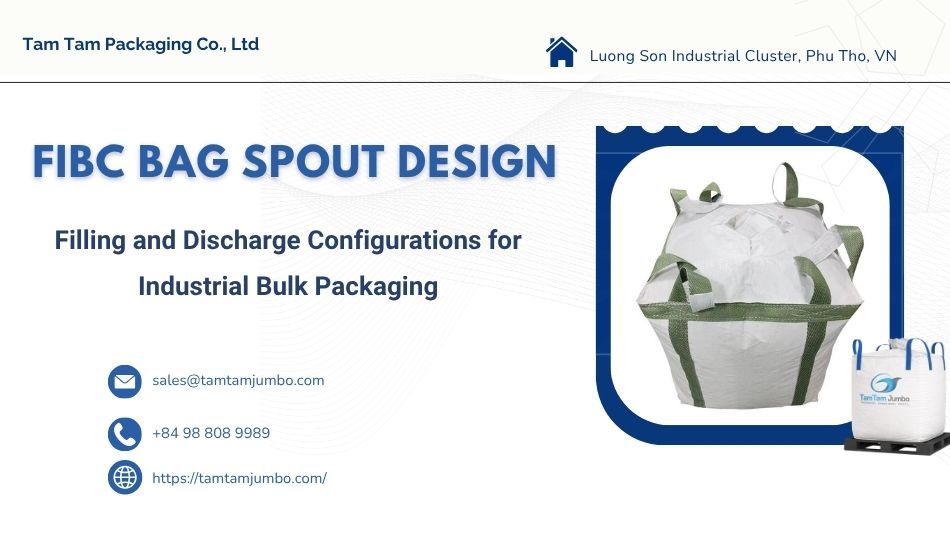
Picking a spout type is only the first decision. Once a buyer knows whether they need a spout top, spout bottom, or Iris closure, the actual engineering work starts: fabric selection, length and diameter calculation, reinforcement at the base, and integration with the rest of the bag construction. This guide covers that engineering process directly, for buyers who need a bag spout built to match specific equipment rather than selected from a generic size chart.
FIBC Bag Spout Design as an Engineering Problem, Not Just a Type Selection
Choosing between a spout top, spout bottom, or Iris closure determines the basic function of the discharge or fill point, but the spout still needs to be engineered to the buyer’s specific equipment, fill weight, and cycle frequency to actually perform well. Two bags with the same spout type can differ meaningfully in real-world performance if one has a spout engineered to match the connecting equipment and the other uses a generic size that happens to be close enough.
Read more: FIBC Bottom Discharge Types: How an Iris Closure Controls Flow
Spout Fabric Selection and Denier
Spout fabric experiences different stress than the main body of the bag, since it is repeatedly handled, connected, and disconnected from filling or discharge equipment. Many manufacturers use a slightly heavier denier fabric at the spout compared to the body, or add a reinforcement layer, to account for this repeated mechanical wear at the connection point rather than assuming body fabric weight is automatically adequate for the spout.
Read more: FIBC Bag GSM Guide: How Fabric Weight Determines Strength
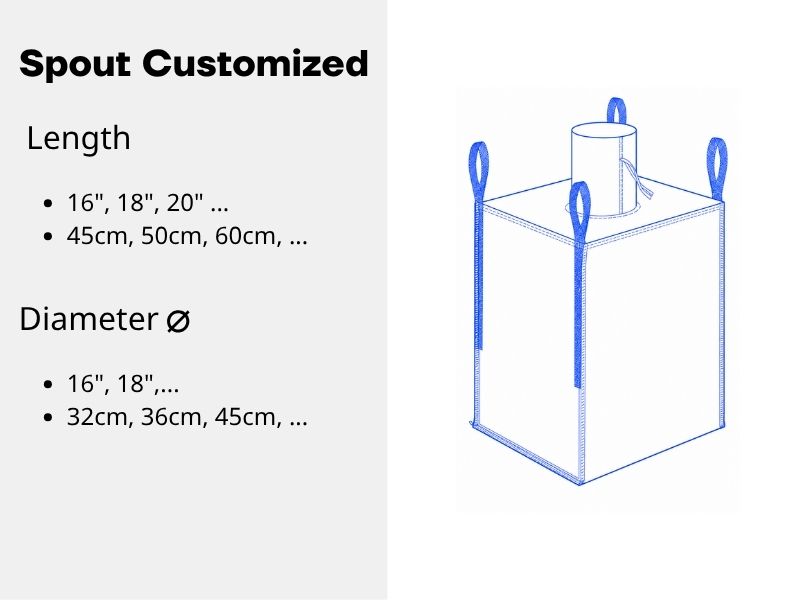
Spout Length and Diameter: How They’re Calculated
Diameter Relative to Bag Capacity
Spout diameter should scale with the bag’s fill volume and expected flow rate, since a spout that is too narrow relative to bag capacity restricts filling or discharge speed regardless of how well it matches connecting equipment on paper. As a general engineering principle, larger capacity bags handling free-flowing material benefit from proportionally larger spout diameters to maintain reasonable cycle times, though the connecting equipment’s own dimensions remain the primary constraint.
Length for Secure Closure and Equipment Clearance
Spout length needs to provide enough fabric to secure a closure, whether tie-off, clamp, or Iris mechanism, while also reaching or clearing the connecting equipment without excess slack that could fold over and restrict flow. A spout that is too short can make secure closure difficult, while one that is too long may need to be gathered or folded in a way that creates its own flow restriction.
Reinforcement Rings and Base Stitching at the Spout
The junction where the spout attaches to the main body panel is a concentrated stress point, particularly for spouts used across multiple open and close cycles. A sewn-in reinforcement ring or additional stitching pattern at this base junction helps distribute stress across a wider area of fabric rather than concentrating it at a single seam line, extending the spout’s service life under repeated handling.
Read more: FIBC Bag Stitching Types: How Sewing Machine Choice Affects Seam
Integrating Spout Design With Top and Bottom Construction
Spout engineering does not happen in isolation from the rest of the bag. A spout top needs to be positioned and sized in coordination with the bag’s overall top panel construction, and a spout bottom needs to work with the base seam design without creating a weak point where the two meet. Buyers specifying custom spout dimensions should confirm the manufacturer is engineering the spout as part of the complete bag design rather than treating it as a separate add-on component.
Custom Spout Engineering for Existing Equipment
For buyers integrating bags into an established filling or discharge line, the most reliable approach is providing the manufacturer with a technical drawing or the exact connection dimensions of the existing equipment, rather than describing the equipment in general terms. This allows the spout to be engineered to fit precisely, and a sample bag can then be tested against the actual equipment before a full production order is committed.
Spout Fabric vs Body Fabric: Should They Match
Spout fabric does not need to be identical to body fabric, but it does need to be compatible in terms of stitching and seam strength where the two are joined. In many cases, a heavier denier spout fabric paired with standard body fabric is a practical middle ground, providing added durability at the connection point without increasing the cost of the entire bag. Buyers should ask manufacturers to specify spout fabric weight separately from body fabric weight rather than assuming they are automatically the same.
Specification Details for Custom FIBC Bag Spout Design
- Spout diameter and length, matched to connecting equipment dimensions.
- Spout fabric denier and whether it differs from body fabric.
- Reinforcement ring or additional stitching at the spout base junction.
- Closure mechanism, whether tie-off, clamp, or Iris diaphragm.
- Expected number of open and close cycles, since this affects how much reinforcement the spout base actually needs.
How Tam Tam Packaging Engineers FIBC Bag Spouts to Order
Tam Tam Packaging engineers spout diameter, length, and fabric specification against the buyer’s actual filling or discharge equipment dimensions, using reinforced base stitching for spouts expected to see repeated open and close cycles. Sample bags are available for equipment fit testing before committing to a full production run, so buyers can confirm the spout performs as intended on their actual line rather than relying on dimensions alone.
Common Spout Design Mistakes
- Requesting a standard spout size without providing actual equipment connection dimensions.
- Using body fabric weight for the spout without considering the additional mechanical stress the spout experiences.
- Skipping reinforcement at the spout base for bags expected to see frequent open and close cycles.
- Specifying spout length without accounting for the closure method’s fabric requirements, resulting in a spout too short to close securely.
- Treating spout design as a separate decision from overall top or bottom construction rather than an integrated part of it.
Applications in Mining
Mining and mineral processing operations often move bulk material through standardized port and rail terminal interfaces, where discharge spouts need to connect precisely and repeatedly with fixed equipment across many cycles. Custom spout engineering, including reinforced base stitching and fabric matched to expected cycle frequency, is common in this sector given the repeated, high-volume handling typical of mineral export supply chains.
Frequently Asked Questions
Why does spout fabric sometimes differ from body fabric?
Spouts experience repeated mechanical stress from connecting and disconnecting with equipment, so a heavier denier or reinforced fabric at the spout can extend service life without increasing the weight of the entire bag.
How is spout diameter determined for a custom order?
By matching it to the connecting equipment’s dimensions and the bag’s fill volume and expected flow rate, ideally confirmed against an actual technical drawing of the equipment.
What is a spout base reinforcement ring?
A sewn-in reinforcement or additional stitching pattern at the point where the spout attaches to the main body panel, distributing stress across a wider area to extend service life under repeated use.
Should I provide equipment drawings when ordering custom spouts?
Yes. Providing exact connection dimensions or a technical drawing allows the manufacturer to engineer a spout that fits precisely, rather than relying on a generic size that may not match.
Does spout length affect closure security?
Yes. A spout that is too short can make secure closure difficult with tie-off, clamp, or Iris mechanisms, while excess length can fold over and restrict flow if not accounted for in the design.
Conclusion
FIBC Bag spout design is an engineering decision that extends well beyond choosing a spout type. Fabric denier, length, diameter, and base reinforcement all need to be specified together and matched to the actual equipment the bag will connect to, ideally confirmed with a sample fit test before committing to a full production order.
Tam Tam Packaging Co. engineers spout diameter, length, and reinforcement to match your specific filling or discharge equipment. Contact our team to confirm the right spout design for your application.
Contact Us
Tam Tam Packaging Co.
Email: sales@tamtamjumbo.com
Website: https://tamtamjumbo.com/
Read more

FIBC Bags for Flour: Why Allergen Status Change the Specification
Flour shares the fine-particle and combustible dust characteristics of other food powders, but wheat’s status...
Aug
FIBC Bag for Starch Powder: Dustproof Bag Needs Antistatic
Starch powder occupies an unusual position in FIBC specification: it is a common food and...
Aug
FIBC Bags for Animal Feed: What Actually Makes a Clean Bulk Bag
FIBC bags for animal feed mean something more specific than a bag that looks unused....
Aug
FIBC Bag for PET Flakes: Why UV Resistance Matter More Than It
Recycled PET flakes share a base polymer with virgin resin pellets, but the two behave...
Aug
FIBC Bags for Plastic Resin: PP Fabric Packaging PP Pellets
There is a certain irony in shipping polypropylene resin pellets inside a bag woven from...
Aug

FIBC Bags for the Food Industry: Building a Food Grade Bag
Food manufacturers sourcing bulk ingredient packaging are working from a different starting point than a...
Aug