
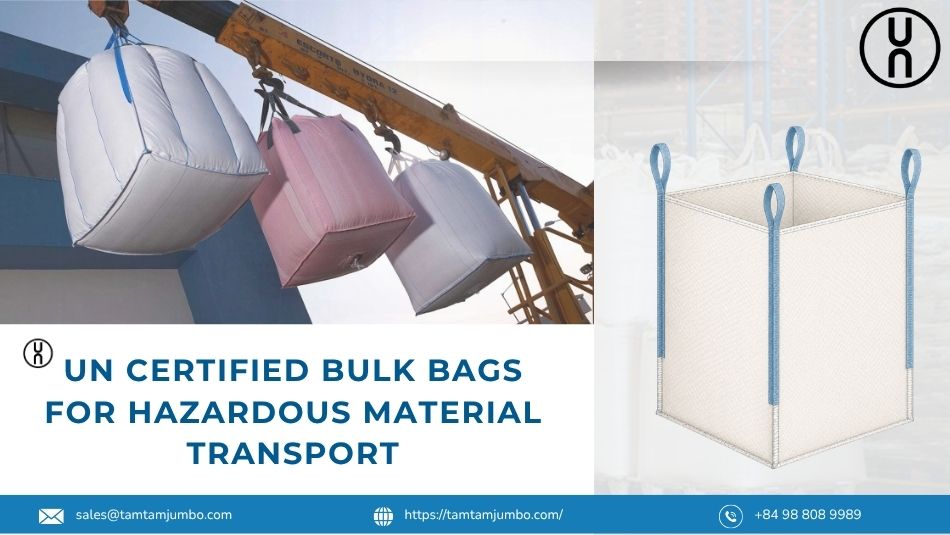
When a shipment of powder, granulate, or chemical intermediate needs to move under the UN Model Regulations for dangerous goods, the flexible intermediate bulk container used to carry it cannot be an ordinary jumbo bag. It must be a UN certified bulk bag, backed by a jumbo bag certificate that proves the packaging passed a defined set of mechanical and performance tests. This article explains what UN certification actually means, how to read the code printed on a bag, what a proper certificate should contain, and how buyers can verify that a supplier’s UN certified bulk bags meet the standard before cargo ever leaves the factory.
What UN Certification Means for a Bulk Bag
A UN certified bulk bag is a flexible intermediate bulk container (FIBC) that has been tested and approved for transporting solid dangerous goods under the United Nations Model Regulations, also referenced in national transport codes such as ADR (road, Europe), IMDG (sea), and 49 CFR (United States). Certification is not a marketing label. It is a formal approval issued after a competent testing authority evaluates a specific bag design against Chapter 6.5 of the UN Model Regulations and confirms the design withstands defined loads, drops, and handling conditions.
Certification applies to a bag construction, not to every bag produced afterward automatically. That is why ongoing quality control and batch traceability matter as much as the initial test report, a detail buyers often overlook when comparing suppliers.
Reading the UN Code Printed on a Jumbo Bag
Every UN certified bulk bag carries a printed code on the bag itself. A typical marking looks like this:
UN 13H1/Y/150/23/VN/0012
Each segment carries specific meaning:
- 13H1 — packaging type code. “13” identifies a flexible intermediate bulk container; “H1” indicates the bag is made of woven plastic without a coating or liner.
- Y — packing group letter, indicating the bag is approved for Packing Group II and III substances (medium and low danger).
- 150 — maximum gross weight in kilograms the bag is approved to carry.
- 23 — year of manufacture, shown as the last two digits.
- VN — country code of manufacture, in this case Vietnam.
- 0012 — manufacturer or approval reference number assigned by the certifying authority.
Buyers should treat this code as the first verification step. A bag without a legible, permanent UN code printed directly onto the fabric, rather than on a removable label, should not be accepted as UN certified.
Packing Group and Danger Class Markings
The packing group (X, Y, or Z) is often the detail buyers get wrong. Group X covers the highest danger level and is rarely approved for flexible bulk bags; Group Y covers medium danger goods; Group Z covers low danger goods. A bag rated Y can also carry Group Z goods, but a bag rated Z cannot legally carry Group Y or X cargo. Selecting the correct packing group is a compliance decision, not just a packaging preference.
What a Jumbo Bag Certificate Should Actually Contain
A proper jumbo bag certificate is the documentation that supports the printed UN code. Buyers frequently receive a one-page PDF with a logo and a signature, but a certificate that will hold up during a customs or transport audit needs to include:
- The exact bag construction tested: fabric weight, denier, coating (if any), liner type, stitching pattern, and lifting loop configuration.
- The maximum permitted gross weight and the safety factor applied during testing.
- The specific tests performed, referencing the UN Manual of Tests and Criteria, Part III, Section 3.
- The name of the testing body or laboratory and the date of testing.
- The approval reference number that matches the code printed on the bag.
- Validity period, since some certifying bodies require re-testing after a defined interval or after a design change.
A certificate that omits the construction specification is effectively unverifiable, since anyone could attach it to a different bag design. Buyers sourcing UN certified bulk bags should request the underlying test report, not just the summary certificate.
Read more: FIBC Bags Safety Factor
Testing Standards Behind UN Certified FIBCs
UN certification is earned through a fixed sequence of physical tests, all conducted at the rated safe working load with the applicable safety factor applied.
Top Lift Test
The bag, filled to its rated capacity, is lifted and suspended by its loops for a set duration, typically five minutes, to confirm the lifting system and body seams hold without failure.
Drop Test
A filled bag is dropped from a specified height onto a hard, flat surface, simulating the impact of a fall during loading or transport. The number of drops and the drop height depend on the packing group.
Stacking Test
The bag is subjected to a compressive load equivalent to the weight of bags stacked above it during storage and transport, held for a defined period to confirm no seam or fabric failure occurs under sustained pressure.
Tear Propagation Test
A controlled cut is made in the bag body, and a load is applied to confirm the tear does not propagate uncontrollably, an important safety consideration for bags carrying hazardous powders or granules.
Bags that pass this sequence are approved for the specific weight and packing group tested. Any change to fabric weight, coating, or stitching pattern requires retesting before the new design can carry the UN mark.
Topple Test
A fully loaded bulk bag (filled to at least 95% maximum capacity) is toppled over from a specified height onto its top surface onto a hard, flat floor. The drop height depends on the hazard packing group (e.g., 0.8 meters for Packing Group III). The bag passes if there is no loss of the filling substance upon impact.
Righting Test
Evaluates the strength of the bag’s lifting straps. The fully loaded bag is deliberately tipped onto its side and then lifted back into an upright position using only two of its lifting devices. To pass, the bag and its lift loops must show no signs of tearing, stress, or deformation.
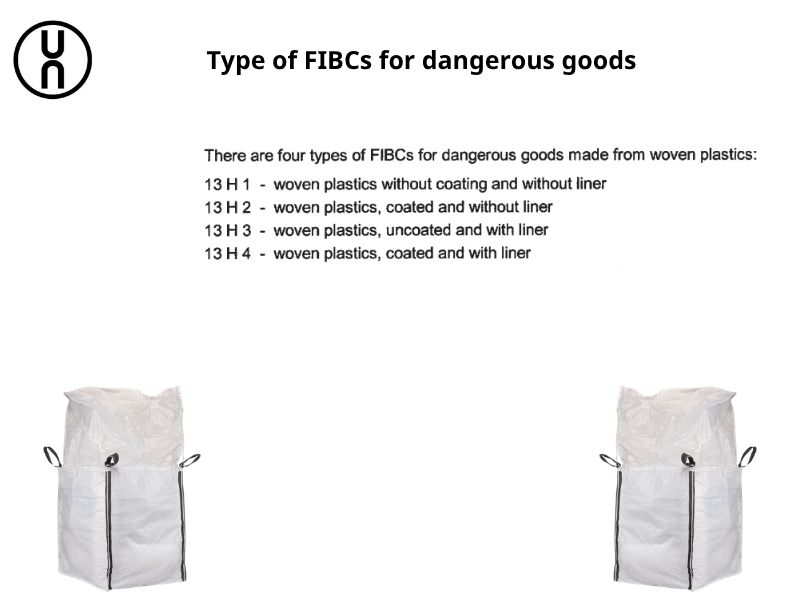
UN Bag Types 13H1 Through 13H4
The UN construction code identifies the bag’s material composition, which affects both compliance and suitability for specific cargo:
- 13H1 — uncoated woven fabric, no liner. Suitable for dry, non-hygroscopic solids.
- 13H2 — coated woven fabric, providing improved resistance to fine powders and moisture ingress.
- 13H3 — uncoated woven fabric with an inner liner, commonly used for chemical powders requiring an additional moisture or contamination barrier.
- 13H4 — coated woven fabric with an inner liner, offering the highest level of containment among the four standard types.
Selecting the correct type depends on the cargo’s moisture sensitivity, particle size, and whether the substance reacts with ambient humidity during transport and storage.
How Tam Tam Packaging Approaches UN Certification
As a manufacturer producing FIBC bulk bags in Vietnam, Tam Tam Packaging builds UN certified constructions to the specific weight, packing group, and bag type a shipment requires, rather than applying a generic marking across a standard product line. Each certified design is tested according to the UN Manual of Tests and Criteria before it enters production, and batch-level quality checks confirm fabric weight, stitching tension, and liner integrity remain consistent with the tested construction throughout the production run.
Buyers working with Tam Tam Packaging on UN certified bulk bags receive the underlying test documentation alongside the certificate, along with traceability data tied to the production batch, information that customs authorities and freight forwarders increasingly ask for when dangerous goods shipments are inspected.
Choosing the Right UN Certified Bulk Bag for Your Cargo
A few questions determine the correct specification before placing an order:
- What is the UN packing group classification of the substance being shipped?
- Is the material moisture sensitive, requiring a coated fabric or liner?
- What is the maximum gross weight per bag, including any safety margin the logistics chain requires?
- Will the bag be stacked during storage or sea freight, and for how long?
- Does the destination country require any additional national transport approval beyond the UN Model Regulations?
Getting these details wrong is a common cause of shipment delays, since customs and freight carriers will reject dangerous goods packaging that does not match the declared classification.
Applications in the Chemical Industry
UN certified bulk bags are most widely used across the chemical sector, where powders, granules, and intermediate compounds frequently fall under dangerous goods regulations due to reactivity, flammability, or environmental hazard classification. Fertilizer intermediates, industrial resins, certain pigments, and specialty chemical powders commonly move in 13H2 or 13H4 construction bags to combine UN compliance with moisture protection.
Chemical manufacturers and distributors typically require batch-specific certificates for customs clearance, along with consistent bag specifications across repeat orders to avoid re-qualifying packaging with each shipment. A manufacturer that maintains stable fabric sourcing and documented quality control reduces this administrative burden considerably.
Common Mistakes Buyers Make When Sourcing UN Certified Bags
Several recurring issues show up during the procurement of UN certified bulk bags:
- Accepting a certificate without matching it against the printed code on the bag itself.
- Assuming a Y-rated bag automatically covers all packing groups.
- Overlooking that certification is tied to a specific construction, not a general product category.
- Failing to request batch traceability records for large or repeat dangerous goods shipments.
- Not confirming whether the destination country requires additional documentation beyond the UN certificate.
Working directly with a manufacturer that understands these requirements reduces the risk of compliance gaps discovered after cargo has already shipped.
Frequently Asked Questions
What does UN certified mean on a bulk bag?
It means the bag design has passed a defined series of mechanical tests under the UN Model Regulations and is approved to transport specific classes of dangerous goods at a stated maximum weight.
Is a jumbo bag certificate the same as a UN code printed on the bag?
No. The printed code is a summary marking; the certificate is the supporting document confirming the tested construction, test results, and approval reference behind that code.
Can any FIBC manufacturer produce UN certified bags?
Only manufacturers whose specific bag construction has been tested and approved by a recognized certifying body can legally apply the UN mark to that design.
How long is a UN certification valid?
Validity depends on the certifying body and any design changes. Many certifications require retesting if fabric weight, coating, stitching, or liner specifications change.
Do UN certified bags cost more than standard bulk bags?
Yes, typically, due to the additional testing, documentation, and quality control required to maintain a certified construction throughout production.
Conclusion
UN certified bulk bags exist to give shippers, carriers, and customs authorities confidence that dangerous goods packaging has been tested to a known standard, not just labeled to appear compliant. Reading the printed code, requesting the full jumbo bag certificate with underlying test data, and handling requirements are the practical steps that keep a shipment moving without delay.
Tam Tam Packaging Co. manufactures UN certified FIBC bulk bags to specific weight and packing group requirements, with full test documentation and batch traceability provided for every certified order. Contact our team to discuss the correct UN bag specification for your cargo.
Contact Us
Tam Tam Packaging Co.
Email: sales@tamtamjumbo.com
Website: https://tamtamjumbo.com/
Read more
FIBC Bags for Flour: Why Allergen Status Change the Specification
Flour shares the fine-particle and combustible dust characteristics of other food powders, but wheat’s status...
Aug
FIBC Bag for Starch Powder: Dustproof Bag Needs Antistatic
Starch powder occupies an unusual position in FIBC specification: it is a common food and...
Aug
FIBC Bags for Animal Feed: What Actually Makes a Clean Bulk Bag
FIBC bags for animal feed mean something more specific than a bag that looks unused....
Aug
FIBC Bag for PET Flakes: Why UV Resistance Matter More Than It
Recycled PET flakes share a base polymer with virgin resin pellets, but the two behave...
Aug
FIBC Bags for Plastic Resin: PP Fabric Packaging PP Pellets
There is a certain irony in shipping polypropylene resin pellets inside a bag woven from...
Aug
FIBC Bags for the Food Industry: Building a Food Grade Bag
Food manufacturers sourcing bulk ingredient packaging are working from a different starting point than a...
Aug