
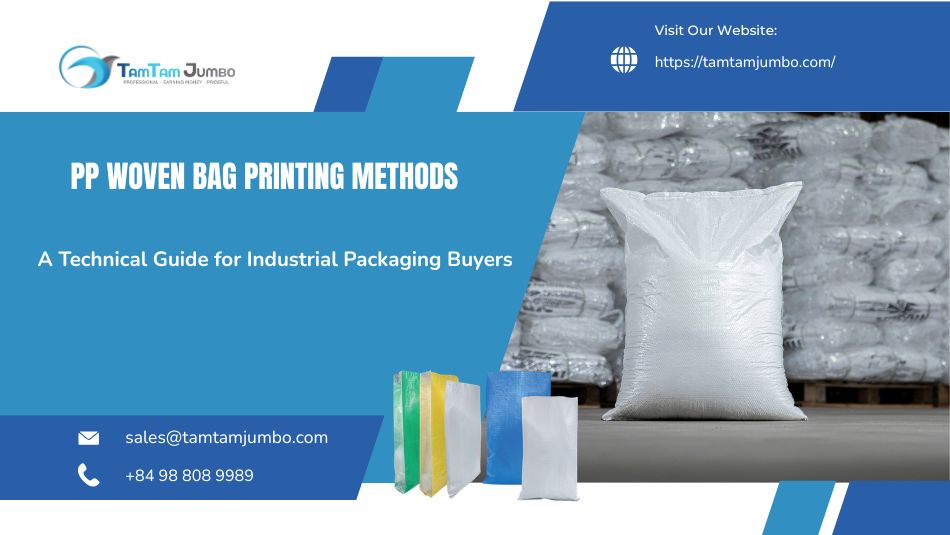
Printed packaging has become an essential part of industrial product distribution. In sectors such as agriculture, fertilizer, chemicals, animal feed, rice, flour, and construction materials, packaging is no longer only for transportation. Buyers increasingly expect packaging to support branding, product identification, compliance labeling, and retail presentation.
For polypropylene woven bags, selecting the correct printing method affects not only appearance but also durability, production cost, lead time, and packaging performance.
This article explains the most widely used PP woven bag printing methods, how they differ, and what international buyers should consider before placing orders with a manufacturer.
At Tam Tam Packaging Co., we manufacture customized PP woven packaging for export markets including Europe, Canada, and Asia. Based on production and export experience, this guide focuses on practical technical considerations rather than generic marketing descriptions.
What Are PP Woven Bag Printing Methods?
PP woven bag printing methods refer to the technologies used to apply logos, product information, branding, graphics, and regulatory details onto woven polypropylene packaging.
The most common printing technologies include:
- Flexographic printing
- Gravure printing
- BOPP reverse printing and lamination
- Screen printing
- Digital printing for sampling
Each method serves different applications depending on:
- Order quantity
- Print quality requirements
- Number of colors
- Packaging market positioning
- Budget
- Moisture resistance requirements
- Export standards
Why Printing Quality Matters in Industrial Packaging
Many buyers focus primarily on bag strength and pricing, but printing quality also directly impacts product performance and commercial value.
High-quality printing can help:
- Improve shelf visibility
- Support brand recognition
- Reduce labeling mistakes
- Meet retail packaging requirements
- Increase resistance to abrasion and moisture
- Enhance perceived product quality
In export markets, especially Europe and Canada, printed packaging is often expected to maintain readability throughout shipping and storage.
Poor printing quality may lead to:
- Ink fading
- Smudging
- Misaligned graphics
- Difficult barcode scanning
- Reduced retail presentation quality
Main PP Woven Bag Printing Methods
Flexographic Printing on PP Woven Bags
Flexographic printing is the most common method used for standard industrial PP woven bags.
How Flexographic Printing Works
Flexible rubber or photopolymer plates transfer ink directly onto the woven fabric surface.
This method is widely used for:
- Rice bags
- Fertilizer bags
- Feed bags
- Flour bags
- Cement bags
- Commodity packaging
Read more: PP Woven Bags for Fertilizer
Advantages of Flexographic Printing
- Cost-effective for medium and large orders
- Fast production speed
- Suitable for simple branding
- Works well for 1–4 color printing
- Good for industrial applications
Limitations
- Lower image resolution compared to gravure or BOPP printing
- Fine details may appear less sharp
- Complex gradients are difficult to reproduce
- Ink can wear faster on rough handling
Best Applications
Flexographic printing is suitable when:
- Cost control is important
- Packaging is mainly for transportation
- Designs are relatively simple
- Large production volumes are required
Gravure Printing for PP Woven Bags
Gravure printing provides higher print precision and image quality than flexographic printing.
How Gravure Printing Works
The design is engraved onto metal cylinders, allowing highly detailed ink transfer onto film or substrate surfaces.
Advantages of Gravure Printing
- Excellent print clarity
- Superior color consistency
- Better photographic image reproduction
- High-end packaging appearance
- Suitable for detailed branding
Limitations
- Higher cylinder cost
- Longer setup time
- More economical only for large production volumes
Typical Applications
Gravure printing is often used for:
- Premium rice packaging
- Retail packaging
- Consumer food products
- Export-oriented branded products
BOPP Reverse Printing and Lamination
BOPP laminated woven bags have become increasingly popular in international packaging markets.
What Is BOPP Printing?
In this process, graphics are reverse-printed on BOPP film using gravure technology. The printed film is then laminated onto woven polypropylene fabric.
Why BOPP Bags Are Popular
BOPP laminated bags provide:
- High-definition graphics
- Glossy or matte appearance
- Excellent moisture resistance
- Strong branding capability
- Better retail shelf presentation
Key Advantages
- Photo-quality printing
- Better scratch resistance
- Improved water resistance
- Stronger visual impact
- Excellent for export retail markets
Considerations for Buyers
BOPP laminated bags usually involve:
- Higher production cost
- More complex manufacturing
- Slightly longer lead time
- Higher MOQ for cost efficiency
However, for branded consumer products, the packaging value often justifies the additional cost.
Read more: BOPP Laminated Bags Advantages
Screen Printing on PP Woven Bags
Screen printing is less common for large-scale industrial production, but is still used in specific applications.
Advantages
- Suitable for small quantities
- Works on finished bags
- Simple customization possible
Limitations
- Slow production speed
- Limited color complexity
- Less suitable for mass production
Typical Uses
- Small custom orders
- Trial production
- Promotional packaging
Comparison of PP Woven Bag Printing Methods
| Printing Method | Print Quality | Cost Level | Production Speed | Best For |
| Flexographic | Medium | Low | High | Industrial bulk packaging |
| Gravure | High | Medium-High | Medium | Premium branding |
| BOPP Lamination | Very High | High | Medium | Retail/export packaging |
| Screen Printing | Basic-Medium | Medium | Low | Small custom orders |
Factors Buyers Should Consider Before Choosing a Printing Method
Product Type
Different products require different packaging performance.
For example:
- Fertilizer bags require moisture resistance
- Rice bags often require a premium shelf appearance
- Chemical bags may require durable warning labels
- Feed bags need abrasion-resistant printing
Export Market Requirements
Packaging expectations vary by region.
Europe
European buyers often prioritize:
- High print consistency
- Retail presentation
- Traceability information
- Sustainable packaging options
Canada
Canadian markets commonly require:
- Durable cold-weather packaging
- Strong moisture resistance
- Clear bilingual labeling
Asia
Many Asian industrial markets focus more on:
- Cost efficiency
- Production speed
- Functional durability
Order Volume
Printing method selection is closely linked to order quantity.
Small to Medium Orders
Flexographic printing is usually more economical.
Large Retail Programs
Gravure and BOPP printing become more cost-efficient at higher volumes.
Packaging Storage Conditions
Humidity, UV exposure, and transportation conditions affect print durability.
For outdoor storage or long shipping periods, laminated structures often perform better.
Common Printing Challenges in PP Woven Bags
From a manufacturing perspective, several technical issues frequently affect print quality.
Ink Adhesion Problems
Poor surface treatment can reduce ink bonding strength.
Color Variation
Inconsistent ink viscosity or machine calibration may cause color differences between batches.
Print Misalignment
Improper fabric tension can lead to registration issues.
Surface Roughness
Because woven fabric is not completely smooth, print sharpness may vary compared to paper or film packaging.
Experienced manufacturers usually control these factors through:
- Corona treatment
- Ink testing
- Production calibration
- Fabric consistency control
- Quality inspection during printing
How Manufacturers Improve Printing Quality
At Tam Tam Packaging Co., printing quality control typically begins before the printing process itself.
Several factors influence final print performance:
- Fabric flatness
- Lamination quality
- Ink compatibility
- Machine calibration
- Drying conditions
- Environmental humidity
For export production, maintaining consistent print quality across multiple shipments is often more important than achieving extremely high graphic resolution.
Industrial buyers usually value consistency and reliability over excessive visual complexity.
Applications of Printed PP Woven Bags
Printed PP woven bags are widely used across industries including:
Agriculture
- Rice
- Seeds
- Animal feed
- Flour
- Sugar
Chemical Industry
- Fertilizer
- Resins
- Additives
- Powders
Construction Materials
- Cement
- Sand additives
- Mortar
- Minerals
Food Industry
- Starch
- Salt
- Grain products
Retail Consumer Packaging
- Branded rice packaging
- Pet food packaging
- Consumer agricultural products
Read more: PP Woven Bags for Rice Packaging
FAQ
What is the best printing method for PP woven bags?
The best method depends on product positioning and budget. Flexographic printing is widely used for industrial packaging, while BOPP laminated printing provides premium retail-quality graphics.
Is BOPP printing better than flexographic printing?
BOPP printing generally provides higher visual quality and better moisture resistance. However, flexographic printing is more cost-effective for standard industrial applications.
Which printing method is most suitable for fertilizer bags?
For standard fertilizer packaging, flexographic printing is commonly used. For branded export fertilizer products, laminated BOPP bags may provide better durability and appearance.
Can PP woven bags be printed in multiple colors?
Yes. Modern printing systems support multi-color printing. BOPP gravure printing can achieve photo-quality graphics with excellent color reproduction.
Does printing affect bag strength?
When properly manufactured, printing should not significantly reduce bag strength. However, excessive heat or poor lamination control can affect fabric performance.
Conclusion
Understanding PP woven bag printing methods helps buyers select packaging that balances cost, durability, branding, and export performance.
Flexographic printing remains the standard for industrial bulk packaging because of its efficiency and cost advantages. Gravure and BOPP laminated printing offer a stronger visual presentation and are increasingly used for premium retail-oriented packaging.
The correct printing method depends on several factors:
- Product type
- Distribution channel
- Export destination
- Storage conditions
- Branding requirements
- Production volume
An experienced manufacturer should help buyers evaluate these factors based on actual packaging applications rather than simply recommending the highest-cost option.
Contact Us
Tam Tam Packaging Co.
Email: sales@tamtamjumbo.com
Website: https://tamtamjumbo.com/
Read more
FIBC Bags for Flour: Why Allergen Status Change the Specification
Flour shares the fine-particle and combustible dust characteristics of other food powders, but wheat’s status...
Aug
FIBC Bag for Starch Powder: Dustproof Bag Needs Antistatic
Starch powder occupies an unusual position in FIBC specification: it is a common food and...
Aug
FIBC Bags for Animal Feed: What Actually Makes a Clean Bulk Bag
FIBC bags for animal feed mean something more specific than a bag that looks unused....
Aug
FIBC Bag for PET Flakes: Why UV Resistance Matter More Than It
Recycled PET flakes share a base polymer with virgin resin pellets, but the two behave...
Aug
FIBC Bags for Plastic Resin: PP Fabric Packaging PP Pellets
There is a certain irony in shipping polypropylene resin pellets inside a bag woven from...
Aug
FIBC Bags for the Food Industry: Building a Food Grade Bag
Food manufacturers sourcing bulk ingredient packaging are working from a different starting point than a...
Aug