
Bulk material handling often requires more than a standard FIBC design. In industries such as construction, mining, cement, and agriculture, buyers frequently search for packaging solutions that can handle heavy loads efficiently while simplifying lifting and transportation.
This is where sling FIBC bags become relevant.
For many international buyers, the question is not only “what are sling FIBC bags,” but also:
- How are they different from standard bulk bags?
- When should they be used?
- Are they suitable for export operations?
- What are the operational advantages?
At Tam Tam Packaging Co., we manufacture various FIBC configurations for industrial bulk packaging applications, including sling-style bag designed for demanding handling environments.
This article explains the structure, applications, technical considerations, and practical advantages of sling FIBC bag from a manufacturer’s perspective.
What Are Sling FIBC Bags?
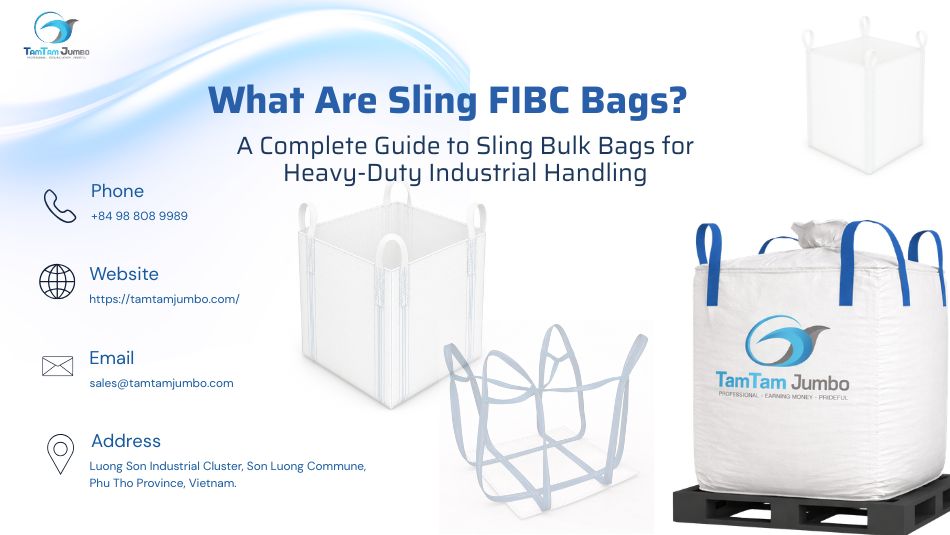
Sling FIBC bags are flexible intermediate bulk containers designed with integrated lifting slings or reinforced lifting belts that support the bag during handling and transportation.
Unlike conventional 4-loop FIBC bags, sling bag often use:
- Wide lifting belts
- Cross-body lifting support
- Full-bottom reinforcement systems
These designs improve load distribution and handling efficiency for heavy or dense materials.
Simple Definition
Sling FIBC bags are heavy-duty bulk bags designed with integrated lifting slings for safer and more efficient lifting of bulk materials using cranes or forklifts.
Structure of Sling FIBC Bags
The core feature of a sling FIBC bag is its lifting configuration.
Main Components
Woven Polypropylene Fabric
Most sling bags are manufactured from woven polypropylene (PP), offering:
- High tensile strength
- Abrasion resistance
- Lightweight structure
- Moisture resistance
Sling Belts
Heavy-duty woven lifting belts run:
- Under the bag body
- Along the side walls
- Toward lifting points
This design distributes weight more evenly across the structure.
Reinforced Stitching
Critical load-bearing areas are reinforced using:
- Double stitching
- Safety stitching
- Belt reinforcement techniques
Filling and Discharge Options
Sling bags can include:
- Open top
- Duffle top
- Filling spout
- Bottom discharge spout
How Sling FIBC Bag Differ from Standard FIBC Bags
Although both are bulk packaging solutions, sling FIBC bag are optimized for different operational requirements.
| Feature | Standard FIBC Bags | Sling FIBC Bags |
| Lifting System | 4 corner loops | Integrated sling belts |
| Load Distribution | Corner-focused | Full-body support |
| Handling Equipment | Forklift mainly | Forklift + crane |
| Best for | Powders, granules | Heavy dense materials |
| Structural Support | Standard | Reinforced |
| Handling Speed | Moderate | Faster in industrial operations |
Key Advantages of Sling FIBC Bags
Improved Load Stability
Integrated sling belts reduce stress concentration on lifting points.
This is particularly important when handling:
- Cement
- Sand
- Minerals
- Stone aggregates
- Industrial waste
Faster Lifting Operations
Sling bags simplify crane handling and hook attachment.
In high-volume industrial environments, this can:
- Reduce loading time
- Improve operational flow
- Lower labor requirements
Better Weight Distribution
The sling system supports the entire bag structure rather than isolated lifting points.
This reduces:
- Fabric stress
- Seam failure risk
- Bag deformation
Suitable for Rough Industrial Conditions
Sling bags are widely used in:
- Construction sites
- Mining operations
- Cement plants
- Infrastructure projects
These environments require durable and efficient handling systems.
Common Applications Industries of Sling FIBC Bags
Construction Industry
One of the largest applications for sling bags includes:
- Cement
- Sand
- Gravel
- Crushed stone
Their crane-friendly structure makes them practical for job-site operations.
Mining Industry
Mining operations often require packaging for:
- Ore
- Minerals
- Aggregates
- Industrial powders
Sling bags simplify handling in harsh operating environments.
Agriculture
Used for:
- Rice
- Feed
- Fertilizer
- Seeds
Particularly in export logistics requiring efficient bulk movement.
Waste Management
Sling bags are also used for:
- Construction debris
- Industrial waste
- Recyclable materials
Their reinforced structure supports heavy and irregular loads.
Single Sling vs Multi-Sling FIBC Bags
Sling FIBC bag can be manufactured in different configurations.
Single Sling Bags
Features:
- One central lifting point
- Simpler handling
- Lower production cost
Typically used for:
- Small-scale operations
- Lightweight materials
Multi-Sling Bags
Features:
- Multiple lifting belts
- Higher load stability
- Better handling safety
Preferred for:
- Heavy materials
- Export operations
- Industrial logistics
Safe Working Load (SWL) and Safety Factors
Most sling FIBC bag are designed with:
- SWL: 500 kg to 2000 kg
- Safety Factor:
- 5:1 for single-trip use
- 6:1 for multi-trip use
Important Buyer Consideration
The correct SWL depends on:
- Product density
- Handling method
- Transportation conditions
- Reusability requirements
Incorrect specification can create operational risks.
Manufacturing Considerations Buyers Should Know
At Tam Tam Packaging Co., one common issue we observe is buyers focusing only on bag dimensions while ignoring handling conditions.
For sling FIBC bags, the following factors are critical:
Belt Quality
Low-quality sling belts can:
- Stretch under load
- Lose tensile strength
- Increase handling risk
Stitching Quality
The connection between:
- Belt
- Fabric
- Base structure
must be engineered carefully.
Poor stitching is one of the most common failure points in industrial bulk bags.
Fabric Selection
Depending on the application, buyers may require:
- UV stabilization
- Coated fabric
- Food-grade fabric
- Moisture barrier liner
Export Packaging Compatibility
International buyers often require:
- Container optimization
- Pallet compatibility
- Compliance documentation
- Labeling systems
Manufacturing experience matters significantly in export-oriented projects.
When Should You Use Sling FIBC Bags?
Sling FIBC bag are recommended when:
- Materials are heavy or dense
- Crane handling is required
- Fast loading/unloading is important
- Rough industrial environments are involved
- Additional lifting stability is needed
When Standard FIBC Bags May Be Better
Standard 4-loop FIBC bags may be more suitable when:
- Products are lightweight
- Forklift-only handling is used
- Budget sensitivity is high
- Applications are less demanding
Selecting the correct design depends on the operational environment rather than price alone.
Quick Summary
Sling FIBC bags are:
- Heavy-duty bulk bags with integrated lifting slings
- Designed for crane and forklift handling
- Suitable for dense industrial materials
- Common in construction, mining, and agriculture
- Available in multiple lifting configurations
- Typically manufactured from woven polypropylene
Key advantages include:
- Better load distribution
- Faster handling
- Improved durability
- Enhanced operational efficiency
FAQ
What are sling FIBC bags used for?
They are used for transporting and handling heavy bulk materials such as cement, sand, minerals, fertilizer, and industrial products.
What is the difference between sling bags and standard FIBC bags?
Sling bags use integrated lifting belts for improved load distribution and handling efficiency, while standard FIBC bags use corner lifting loops.
Are sling FIBC bag reusable?
Yes. Depending on the safety factor and construction quality, many sling bags are suitable for multiple trips.
What materials are sling FIBC bag made from?
Most are manufactured from woven polypropylene fabric with reinforced lifting belts.
What industries commonly use sling FIBC bag?
Construction, mining, agriculture, cement, recycling, and industrial manufacturing industries.
Conclusion
Understanding what sling FIBC bags are helps buyers select the correct packaging solution for demanding industrial operations.
While standard FIBC bags remain suitable for many applications, sling bags provide important advantages in:
- Heavy-duty handling
- Crane operations
- Load stability
- Operational efficiency
For export-oriented businesses and industrial projects, selecting the correct lifting design can significantly improve safety and logistics performance.
Contact Us
Tam Tam Packaging Co.
Email: sales@tamtamjumbo.com
Website: https://tamtamjumbo.com/
Read more

FIBC Bags for Flour: Why Allergen Status Change the Specification
Flour shares the fine-particle and combustible dust characteristics of other food powders, but wheat’s status...
Aug
FIBC Bag for Starch Powder: Dustproof Bag Needs Antistatic
Starch powder occupies an unusual position in FIBC specification: it is a common food and...
Aug
FIBC Bags for Animal Feed: What Actually Makes a Clean Bulk Bag
FIBC bags for animal feed mean something more specific than a bag that looks unused....
Aug
FIBC Bag for PET Flakes: Why UV Resistance Matter More Than It
Recycled PET flakes share a base polymer with virgin resin pellets, but the two behave...
Aug
FIBC Bags for Plastic Resin: PP Fabric Packaging PP Pellets
There is a certain irony in shipping polypropylene resin pellets inside a bag woven from...
Aug
FIBC Bags for the Food Industry: Building a Food Grade Bag
Food manufacturers sourcing bulk ingredient packaging are working from a different starting point than a...
Aug