

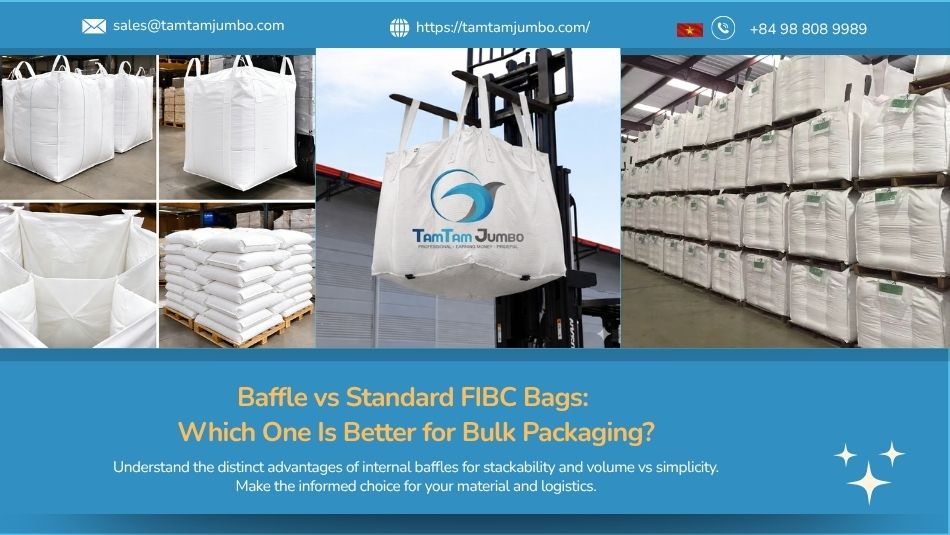
In bulk packaging, choosing the wrong bag doesn’t just affect handling—it directly impacts your logistics cost, storage efficiency, and operational safety.
Many buyers researching “baffle vs standard FIBC bags” are trying to answer a critical question:
👉 Should I optimize for cost or total supply chain efficiency?
At first glance, standard FIBC bags seem more economical. But in real-world export operations, hidden costs such as:
- Wasted container space
- Poor stacking stability
- Increased freight cost
can significantly impact your bottom line.
In this guide, Tam Tam Packaging Co. provides a clear, manufacturer-level comparison to help you choose the right solution.
What Are Standard FIBC Bags?
Standard FIBC bags are basic bulk bags made from woven polypropylene fabric without internal structural support.
👉 Characteristics:
- Flexible structure
- Expands outward when filled
- Typically forms a round or bulging shape
👉 When fully loaded, these bags often become “pear-shaped” or cylindrical due to internal pressure.
What Are Baffle FIBC Bags?
Baffle FIBC bags are engineered bulk bags with internal fabric panels (baffles) sewn into the corners.
👉 Characteristics:
- Maintain a square or cubic shape
- Prevent outward bulging
- Provide structural stability
👉 The internal baffles act as supports that control deformation during filling.
Baffle vs Standard FIBC Bags
1. Structural Design
- Standard FIBC:
- No internal support
- Fabric expands freely
- Baffle FIBC:
- Internal panels restrict expansion
- Maintains rigid structure
2. Shape Retention
- Standard bags bulge by 10–15% on each side when filled
- Baffle bags retain original dimensions
👉 This is the core difference between the two.
3. Storage & Container Efficiency
- Standard bags:
- Create gaps between units
- Waste container space
- Baffle bags:
- Fit tightly together
- Increase container utilization by 10–30%
4. Stacking Stability
- Standard:
- Less stable
- Limited stacking height
- Baffle:
- Stable cubic structure
- Can be stacked 3–4 layers safely
5. Cost Comparison
- Standard FIBC:
- Lower initial cost
- Baffle FIBC:
- Slightly higher cost (+5–15%)
Baffle bags cost more per unit—but reduce total logistics cost.
Baffle vs Standard FIBC Bags – Comparison Table
| Criteria | Standard FIBC Bags | Baffle FIBC Bags |
| Shape when filled | Bulging / round | Square / cubic |
| Internal structure | None | Baffles (internal panels) |
| Space efficiency | Medium | High |
| Container utilization | Lower | Higher |
| Stacking stability | Limited | Excellent |
| Cost | Lower | Slightly higher |
| Best use case | Local / low-cost transport | Export / high-efficiency logistics |
Applications Industries – When to Use Each Type
When to Use Standard FIBC Bags
✔ Suitable for:
- Sand, gravel
- Construction materials
- Low-value bulk goods
✔ Conditions:
- Local transport
- Low logistics pressure
- Cost-sensitive projects
When to Use Baffle FIBC Bags
✔ Suitable for:
- Powder (flour, chemicals, resin)
- Food ingredients
- High-volume export
✔ Conditions:
- Container shipping
- Warehouse optimization
- Automated systems
👉 Baffle bags are widely used for fine materials and export logistics.
Cost vs Efficiency – Real Business Insight
From a manufacturer/export perspective:
✔ Standard FIBC:
- Lower upfront cost
- Higher logistics inefficiency
✔ Baffle FIBC:
- Slightly higher price
- Lower total supply chain cost
👉 Real-world example:
- Standard bags:
- 18 tons per container
- Baffle bags:
- 20–22 tons per container
➡️ This difference significantly reduces cost per ton shipped.
Common Mistakes Buyers Make
❌ Choosing based only on unit price
→ Ignores shipping cost impact
❌ Not considering container loading
→ Leads to wasted space
❌ Using standard bags for export
→ Reduces competitiveness
❌ Ignoring warehouse efficiency
→ Increases handling complexity
Manufacturing Experience
At Tam Tam Packaging Co., we often see:
🔍 Pattern:
- New buyers choose standard bags
- Experienced importers switch to baffle
👉 Expert insight:
In international trade, packaging is not just a cost—it is a logistics optimization tool.
How to Choose Between Baffle and Standard FIBC Bags
✔ Choose Standard when:
- Cost is the primary concern
- Local or short-distance transport
- Low stacking requirements
✔ Choose Baffle when:
- Exporting internationally
- Shipping container optimization is critical
- Storage space is limited
✔ Decision rule:
If logistics cost > bag cost → choose baffle
Quick Summary
- Standard FIBC bags:
- Flexible, low-cost
- Bulge when filled
- Lower efficiency
- Baffle FIBC bags:
- Maintain a square shape
- Improve stacking and storage
- Reduce logistics cost
- Key difference:
👉 Shape retention = efficiency gain
FAQ – Baffle vs Standard FIBC Bags
1. What is the main difference between baffle and standard FIBC bags?
Baffle bags maintain a square shape, while standard bags bulge when filled.
2. Are baffle bags worth the higher cost?
Yes, especially for export, as they reduce shipping and storage costs.
3. Which bag is better for container shipping?
Baffle FIBC bags due to better space utilization.
4. Can standard bags be stacked?
Yes, but less stable compared to baffle bags.
5. What industries prefer baffle bags?
Food, chemical, and export-oriented industries.
Conclusion
Understanding baffle vs standard FIBC bags is essential for optimizing your bulk packaging strategy.
- Standard bags = low cost, basic performance
- Baffle bags = higher efficiency, lower total cost
The right choice depends on your:
- Logistics model
- Export volume
- Cost structure
Working with an experienced manufacturer ensures you select the solution that delivers both performance and profitability.
Contact Us
Looking for a reliable FIBC bags manufacturer?
Tam Tam Packaging Co. provides high-quality, customizable standard and baffle FIBC bags tailored to your application.
- 📧 Email: sales@tamtamjumbo.com
- 🌐 Website: https://tamtamjumbo.com/
👉 Contact us today for expert consultation and quotation.
Read more
FIBC Bags for Flour: Why Allergen Status Change the Specification
Flour shares the fine-particle and combustible dust characteristics of other food powders, but wheat’s status...
Aug
FIBC Bag for Starch Powder: Dustproof Bag Needs Antistatic
Starch powder occupies an unusual position in FIBC specification: it is a common food and...
Aug
FIBC Bags for Animal Feed: What Actually Makes a Clean Bulk Bag
FIBC bags for animal feed mean something more specific than a bag that looks unused....
Aug
FIBC Bag for PET Flakes: Why UV Resistance Matter More Than It
Recycled PET flakes share a base polymer with virgin resin pellets, but the two behave...
Aug
FIBC Bags for Plastic Resin: PP Fabric Packaging PP Pellets
There is a certain irony in shipping polypropylene resin pellets inside a bag woven from...
Aug
FIBC Bags for the Food Industry: Building a Food Grade Bag
Food manufacturers sourcing bulk ingredient packaging are working from a different starting point than a...
Aug