

When sourcing bulk packaging, one of the most misunderstood yet critical specifications is FIBC bags safety factor.
Many buyers focus on price or size—but ignore the safety factor. This can lead to:
- Bag failure during lifting
- Product loss or contamination
- Serious safety risks in industrial environments
At Tam Tam Packaging Co., we often see that choosing the wrong safety factor is not just a technical mistake—it is a risk management failure.
This guide will explain everything you need to know about FIBC safety factor—from definition to real-world application—so you can make informed, safe, and cost-effective decisions.
What Is FIBC Bags Safety Factor?
FIBC bags’ safety factor (SF) is the ratio between a bag’s breaking strength and its Safe Working Load (SWL).
👉 Simple Definition:
Safety Factor = Maximum tested load ÷ Safe Working Load (SWL)
For example:
- A 1000 kg bag with a 5:1 safety factor is tested to withstand 5000 kg before failure
Why Safety Factor Is Critical in Bulk Bag Selection
From a manufacturer’s perspective, the safety factor determines:
✔ Structural integrity
Ensures the bag can handle stress during lifting, transport, and discharge
✔ Worker safety
Prevents accidents in high-risk environments (especially lifting operations)
✔ Compliance
Many industries (EU, mining, chemicals) require specific safety standards
✔ Total cost efficiency
A wrong safety factor can lead to:
- Product loss
- Operational downtime
- Legal liability
👉 Key insight:
Safety factor is not just a specification—it is a risk control parameter.
Common FIBC Safety Factors Explained
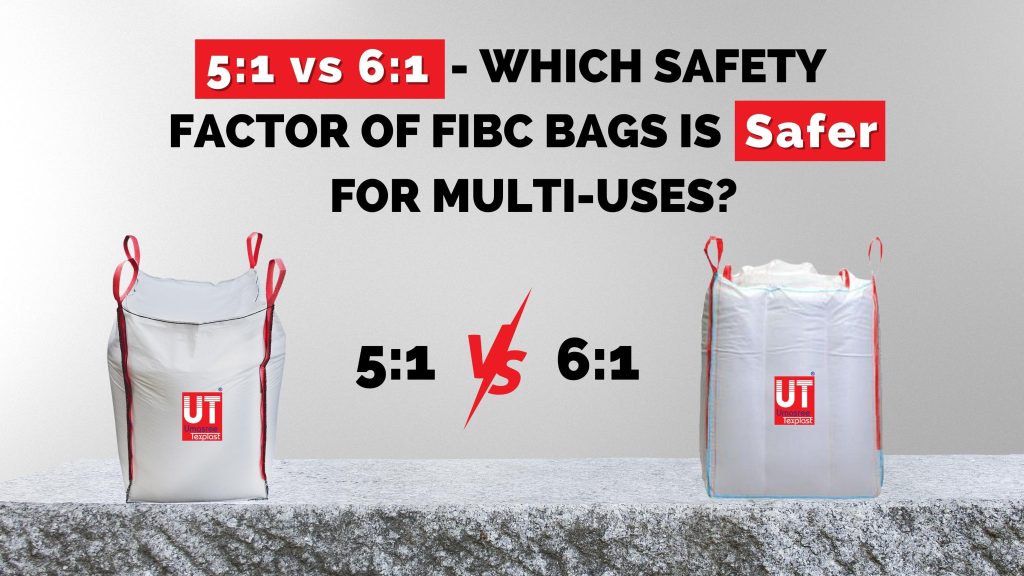
The most widely used safety factors in the industry include:
5:1 Safety Factor (Single-Trip Bags)
Definition:
A bag designed to withstand 5 times its SWL and intended for single use only
Typical applications:
- Agriculture (grains, seeds)
- Construction (sand, cement)
- Non-hazardous materials
Advantages:
- Lower cost
- Widely available
- Suitable for most standard applications
Limitations:
- Not designed for reuse
- Lower durability under repeated stress
6:1 Safety Factor (Multi-Trip Bags)
Definition:
A bag tested to withstand 6 times its SWL and suitable for multiple uses under controlled conditions
Typical applications:
- Chemical industry
- Mining
- Export logistics requiring reuse
Advantages:
- Higher durability
- Better resistance to fatigue and handling stress
- Suitable for repeated cycles
Important note:
Even multi-trip bags must be inspected and maintained before reuse
7:1 and 8:1 Safety Factor (Heavy-Duty / Premium Applications)
Although less common, higher safety factors are used for:
- Abrasive or heavy materials
- High-value products
- High-risk environments
Key benefit:
- Maximum safety margin
- Longer lifespan
👉 According to industry practice, higher SF is recommended when dynamic forces or repeated handling increase risk
4:1 Safety Factor (Special Controlled Use)
- Used in controlled environments
- Only for lightweight materials
- Not recommended for general industrial use
Safety Factor vs Safe Working Load (SWL)
This is one of the most common misunderstandings.
✔ SWL (Safe Working Load)
- The maximum weight the bag is designed to carry safely
✔ Safety Factor
- The safety margin beyond SWL
👉 Example:
| Parameter | Value |
| SWL | 1000 kg |
| Safety Factor | 5:1 |
| Breaking Load | 5000 kg |
👉 Important:
You should NEVER load beyond SWL—even if the bag is tested higher.
How to Choose the Right FIBC Bags Safety Factor
From real manufacturing and export experience, the selection depends on:
1. Usage Frequency
- Single use → 5:1
- Multiple use → 6:1
2. Material Type
- Fine powders → require higher safety margin
- Abrasive materials → 6:1 or higher
3. Handling Conditions
- Manual / light handling → 5:1
- Rough handling / crane lifting → 6:1+
4. Industry Regulations
- EU market → stricter compliance
- Mining / chemicals → often require 6:1
5. Risk Tolerance
- Low-risk operations → 5:1
- High-risk operations → 6:1 or higher
Real Manufacturer Insight (Critical for Buyers)
At Tam Tam Packaging Co., we often see these mistakes:
❌ Choosing lower safety factor to reduce cost
→ Leads to higher total cost due to failure
❌ Reusing 5:1 bags
→ Major safety violation
❌ Ignoring dynamic load (lifting, vibration)
→ Real stress is often higher than static weight
👉 Expert insight:
In export logistics, especially container loading and unloading, dynamic forces can exceed 1.5–2x static load. This is why 6:1 is often recommended even when 5:1 seems sufficient.
Safety Factor Impact on Cost and Performance
| Factor | 5:1 | 6:1 | 7:1+ |
| Cost | Lower | Medium | Higher |
| Durability | Standard | High | Very high |
| Reusability | No | Yes | Yes |
| Safety margin | Basic | Strong | Maximum |
👉 Key takeaway:
Higher safety factor = higher upfront cost, but lower long-term risk.
Quick Summary
- Safety factor = breaking load ÷ SWL
- 5:1 → single-trip standard
- 6:1 → multi-trip, higher durability
- 7:1+ → heavy-duty applications
- Never exceed SWL
- Correct selection depends on:
- Material
- Handling
- Reuse
- Industry requirements
FAQ – FIBC Bags Safety Factor
1. What does 5:1 safety factor mean?
It means the bag is tested to hold 5 times its rated SWL, but should only be used once.
2. What is the difference between 5:1 and 6:1?
- 5:1 → single use
- 6:1 → reusable under controlled conditions
3. Can I reuse a 5:1 FIBC bag?
No. It is not designed or certified for reuse.
4. Which safety factor should I choose?
- General use → 5:1
- Heavy-duty or reuse → 6:1 or higher
5. Does higher safety factor mean higher load capacity?
No. It increases the safety margin, not SWL.
Conclusion
Understanding FIBC bags safety factor is essential for safe and efficient bulk handling.
It is not just a technical specification—it directly impacts:
- Safety
- Compliance
- Cost
- Operational reliability
Choosing the right safety factor ensures your packaging system performs consistently under real-world conditions.
Read more
FIBC Bags for Flour: Why Allergen Status Change the Specification
Flour shares the fine-particle and combustible dust characteristics of other food powders, but wheat’s status...
Aug
FIBC Bag for Starch Powder: Dustproof Bag Needs Antistatic
Starch powder occupies an unusual position in FIBC specification: it is a common food and...
Aug
FIBC Bags for Animal Feed: What Actually Makes a Clean Bulk Bag
FIBC bags for animal feed mean something more specific than a bag that looks unused....
Aug
FIBC Bag for PET Flakes: Why UV Resistance Matter More Than It
Recycled PET flakes share a base polymer with virgin resin pellets, but the two behave...
Aug
FIBC Bags for Plastic Resin: PP Fabric Packaging PP Pellets
There is a certain irony in shipping polypropylene resin pellets inside a bag woven from...
Aug
FIBC Bags for the Food Industry: Building a Food Grade Bag
Food manufacturers sourcing bulk ingredient packaging are working from a different starting point than a...
Aug