

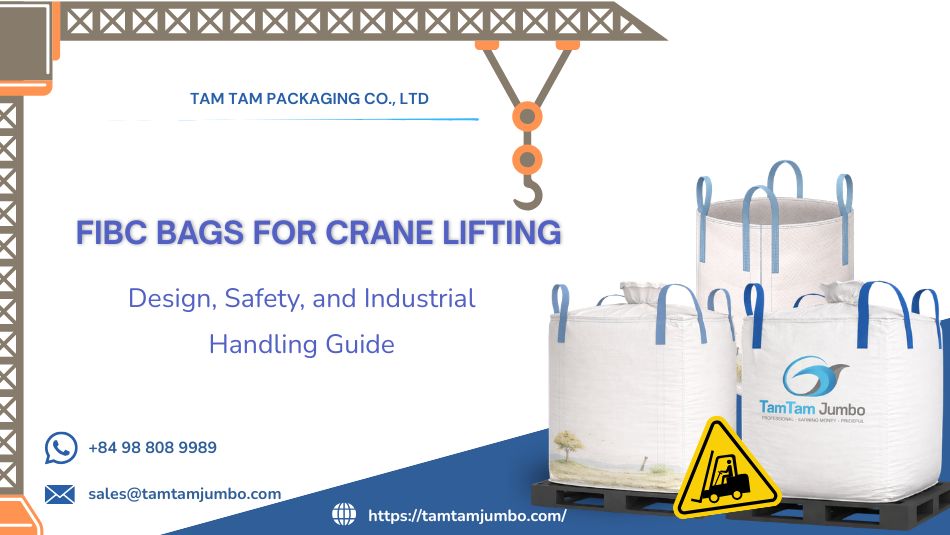
FIBC Bags for Crane Lifting: What Industrial Buyers Should Know
FIBC bags are widely used in industries where bulk materials must be lifted, transported, and discharged efficiently. While forklifts remain common in warehouse operations, many industries rely heavily on crane lifting systems for handling heavy bulk bags.
Construction sites, mining operations, ports, chemical plants, and industrial manufacturing facilities frequently use cranes and hoists to move FIBC bags weighing from 500 kg to over 2000 kg.
However, not all bulk bags are equally suitable for crane lifting.
The lifting method, loop design, reinforcement structure, and safety factor all directly affect lifting performance and operational safety.
At Tam Tam Packaging Co., crane lifting requirements are often discussed during the early engineering stage because improper lifting configuration can create:
- Safety hazards
- Loop stress concentration
- Product instability
- Equipment compatibility issues
- Premature bag failure
This guide explains how FIBC bags for crane lifting are designed, how they should be handled safely, and what industrial buyers should evaluate before purchasing.
What Are FIBC Bags for Crane Lifting?
FIBC bags for crane lifting are bulk bags specifically designed to be lifted using:
- Cranes
- Hoists
- Hooks
- Spreader bars
- Rigging systems
These bags use reinforced lifting loops engineered to support vertical suspended loads safely during handling operations.
Simple Definition
FIBC bags for crane lifting are bulk bags designed with reinforced lifting systems that allow safe handling using cranes or hoisting equipment.
Crane lifting applications typically require closer attention to:
- Load balance
- Loop reinforcement
- Hook compatibility
- Dynamic lifting stress
Why Crane Lifting Requires Special Consideration
Crane lifting creates different stress conditions compared to forklift handling.
With forklifts:
- Load support is distributed through forks
- Movement is generally more stable
With cranes:
- The entire load becomes suspended
- Dynamic movement increases
- Swinging forces may occur
- Loop stress concentration becomes higher
Because of this, crane lifting requires:
- Proper loop positioning
- Balanced load distribution
- Reinforced lifting points
- Controlled lifting motion
Improper handling can significantly reduce bag safety performance.
Common Types of FIBC Bags Used for Crane Lifting
Read more: Types of FIBC Bags
4-Loop FIBC Bags
The most common crane-compatible design is the 4-loop FIBC bag.
Key Features
- Four reinforced lifting loops
- Balanced load distribution
- Good stability during suspended lifting
Advantages
- Strong lifting performance
- Better load balance
- Suitable for heavy materials
- Compatible with cranes and forklifts
Typical Applications
- Construction materials
- Chemicals
- Minerals
- Industrial powders
Sling FIBC Bags
Sling bags use extended lifting sleeves or heavy-duty fabric slings integrated into the bag body.
Advantages
- Excellent heavy-load capability
- Strong structural support
- Suitable for crane-heavy environments
Common Industries
- Cement
- Mining
- Large-scale infrastructure projects
Single Loop FIBC Bags
Single loop bags can also be used with crane systems, especially in automated operations.
Limitations
- Less load stability
- Higher swinging risk
- Reduced flexibility
Single loop crane lifting should only be used for bags specifically designed for this purpose.
Important Lifting Loop Configurations
Side Seam Loops
Side seam loops are stitched into the side seams of the bag body.
Benefits of Crane Handling
- Strong vertical support
- Stable lifting geometry
- Reduced loop twisting
Cross Corner Loops
Cross corner loops are common in export markets because they support both:
- Forklift handling
- Crane operations
Advantages
- Operational flexibility
- Efficient warehouse movement
- Export-friendly handling
Tunnel Lift Sleeves
Tunnel lift designs are primarily intended for forklifts and are generally less suitable for crane-only operations.
Crane Lifting Safety Requirements
Use All Lift Loops
One of the most important rules in FIBC crane handling is using all designated lifting points.
Industrial safety guidelines recommend:
- Never lifting with fewer loops than provided
- Never concentrate the load onto one loop unless specifically engineered for it
Improper lifting can tear loops or overload seams.
Keep Loops Vertical
Twisted or angled loops create uneven stress distribution.
During crane lifting:
- Loops should remain vertical
- Loops should not twist or knot
- Tension should be evenly distributed
This improves load stability and reduces structural stress.
Use Rounded Crane Hooks
Sharp hooks can cut or damage lifting loops.
Industry handling guidelines recommend:
- Rounded hook surfaces
- Protective covers
- Safety latches when possible
Hooks should have a sufficient radius to avoid compressing the lifting webbing.
Lift Smoothly
Sudden lifting movement increases dynamic load stress.
Operators should avoid:
- Jerking motion
- Abrupt stops
- Rapid acceleration
Smooth lifting significantly improves operational safety.
Understanding Safety Factor in Crane-Lifted FIBCs
Read more: FIBC Bags Safety Factor
The safety factor is critical in crane lifting operations.
Most industrial FIBC bags use:
- 5:1 safety factor for single-trip use
- 6:1 safety factor for multi-trip use
However, the safety factor does not mean the bag should be overloaded.
Crane lifting introduces additional dynamic forces during:
- Swinging
- Acceleration
- Positioning
This is why proper lifting technique remains essential even when bags meet required testing standards.
Industries That Commonly Use Crane-Lifted FIBC Bags
Construction Industry
Construction sites frequently use cranes to lift:
- Sand
- Cement
- Aggregates
- Stone materials
Crane lifting reduces manual handling and improves site efficiency.
Mining Industry
Mining operations often require heavy-duty FIBC bags for:
- Mineral concentrates
- Ore
- Industrial powders
These applications typically require reinforced lifting loops and high SWL ratings.
Chemical Industry
Chemical facilities may use overhead crane systems for:
- Resin handling
- Powder transfer
- Industrial additives
In hazardous environments, conductive or static-protective FIBC designs may also be required.
Port and Export Logistics
Ports and bulk terminals sometimes use crane systems for container loading and unloading.
Crane-compatible FIBC bags improve:
- Handling flexibility
- Export efficiency
- Operational speed
Common Buyer Mistakes
Selecting Bags Based Only on Price
Lower-cost bags may use:
- Weaker webbing
- Lower stitching quality
- Reduced reinforcement
These differences may not appear visually but can significantly affect lifting safety.
Ignoring Hook Compatibility
Many buyers focus on bag dimensions but overlook:
- Hook size
- Hook radius
- Spreader bar configuration
This can damage lifting loops during operation.
Overlooking Dynamic Load Conditions
A suspended FIBC bag experiences movement during:
- Hoisting
- Swinging
- Lowering
Dynamic stress should always be considered during bag engineering.
Manufacturing Perspective: What Determines Crane Lifting Performance?
At Tam Tam Packaging Co., crane lifting performance depends on several production factors:
- Webbing tensile strength
- Sewing quality
- Loop reinforcement
- Fabric consistency
- Load testing
- Dimensional accuracy
The lifting loop area is one of the highest stress zones in an FIBC bag.
Proper engineering and controlled production are essential for safe crane handling.
Best Practices for Crane Lifting FIBC Bags
Before lifting:
- Inspect loops and seams
- Verify SWL
- Confirm hook compatibility
- Use all lifting loops
- Keep loops untwisted
- Ensure load balance
During lifting:
- Lift smoothly
- Avoid sudden movement
- Maintain stable suspension
- Keep personnel away from suspended bags
After lifting:
- Inspect bags for damage
- Store correctly
- Avoid dragging or abrasion
Comparison Table: Crane Lifting vs Forklift Handling
| Feature | Crane Lifting | Forklift Handling |
| Load Suspension | Fully suspended | Partially supported |
| Dynamic Stress | Higher | Lower |
| Swing Risk | Higher | Lower |
| Loop Stress | Concentrated | Distributed |
| Handling Flexibility | Excellent | Excellent |
| Common Industries | Construction, mining | Warehousing, logistics |
| Equipment Requirement | Hooks, cranes | Forklift tines |
Quick Summary
FIBC bags for crane lifting require:
- Reinforced lifting loops
- Proper loop geometry
- Balanced load distribution
- Correct hook compatibility
- Safe lifting procedures
The most common crane-compatible designs include:
- 4-loop FIBC bags
- Sling bags
- Reinforced heavy-duty bulk bags
Safe crane handling depends on:
- Proper equipment
- Correct lifting methods
- Manufacturing quality
- Operator training
FAQ
Can all FIBC bags be lifted by a crane?
No. FIBC bags should only be crane-lifted if they are designed and tested for that handling method.
What is the best FIBC design for crane lifting?
4-loop and sling FIBC bags are commonly preferred for crane operations due to better load stability.
Why are rounded hooks important?
Rounded hooks reduce stress concentration and help prevent lifting loop damage.
Can one hook be used for all loops?
Only if the bag is specifically designed for single-point lifting, standard 4-loop bags should use all lifting points correctly.
What industries commonly use crane-lifted FIBC bags?
Construction, mining, chemical processing, infrastructure, and port logistics industries frequently use crane lifting systems.
Conclusion
FIBC bags for crane lifting require more than basic lifting capability. Proper engineering, reinforced loop construction, and safe handling procedures are essential for operational reliability and workplace safety.
For industrial buyers, selecting the correct crane-compatible FIBC design improves:
- Lifting stability
- Safety performance
- Equipment compatibility
- Logistics efficiency
- Long-term operational reliability
A properly engineered bulk bag system helps reduce handling risk while supporting efficient material movement in demanding industrial environments.
Contact Us
Tam Tam Packaging Co.
Email: sales@tamtamjumbo.com
Website: https://tamtamjumbo.com/
Read more

FIBC Bags for Flour: Why Allergen Status Change the Specification
Flour shares the fine-particle and combustible dust characteristics of other food powders, but wheat’s status...
Aug
FIBC Bag for Starch Powder: Dustproof Bag Needs Antistatic
Starch powder occupies an unusual position in FIBC specification: it is a common food and...
Aug
FIBC Bags for Animal Feed: What Actually Makes a Clean Bulk Bag
FIBC bags for animal feed mean something more specific than a bag that looks unused....
Aug

FIBC Bag for PET Flakes: Why UV Resistance Matter More Than It
Recycled PET flakes share a base polymer with virgin resin pellets, but the two behave...
Aug

FIBC Bags for Plastic Resin: PP Fabric Packaging PP Pellets
There is a certain irony in shipping polypropylene resin pellets inside a bag woven from...
Aug
FIBC Bags for the Food Industry: Building a Food Grade Bag
Food manufacturers sourcing bulk ingredient packaging are working from a different starting point than a...
Aug