
Discover types of FIBC bags, including Type A, B, C, D, and construction styles. Expert guide from a trusted FIBC manufacturer for global buyers.
When sourcing bulk packaging, many buyers search for “types of FIBC bags”—but quickly realize the topic is more complex than expected.
Choosing the wrong type of FIBC bag is not just a technical mistake—it can lead to:
- Safety risks (especially with static electricity)
- Product contamination
- Increased logistics cost
As a manufacturer, Tam Tam Packaging Co. has seen many importers and wholesalers face these issues simply because they selected the wrong bag type.
This guide will give you a complete, practical, and expert-level understanding of FIBC bag types—so you can make the right decision for your business.
What Are FIBC Bags?
FIBC bags (Flexible Intermediate Bulk Containers) are large industrial bags made from woven polypropylene, designed to store and transport dry bulk materials such as powders, granules, and aggregates.
They are also known as:
- Bulk bags
- Jumbo bags
- Big bags
- Ton bags
👉 Typical capacity: 500 kg – 2000 kg
How Are Types of FIBC Bags Classified?
To fully understand types of FIBC bags, you need to look at two main classification systems:
1. By Electrostatic Safety (A–D Types)
👉 Critical for chemical and hazardous environments
2. By Construction & Design
👉 Important for logistics, storage, and cost optimization
Types of FIBC Bags by Electrostatic Classification (A, B, C, D)
This is the most important classification for B2B buyers.
Type A FIBC Bags (Standard Bulk Bags)
Definition:
Made from standard woven polypropylene with no static protection.
Suitable for:
- Non-flammable materials
- Agriculture products (grains, seeds)
- Construction materials (sand, cement)
Not suitable for:
- Flammable powders
- Hazardous environments
👉 Type A bags can generate static electricity during filling and discharge.
👉 Want to learn more about standard bulk bags and their industrial applications?
Read our complete guide: “What is Type A FIBC Bags? Complete Guide for Industrial Bulk Packaging” to understand specifications, advantages, limitations, and how to choose the right Type A FIBC bag for your business needs.
Type B FIBC Bags (Low Breakdown Voltage)
Definition:
Similar to Type A but designed to reduce high-energy static discharges.
Suitable for:
- Dry flammable powders
- Low-risk dust environments
Limitation:
- Still NOT safe in environments with flammable gases
Type C FIBC Bags (Conductive Bags)
Definition:
Made with conductive threads, it must be grounded during use.
Suitable for:
- Flammable powders
- Chemical industry
Key requirement:
- Must be properly grounded
👉 Manufacturer insight:
Many accidents happen because grounding is ignored—not because of the bag itself.
Type D FIBC Bags (Anti-static / Static Dissipative)
Definition:
Advanced fabric that dissipates static electricity without grounding.
Suitable for:
- Hazardous environments
- Flammable gases, vapors, and dust
👉 This is the highest safety level among all FIBC types.
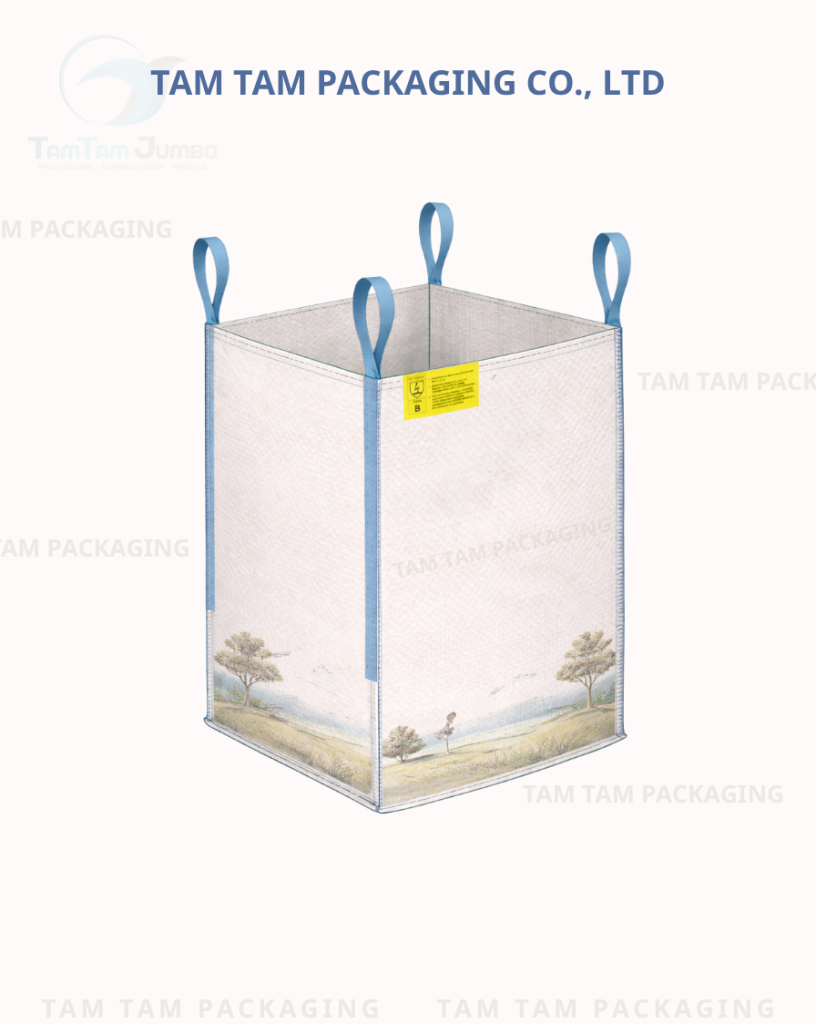
Types of FIBC Bags by Construction
Beyond safety, structure also affects performance and cost.
Circular (Tubular) FIBC Bags
- Made from one piece of fabric
- Fewer seams → lower leakage risk
- Cost-effective
U-Panel FIBC Bags
- Most commonly used
- Better shape retention
- Ideal for stacking
4-Panel FIBC Bags
- Square shape
- Strong and stable
- Preferred for export logistics
Baffle FIBC Bags (Form-Stable Bags)
- Internal panels maintain shape
- Maximize container space
- Reduce transport cost
👉 These designs directly impact container efficiency and shipping cost.
Comparison of FIBC Bag Types
| Type | Static Protection | Grounding Required | Application |
| Type A | ❌ None | ❌ No | Non-hazardous materials |
| Type B | ⚠️ Limited | ❌ No | Low-risk powders |
| Type C | ✅ Yes | ✅ Yes | Flammable materials |
| Type D | ✅ Advanced | ❌ No | Hazardous environments |
How to Choose the Right Type of FIBC Bags
From a manufacturer’s perspective, selection should follow this logic:
✔ Step 1: Identify Material Type
- Powder → requires a liner or anti-static
- Granules → standard bags may work
✔ Step 2: Evaluate Risk Level
- Flammable → Type C or D
- Non-hazardous → Type A
✔ Step 3: Consider Logistics
- Export container → Baffle or 4-panel
- Local use → Circular or U-panel
✔ Step 4: Check Regulations
- EU → strict compliance (especially for chemicals)
- Food → requires food-grade certification
👉 Real insight:
Many buyers overpay for Type D when Type B is sufficient—or worse, under-specify and face safety issues.
Common Mistakes When Choosing FIBC Bag Types
❌ Choosing based on price only
→ leads to safety or product loss
❌ Ignoring static electricity risks
→ especially dangerous in the chemical industry
❌ Not considering the filling/discharge method
→ reduces efficiency
❌ No consultation with the manufacturer
→ wrong specifications
Quick Summary
- FIBC bags are classified into Type A, B, C, D based on static safety
- Type A = basic, Type D = highest safety
- Construction types include:
- Circular
- U-panel
- 4-panel
- Baffle
- Choosing the right type depends on:
- Material
- Environment
- Logistics
- Incorrect selection can cause safety risks and cost loss
FAQ – Types of FIBC Bags
1. How many types of FIBC bags are there?
There are four main types: Type A, B, C, and D, classified based on static electricity control.
2. Which FIBC bag is safest?
Type D FIBC bags are considered the safest because they dissipate static electricity without grounding.
3. What is the difference between Type C and Type D?
- Type C → requires grounding
- Type D → does not require grounding
4. Which type is most commonly used?
Type A and U-panel construction bags are most widely used due to cost efficiency.
5. Can I customize FIBC bag types?
Yes, manufacturers can customize:
- Size
- Fabric
- Loops
- Liner
- Printing
Conclusion
Understanding the different types of FIBC bags is essential for making the right packaging decision.
For B2B buyers, the goal is not just to buy a bag, but to choose a solution that:
- Ensures safety
- Reduces cost
- Improves logistics efficiency
Working directly with a manufacturer allows you to optimize all these factors.